
Can Linea's Token-Burning Strategy Reverse Its 49% Post-Airdrop Slump?
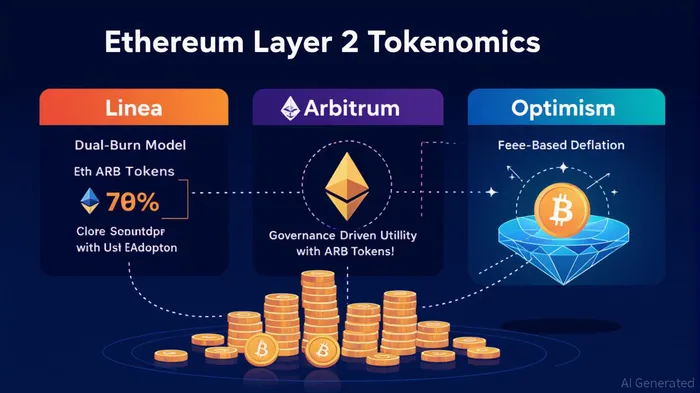
The EthereumETH-- Layer 2 (L2) landscape has become a battleground of innovation, with projects like Linea, Arbitrum, and OptimismOP-- vying to redefine scalability and tokenomics. Linea, the zkEVM-based L2 developed by ConsenSys, has drawn attention for its dual-burn model—a mechanism designed to create deflationary pressure on both ETH and its native token, LINEA. Yet, just weeks after its airdrop in September 2025, the token has plummeted by nearly 50%, raising urgent questions: Can Linea's token-burning strategy reverse this slump? And more broadly, is fee-driven tokenomics a sustainable model for Ethereum L2s?
Linea's Dual-Burn Model: A Double-Edged Sword
Linea's tokenomics are built on a dual-burn framework: 20% of net Layer 2 fees are burned directly as ETH, while 80% are used to buy and burn LINEA tokens from the open market [1]. This approach aligns with Ethereum's broader economic model, which has embraced ETH burns as a deflationary tool. However, the strategy's success hinges on two critical factors: network usage and token utility.
At launch, 22% of LINEA's total supply (15.8 billion tokens) was released into circulation, creating immediate liquidity but also exposing the token to heavy selling pressure from airdrop recipients [2]. The airdrop, which distributed 9.36 billion tokens to 749,000 wallets, was designed to reward early users and builders. Yet, as one analyst noted, “Airdrops are a double-edged sword—they democratize distribution but often trigger short-term volatility as recipients cash out” [3].
The dual-burn model's potential lies in its ability to tie token value to network activity. As usage grows, more fees are generated, accelerating the burn rate and reducing supply. However, this assumes that the network's utility justifies the token's price. For Linea, the challenge is that LINEA is not used for gas fees (ETH remains the primary medium) but instead serves ecosystem incentives and governance. This separation from transactional utility weakens the direct link between usage and demand, a gap that competitors like Arbitrum and Optimism have sought to bridge.
Arbitrum and Optimism: Contrasting Approaches to Tokenomics
Arbitrum (ARB) and Optimism (OP) offer contrasting models. Arbitrum, for instance, does not burn ARB tokens directly but relies on ETH for gas fees. Instead, its tokenomics focus on governance and ecosystem growth, with a fixed supply of 10 billion ARB tokens [4]. Post-airdrop, ARB's price stabilized as demand for governance rights and institutional adoption (e.g., the U.S. Department of Commerce publishing GDP data on Arbitrum) drove utility [5].
Optimism, meanwhile, has embraced a fee-driven deflationary model. Its post-airdrop recovery was fueled by real-world utility in governance and gas fees, allowing the token to find a floor despite an initial sell-off [6]. Analysts argue that Optimism's success stems from its ability to balance token supply with demand through structured vesting and community-driven governance.
Linea's dual-burn model, by contrast, lacks a DAO or public governance process, raising concerns about centralization and long-term control [1]. While the burn mechanism is theoretically sound, its effectiveness depends on sustained network activity—a hurdle for any L2 in a crowded market.
Post-Airdrop Price Dynamics: Volatility and the Path to Recovery
The LINEA token's 49% post-airdrop slump reflects the challenges of balancing supply and demand in a nascent ecosystem. According to data from Mitrade, the price dropped to an all-time low of $0.023 within days, driven by heavy selling from airdrop recipients and whales holding large token clusters [7]. This mirrors broader trends in airdrop-driven tokens, where initial liquidity often outpaces demand.
However, technical indicators suggest a potential for recovery. The Chaikin Money Flow (CMF) and Money Flow Index (MFI) show buyer activity persisting despite the sell-off, with key resistance levels at $0.026 and $0.028 acting as potential catalysts [8]. Binance's listing of LINEA as a borrowable asset has further stoked bullish sentiment, though risks remain from daily token unlocks and low early-stage demand [9].
The Sustainability of Fee-Driven Tokenomics
The broader question is whether fee-driven tokenomics can sustain long-term value in Ethereum L2s. For Linea, the dual-burn model's success depends on three factors:
1. Network Adoption: Increased usage will generate more fees, accelerating burns and reducing supply.
2. Token Utility: Expanding LINEA's role in governance and ecosystem incentives could strengthen demand.
3. Ecosystem Fundamentals: Linea's 10-week “Ignition Program” aims to incentivize liquidity and protocol usage, potentially stabilizing the token price [10].
Arbitrum and Optimism demonstrate that tokenomics alone are insufficient without real-world utility. Arbitrum's institutional adoption and Optimism's governance-driven utility have proven more resilient than purely deflationary models. For Linea, the path forward requires not just burning tokens but building a compelling use case that justifies their value.
Conclusion: A Test of Resilience
Linea's token-burning strategy is a bold experiment in aligning token value with network activity. Yet, the 49% post-airdrop slump underscores the fragility of fee-driven models in the absence of robust utility. While the dual-burn mechanism creates deflationary pressure, its success hinges on sustained adoption and a clear value proposition for LINEA.
As the Ethereum L2 market matures, projects must prove that their tokenomics are not just innovative but sustainable. For Linea, the coming months will be a test of whether its economic design can withstand the pressures of a competitive ecosystem—and whether its burns can truly reverse the slump.






Comentarios
Aún no hay comentarios