
LINEA's Strategic Launch on Upbit: A New On-Ramp for Institutional and Retail Investors in the Korean Crypto Market
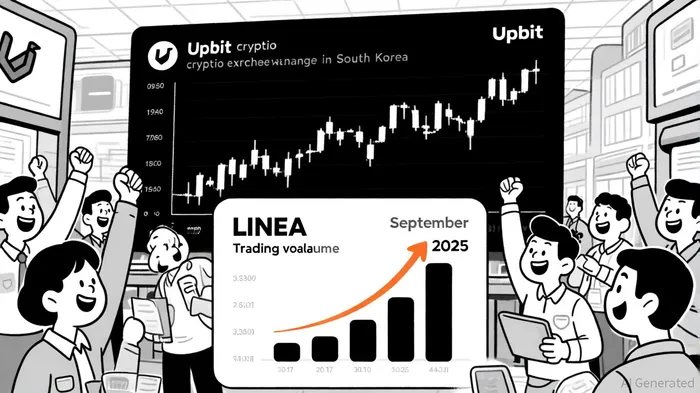
In the rapidly evolving landscape of cryptocurrency, market access and liquidity remain the twin engines driving asset adoption. South Korea's Upbit, a dominant force in the region's crypto ecosystem, has long served as a liquidity catalyst for emerging projects. With its recent listing of LINEA—a zero-knowledge EthereumETH-- Layer 2 (zkEVM) solution—the exchange has positioned itself as a critical on-ramp for both retail and institutional capital. This analysis explores how Upbit's strategic partnership with LINEA amplifies market access, liquidity, and institutional adoption, reshaping the dynamics of the Korean crypto market.
Upbit: The Korean Crypto Market's Liquidity Engine
Upbit's dominance in South Korea is unparalleled. As of Q3 2025, it controls 73–80% of the local crypto trading market, with a daily volume of $2.5 billion and 8.9 million active users—far outpacing competitors like LocalBitcoins [1]. This scale is not merely a function of user base but a structural advantage: Upbit's listings often act as price discovery mechanisms for global markets. For instance, tokens listed on Upbit frequently see immediate liquidity spikes, as Korean retail investors—known for their aggressive trading behavior—flood new markets [2].
The exchange's influence extends beyond retail. Institutional players, including hedge funds and family offices, increasingly use Upbit as a gateway to Korean-specific assets. Its integration of KRW pairs (local currency trading) further lowers barriers for fiat investors, making it a unique bridge between traditional finance and crypto [3].
LINEA's Strategic Listing: A Catalyst for Liquidity and Market Access
LINEA, an Ethereum-aligned zkEVM solution with $1.6 billion in total value locked (TVL), launched on Upbit on September 11, 2025, alongside KRW, BTC, and USDT trading pairs [4]. This listing followed a massive token generation event (TGE) and airdrop, which distributed 9.36 billion LINEA tokens to 749,000 wallets. The timing was deliberate: by aligning the listing with the TGE, LINEA leveraged Upbit's liquidity infrastructure to maximize exposure and trading volume.
The results were immediate. On the first day of trading, LINEA generated $452 million in volume, briefly ranking it among the top 140 cryptocurrencies by market cap [5]. However, the token's price dropped 22% due to selling pressure from airdrop recipients—a common phenomenon in large-scale token distributions [6]. Despite this, the listing's long-term implications are profound. By offering KRW pairs, Upbit enabled Korean investors to access LINEA without converting to USD or BTC, reducing friction and expanding the token's user base.
Institutional Adoption: A New Frontier for LINEA
While retail demand is significant, LINEA's alignment with Ethereum's post-Dencun upgrade and its deflationary mechanicsMCHB-- (e.g., token burns and native ETH staking) have attracted institutional interest. Q3 2025 saw $4 billion in inflows into Ethereum-based products, including ETFs and staking vehicles, driven by the network's scalability improvements and growing DeFi adoption [7]. LINEA's role as a Layer 2 solution—offering low fees and high throughput—positions it to capture a portion of this institutional capital.
Upbit's listing further accelerates this trend. Institutional investors, particularly those focused on Ethereum's ecosystem, now have a liquid on-ramp to LINEA via Upbit's KRW pairs. This is critical in a market where fiat onboarding remains a bottleneck. Additionally, LINEA's Ignition program—a liquidity incentive offering 1.6 billion tokens—targets institutional liquidity providers, aiming to boost TVL to $1 billion by Q4 2025 [8].
The Bigger Picture: Why This Matters for Emerging Crypto Assets
LINEA's Upbit listing underscores a broader shift in the crypto market. As regulatory scrutiny intensifies globally, regional exchanges like Upbit are becoming pivotal in balancing compliance with innovation. For emerging assets, securing a listing on Upbit is no longer optional—it's a prerequisite for meaningful liquidity and institutional adoption.
Moreover, the Korean market's unique characteristics—high retail participation, fiat-friendly infrastructure, and a culture of speculative trading—make it a testing ground for new projects. LINEA's success here could serve as a blueprint for other Layer 2 solutions seeking to scale in Asia.
Conclusion
LINEA's strategic launch on Upbit is more than a technical milestone—it's a masterclass in leveraging regional exchange dominance to unlock global liquidity. By tapping into Upbit's 8.9 million users and institutional-grade infrastructure, LINEA has created a flywheel effect: retail demand drives initial liquidity, while institutional adoption ensures long-term stability. For investors, this represents a rare convergence of market access, scalability, and ecosystem growth. As the Korean crypto market continues to mature, projects like LINEA—backed by strategic exchange partnerships—will define the next phase of crypto's institutionalization.






Comentarios
Aún no hay comentarios