
Lighter's Treasury Allocation as a Strategic Move in a Volatile Crypto Market
In the ever-shifting landscape of decentralized finance (DeFi), strategic treasury allocation has emerged as a critical lever for balancing growth incentives with platform stability. Lighter, a zk-native decentralized perpetual futures exchange, has positioned itself at the forefront of this evolution with its 2025 token generation event (TGE) and treasury strategy. By allocating 25% of its token supply to an automatic airdrop and 50% to community-driven initiatives, Lighter aims to catalyze user engagement while mitigating the risks of speculative volatility. This analysis evaluates how these allocations align with broader DeFi trends and whether they offer a blueprint for sustainable growth in a market still grappling with systemic fragility.
DeFi's 2025 Landscape: Maturity and Institutionalization
The DeFi ecosystem in 2025 has transitioned from speculative hype to structured financial infrastructure. report, stablecoins have solidified their role as the core monetary base, while trading systems are converging into a unified stack. Institutional adoption has surged, with over $41 billion in capital flowing into tokenized assets and compliant yield instruments. This shift underscores a demand for treasury strategies that prioritize liquidity, risk management, and long-term user retention-areas where Lighter's allocations appear to align with industry needs.
Lighter's 2025 Treasury Strategy: Airdrops and Community Incentives
Lighter's 2025 TGE introduced a 25% airdrop of its LITLIT-- token supply, automatically distributed to wallet holders without requiring manual claiming. This approach mirrors successful models like Uniswap's 2020 airdrop, which rewarded early users and fostered community trust. By eliminating friction in token distribution, Lighter aims to incentivize organic participation while reducing reliance on short-term speculative inflows.
The 50% community allocation further reinforces this strategy, with tokens earmarked for liquidity incentives, exchange listings, and ecosystem development. This mirrors Hyperliquid's structured token distribution model, which allocates monthly team distributions to ensure predictable incentives. However, Lighter's approach diverges by emphasizing retail accessibility, as evidenced by its zero-fee trading model and Ethereum-anchored security.
Impact on Stability and Growth: TVL, Liquidity, and User Retention
Lighter's TVL surged from $1.8 million pre-2025 to $1.16 billion by late 2025, a 600x increase. This growth, however, was not without volatility: a single-day net outflow of $40.59 million in December 2025 highlighted the platform's susceptibility to market stress. Competitors like Hyperliquid, which maintains a 63% market share in open interest (OI), demonstrate superior liquidity retention through robust risk controls and institutional-grade infrastructure.
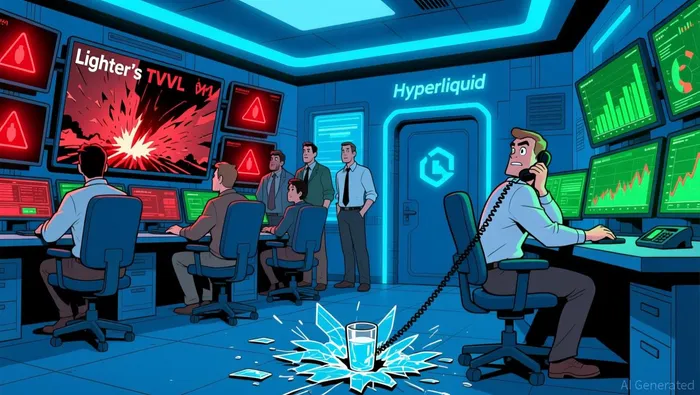
The effectiveness of Lighter's airdrop and community allocations in stabilizing user retention remains debated. While airdrops can drive short-term engagement, their long-term success depends on aligning token utility with real protocol usage. For instance, Aave's transition from LEND to AAVEAAVE-- tokens integrated staking and governance, creating a feedback loop of value accrual. Lighter's strategy, by contrast, relies on speculative volume and yield incentives, which may struggle to retain users during market downturns.
Comparative Analysis: Lighter vs. Hyperliquid and EdgeX
Hyperliquid's dominance in the perp DEX space is underpinned by its custom Layer 1 blockchain and high OI-to-TVL ratio (1.82), indicating strong capital commitment. Its treasury strategy prioritizes infrastructure development over user incentives, a model that has attracted institutional capital and a regulated ETP listing. Lighter, with a more conservative OI-to-TVL ratio of 1.18, focuses on retail accessibility and low-cost execution but faces challenges in matching Hyperliquid's liquidity depth.
EdgeX, meanwhile, positions itself as a liquidity layer for institutions, leveraging mobile-first design and tighter spreads. While its market share (6.1%) lags behind Hyperliquid and Lighter, its treasury allocations emphasize institutional alignment, a strategy that may prove resilient in volatile markets.
Expert Evaluations and Future Outlook
Analysts remain divided on Lighter's long-term viability. Proponents highlight its innovative use of zero-knowledge proofs and potential for cross-chain expansion. Critics, however, caution that its reliance on airdrops and yield incentives could exacerbate liquidity fragmentation, a persistent issue in DeFi. The success of Lighter's treasury strategy will likely hinge on its ability to transition from speculative volume to sustainable capital retention-a challenge shared by many DeFi projects in 2025.
Institutional adoption and regulatory clarity will further shape the trajectory of Lighter and its peers. As BlackRock and Franklin Templeton expand tokenized offerings in 2026, projects with credible risk controls and clear economic models are expected to outperform. Lighter's upcoming buyback program, though details remain undisclosed, could play a pivotal role in stabilizing its tokenomics and reinforcing investor confidence.
Conclusion
Lighter's 2025 treasury allocation represents a calculated bet on community-driven growth in a maturing DeFi ecosystem. While its airdrop and community incentives have driven rapid TVL expansion, the platform's stability under market stress remains unproven. In a landscape dominated by Hyperliquid's institutional-grade infrastructure and EdgeX's liquidity-focused strategy, Lighter's success will depend on its ability to balance retail accessibility with long-term capital retention. As the crypto market navigates 2026's AI-driven innovations and regulatory shifts, Lighter's approach offers a compelling case study in the evolving role of treasury management in DeFi.







Comentarios
Aún no hay comentarios