
LifeMD, Inc. (LFMD): Navigating Corporate Governance Risks and Investor Recourse Amid Securities Fraud Allegations
The Rise and Reckoning of LifeMD
LifeMD, Inc. (LFMD) has emerged as a disruptive force in telehealth, with first-quarter 2025 revenue surging 49% year-over-year to $65.7 million, driven by its weight management programs and partnerships with LillyDirect and NovoCare [1]. The company's Telehealth Adjusted EBITDA turned positive at $5.3 million in Q1 2025, a stark contrast to the $1.3 million loss in Q1 2024 [1]. However, this rapid growth has been accompanied by escalating governance risks and investor scrutiny.
Corporate Governance Risks: A Closer Look
LifeMD's governance structure remains opaque, with limited public disclosure on board composition, internal controls, or executive compensation frameworks. While the company holds annual stockholder meetings—such as the 2023 election of nine directors—its 2025 proxy statement and 10-K filing have yet to be fully analyzed for transparency [6]. This lack of detailed governance documentation raises red flags for investors, particularly in light of recent allegations.
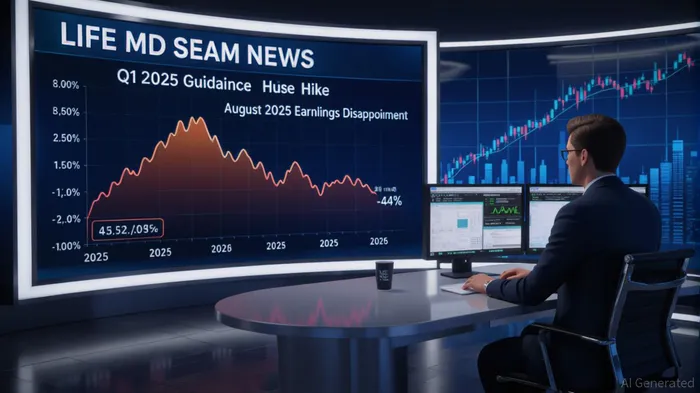
A class-action securities lawsuit filed between May 7, 2025, and August 5, 2025, accuses LifeMDLFMD-- and its executives of misleading investors about its financial health. Specifically, the lawsuit targets May 6, 2025, when the company raised full-year revenue and EBITDA guidance despite undisclosed challenges: rising customer acquisition costs in its RexMD segment and a higher-than-expected refund rate in its weight management business [3]. These issues materialized in August 2025, when Q2 results fell short of expectations, triggering a 44% stock price plunge [4].
Historical backtesting of LFMD's earnings releases from 2022 to 2025 reveals a pattern of short-term positive returns following earnings announcements. On average, the stock delivered +3.8% and +4.7% excess returns on day 1 and day 2 post-earnings, respectively, with the most profitable holding window (14–17 trading days) yielding +8–9% cumulative returns[7]. However, the August 2025 earnings event deviated sharply from this norm, with a 44% decline reflecting the materialization of previously undisclosed risks. This anomaly underscores the critical role of governance transparency in sustaining investor confidence.
The lawsuit underscores a critical governance failure: the absence of robust internal controls to prevent or disclose material misstatements. While LifeMD excluded unrealized losses on its investment in common stock from certain reports to clarify financial performance [2], this selective transparency may have masked underlying operational risks.
Investor Protection Strategies: Legal Recourse and Regulatory Scrutiny
For investors who suffered losses during the May–August 2025 period, the class-action lawsuit offers a legal avenue for recourse. Hagens Berman, the lead firm in the case, emphasizes that the lawsuit seeks to hold LifeMD accountable for alleged misrepresentations [3]. Investors are encouraged to join the action, which could set a precedent for holding telehealth firms to higher governance standards.
Regulatory filings, such as LifeMD's SEC reports, remain a key tool for investor protection. However, the absence of a 2025 10-K at the time of writing limits real-time assessment of the company's risk management practices [5]. Investors must rely on third-party analyses and proxy statements, like the 2023 document, which outlined board elections and auditor ratification [6].
Strategic Shifts and Long-Term Viability
LifeMD's recent strategic moves—such as expanding into women's health and behavioral tele-psychiatry—highlight its ambition to diversify its Total Addressable Market (TAM) [1]. Yet, these initiatives come amid operational headwinds, including a 270-basis-point gross margin decline and a 5% drop in WorkSimpli subscribers. The company attributes these challenges to a deliberate shift toward high-LTV customers and cash flow optimization [1], but such explanations may not fully address governance concerns.
Conclusion: Balancing Growth and Accountability
LifeMD's trajectory exemplifies the dual-edged nature of high-growth telehealth ventures. While its partnerships and revenue growth are commendable, the recent securities fraud allegations expose vulnerabilities in its governance framework. Investors must weigh the company's innovative strategies against the risks of inadequate transparency and internal controls.
For those considering LFMDLFMD--, the path forward involves:
1. Monitoring the outcome of the class-action lawsuit and subsequent SEC investigations.
2. Scrutinizing future proxy statements and 10-K filings for governance improvements.
3. Diversifying exposure to mitigate risks tied to a single company's operational volatility.
In an industry where trust is paramount, LifeMD's ability to rebuild investor confidence will hinge on its commitment to accountability—and not just its ability to prescribe virtual care.





Comentarios
Aún no hay comentarios