
Why Liberty Energy (LBRT) Is Poised for a Post-2026 Energy Cycle Rebound
The energy sector is on the cusp of a transformative phase, and Liberty EnergyLBRT-- (NYSE:LBRT) is uniquely positioned to capitalize on the dual forces of infrastructure modernization and AI-driven demand. With UBS's recent "Buy" rating, a robust institutional ownership base according to data, and a strategic pivot toward distributed power generation, LBRTLBRT-- is emerging as a compelling play for investors seeking exposure to the post-2026 energy cycle.
UBS's "Buy" Rating and the LPI Growth Story
UBS initiated coverage on Liberty Energy in December 2025 with a $23.00 price target, implying nearly 20% upside from its current valuation. This bold call is anchored in the company's Liberty Power Innovations (LPI) unit, which is projected to deploy 1 GW of distributed power capacity by mid-2028. Analysts at UBS highlight that LPI's EBITDA could surge from $137 million in 2027 to $281 million in 2028, driven by its focus on natural gas-based power solutions for data centers and industrial clients. This trajectory underscores LPI's potential to become a standalone growth engine, even as traditional oilfield services face cyclical headwinds.
Frac Market Recovery and the AI-Driven Energy Surge
While the frac market has been volatile, analysts predict a meaningful rebound in the second half of 2026 and into 2027. This recovery is tied to rising crude oil prices post-Q1 2026 and the broader electrification of oilfield operations. Liberty Energy is already pivoting to meet this demand, shifting away from diesel-based power to natural gas and hybrid solutions.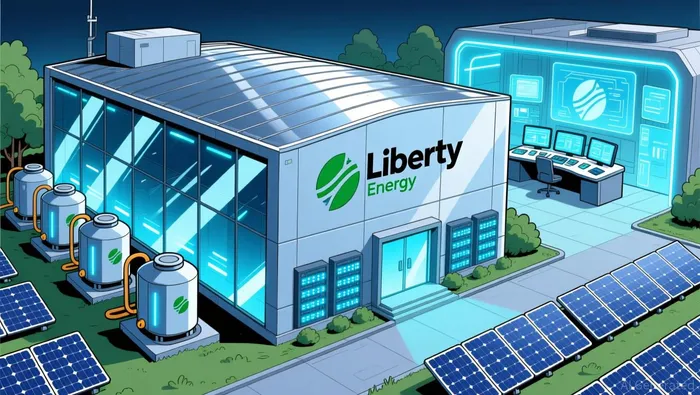
Simultaneously, the company is tapping into the AI boom. Data centers, which require massive and reliable power, are becoming a critical client base for Liberty Energy. By 2027, LPI aims to deliver over 1 GW of power capacity, with a significant portion earmarked for data centers. This aligns with a broader industry trend: oilfield services firms like Halliburton and Baker Hughes are also retooling for AI infrastructure according to market analysis. The U.S. is facing a dual challenge-ensuring sufficient power for AI development while managing global oil oversupply-but Liberty Energy's diversified approach positions it to thrive in this environment.
Institutional confidence in LBRT remains robust. Russell Investments Group Ltd. increased its stake by 30.5% in Q4 2025, while Vanguard Group Inc. added 6.5% to its holdings. Despite some trimming by Franklin Resources, the overall institutional ownership of LBRT stands at 98.22%, reflecting deep conviction in the company's long-term prospects.
Liberty Energy is also forging strategic partnerships to future-proof its business. Its collaboration with nuclear startup Oklo to explore small modular reactors for data centers highlights its forward-looking strategy. While natural gas will dominate in the near term, these partnerships signal the company's intent to stay ahead of the curve in a rapidly evolving energy landscape.
Risks and the Path Forward
No investment is without risk. The frac market's recovery hinges on oil prices stabilizing post-2026, and U.S. tariff policies-criticized by CEO Ron Gusek as a "path to mediocrity"-could complicate Liberty Energy's access to critical materials like steel and aluminum. However, the company's dual focus on oilfield services and distributed power provides a buffer against sector-specific volatility.
For investors, the key takeaway is clear: Liberty Energy is not just surviving the current energy transition-it's leading it. With UBS's endorsement, a compelling growth roadmap, and institutional backing, LBRT is well-positioned to outperform as the post-2026 energy cycle gains momentum.





Comentarios
Aún no hay comentarios