
Lianhe Sowell's Valuation and Business Risks Amid Industry Growth: A Contrarian Lens on High-Growth Tech IPOs
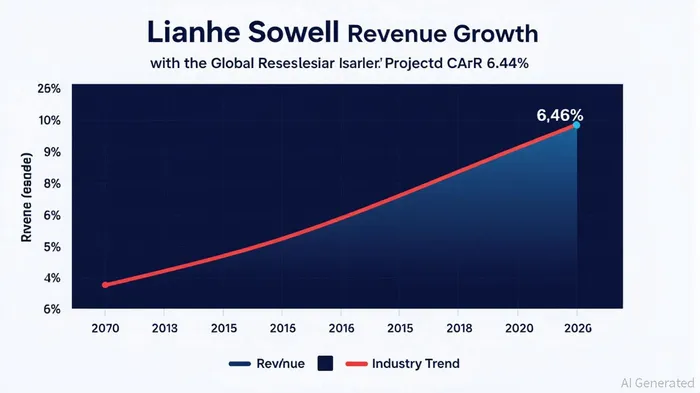
In the volatile arena of high-growth tech IPOs, Lianhe SowellLHSW-- International Group Ltd (LHSW) has emerged as a case study in ambition and risk. The company's recent Nasdaq debut and aggressive expansion plans for its robotics production line have drawn attention, but a closer look reveals a valuation that may not align with its fundamentals—or the broader industry's trajectory. As contrarian investors increasingly scrutinize the sustainability of tech IPOs, LHSW's story offers a cautionary tale.
A Strategic Shift, But at What Cost?
Lianhe Sowell's fiscal 2025 results highlight a deliberate pivot toward higher-margin software offerings. Software revenue surged 177% to $14.57 million, contributing 40% of total revenue, while electronic products revenue fell 30% to $21.97 million[3]. This shift drove a 13% increase in net income to $3.18 million and a 4-point gross margin expansion to 26%[3]. However, the company's valuation metrics—pegged at a P/E ratio of 40.9x and a P/S ratio of 3.5x[2]—suggest optimism that may outpace its actual growth potential.
The industrial robotics market, where LHSWLHSW-- aims to expand, is indeed growing. By 2025, global revenue in this sector is projected to reach $145.8 billion, driven by AI and IoT adoption[1]. Yet LHSW's $127.92 million market cap implies a premium to this trend. With $2.5 million in debt against $206,187 in cash and equivalents[1], the company's leveraged balance sheet raises questions about its ability to fund its $85 million+ expansion plan without diluting shareholders or facing refinancing risks[4].
Contrarian Risks in a Crowded Field
The broader tech IPO landscape provides a sobering context. FigmaFIG--, Chime, and CoreWeave—all high-profile debuts—have seen their valuations recalibrate sharply post-IPO, with Figma's shares dropping nearly 50% from their peak despite remaining above the IPO price[5]. Academic research on retail IPO access programs further underscores a pattern of underperformance, attributing it to “adverse selection and attention-driven retail trading”[6]. For LHSW, these trends highlight the fragility of investor enthusiasm in a sector prone to overvaluation.
LHSW's niche in industrial materials and robotics is promising but fraught with challenges. The company operates in a market dominated by giants like AmazonAMZN-- Robotics and MiR, while its own scale remains limited. Regulatory hurdles, trade volatility, and rising input costs—projected to increase by 2.7% over the next year[4]—add layers of uncertainty. Moreover, its lack of dividend payments signals a reinvestment strategy that may not appeal to income-focused investors[1].
A Contrarian's Take: Growth vs. Sustainability
While LHSW's pivot to software and robotics aligns with long-term industry trends, its valuation appears disconnected from near-term realities. A P/E ratio of 40.9x implies investors are betting on a dramatic acceleration in earnings, yet the company's net income margin of 8.55%[2] lags behind the gross margins of more established players. The $15 million investment in its robot production line, aiming for 1,000–2,000 units annually by March 2026[4], is ambitious but may struggle to achieve economies of scale without significant market share gains.
The InvescoIVZ-- Contrarian Opportunities Portfolio, which seeks undervalued or overlooked opportunities, might view LHSW as a candidate for short-term volatility but cautions against overcommitment[2]. The company's share price, which has swung from $0.99 to $8.18 in a 52-week period[2], reflects the market's indecision between optimism and skepticism.
Conclusion: A High-Stakes Gamble
Lianhe Sowell's IPO and expansion plans encapsulate the allure and peril of high-growth tech investing. While its strategic shift to software and robotics taps into a $145.8 billion market, its valuation metrics and financial leverage suggest a disconnect between current expectations and achievable outcomes. For contrarian investors, the lesson is clear: in a sector where hype often outpaces fundamentals, patience and skepticism are as valuable as ambition.





Comentarios
Aún no hay comentarios