
Liability Risks in the Gig Economy: Regulatory and Legal Exposure Reshaping Investor Valuations
The gig economy, once a symbol of flexible labor and scalable innovation, now faces a critical inflection point as regulatory and legal challenges redefine its financial landscape. For investors, the interplay between worker classification rulings, algorithmic management scrutiny, and evolving labor laws has become a central determinant of valuation stability. Recent developments-from the U.S. Department of Labor's (DOL) rescission of the Biden-era gig worker rule to the California Supreme Court's Prop 22 decision-highlight both the opportunities and risks embedded in this sector.
Worker Classification: A Double-Edged Sword
The classification of gig workers as independent contractors versus employees remains the most contentious legal issue. In July 2024, the California Supreme Court issued a ruling upholding Proposition 22, a 2020 ballot measure that allows app-based drivers to remain independent contractors while offering limited benefits. This ruling, which ended a years-long legal battle, immediately alleviated financial pressures on platforms like UberUBER--, LyftLYFT--, and DoorDashDASH--. Analysts estimated that a potential repeal of Prop 22 would have added $1 billion in costs for DoorDash and $1.1 billion for Uber by 2025, according to Investors Business Daily. The market responded favorably: Uber's stock rose 5%, DoorDash's surged nearly 6%, and Lyft's climbed 7.4% following the decision, as MarketWatch reported.
However, this victory is not without risks. The DOL's recent rescission of the Biden-era rule, which had made it harder to classify workers as independent contractors under the Fair Labor Standards Act, has shifted the regulatory pendulum back toward gig-friendly policies, according to Nelson Mullins. While this reduces immediate compliance costs, it also increases exposure to misclassification lawsuits. For instance, New York's Freelance Isn't Free Act, which mandates written contracts for gig work exceeding $800 over four months, introduces new administrative burdens, as [Legal Husk] (https://legalhusk.com/legal-contracts-and-agreements/legal-updates-recent-changes-in-service-agreement-laws-eg-data-privacy-and-gig-economy) notes. These conflicting state and federal standards create a patchwork of obligations, forcing platforms to navigate a complex compliance landscape that could erode profit margins.
Algorithmic Management: Efficiency vs. Accountability
Beyond worker classification, the use of algorithmic systems to manage gig labor has drawn regulatory attention. Platforms like Uber and Lyft rely on opaque algorithms to assign jobs, set pay rates, and evaluate performance-a practice critics argue blurs the line between independent contracting and employment, as a Springer article explains. The European Union's proposed Platform Work Directive seeks to address these concerns by mandating transparency in algorithmic decision-making, while the U.S. Federal Trade Commission (FTC) has begun enforcing consumer protection laws against deceptive practices, such as misrepresenting earnings or tip distribution, as discussed in the Harvard Law Review.
The financial implications of these regulations are profound. A single algorithmic error-such as Lyft's recent earnings report typo, which erroneously added an extra zero and briefly inflated its stock price-demonstrates how automated systems can amplify human mistakes, as [Forbes] (https://www.forbes.com/sites/jamesbroughel/2024/02/16/what-lyfts-big-typo-teaches-investors-about-new-technologies/) highlighted. For investors, the broader risk lies in the potential for regulatory interventions that require costly system overhauls or limit algorithmic control, thereby reducing operational efficiency.
Investor Sentiment: Balancing Flexibility and Liability
The gig economy's valuation dynamics hinge on its ability to balance flexibility with liability. Post-Prop 22, platforms have enjoyed a temporary reprieve from employee-related costs, which include health insurance, retirement benefits, and workers' compensation. Jefferies analysts projected that this flexibility could sustain investor confidence, with Uber, Lyft, and DoorDash's share prices reflecting renewed optimism, as reported by Yahoo Finance. However, the DOL's policy reversal has introduced uncertainty. While it removes the threat of federal reclassification, it also signals a regulatory environment where labor laws may continue to evolve unpredictably.
State-level actions further complicate the picture. California's AB5 law, which enforces stricter employee classification standards, forces national platforms to adopt divergent strategies across jurisdictions, according to Attorneys Media. This fragmentation increases compliance costs and deters institutional investors seeking predictable regulatory environments.
Conclusion: Navigating a High-Stakes Landscape
For investors, the gig economy's future depends on how platforms adapt to a dual challenge: defending their business model against labor advocates while complying with an increasingly fragmented regulatory framework. The Prop 22 victory and DOL's policy shift have provided short-term relief, but long-term stability will require proactive engagement with emerging labor laws and algorithmic accountability standards.
As the sector evolves, the key question remains: Can gig platforms maintain their cost advantages without compromising worker protections-or will the next legal or regulatory misstep trigger a valuation reset? For now, the market appears to bet on the former, but the risks remain significant.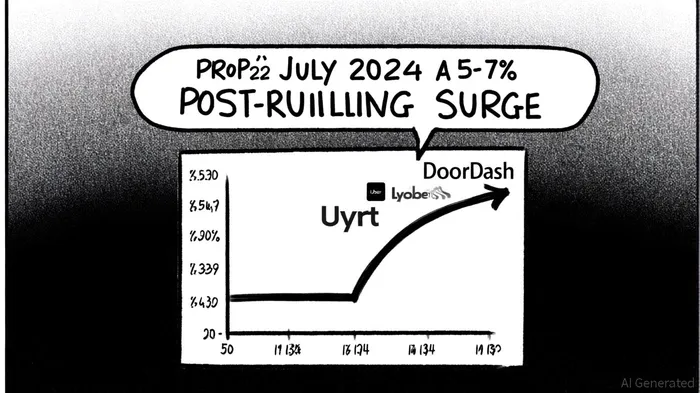







Comentarios
Aún no hay comentarios