
Liability Risks in the Aerospace and Aviation Sector: Legal and Reputational Exposure for OEMs and Suppliers
The aerospace and aviation sector, a cornerstone of global trade and technological innovation, is increasingly under scrutiny for legal and reputational risks that threaten its financial stability and public trust. From high-profile cases involving original equipment manufacturers (OEMs) like BoeingBA-- and Airbus to enforcement actions against suppliers, the industry faces a complex web of liability exposures. These risks, amplified by regulatory shifts and whistleblower-driven litigation, demand a nuanced understanding for investors navigating this capital-intensive sector.
OEMs: A Tale of Two Giants
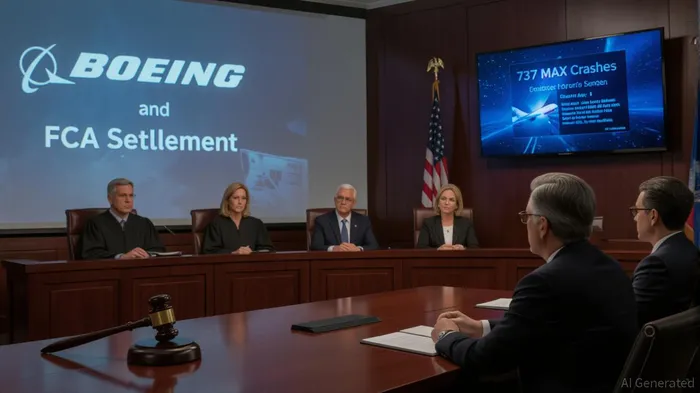
Boeing's legal saga remains a cautionary tale. The company's 2021 Deferred Prosecution Agreement (DPA) over the 737 MAX crashes—initially seen as a resolution—unraveled in 2024 when the DOJ alleged Boeing had violated the agreement by failing to implement an effective compliance program. A proposed guilty plea was rejected by a federal judge, who criticized the terms as insufficiently punitive [2]. In May 2025, the DOJ dropped the criminal case under a non-prosecution agreement (NPA), with Boeing agreeing to pay $444.5 million to a victims' fund and $240 million in penalties [4]. Critics argue the deal fails to hold Boeing accountable, with families of crash victims and lawmakers decrying it as a “corporate pass” [6]. The case underscores the reputational toll of prolonged legal battles, as Boeing's stock remains volatile and its brand tarnished by perceptions of systemic negligence.
Airbus, meanwhile, faces distinct but equally challenging legal headwinds. A UK HMRC investigation into potential export control violations by Airbus UK entities has raised questions about the company's compliance with international trade rules [1]. Separately, a Dutch court is adjudicating a €300 million investor loss case against Airbus, its executives, and auditors, with a December 2025 ruling expected [2]. These cases highlight the sector's vulnerability to cross-border regulatory scrutiny and the reputational damage of perceived governance failures.
Suppliers: The Hidden Front Lines of Liability
While OEMs dominate headlines, suppliers face equally severe risks under the False Claims Act (FCA). In 2024, Sikorsky Support Services, Inc. (SSSI) and Derco Aerospace Inc. settled a $70 million FCA case for overcharging the Navy via a prohibited cost-plus-percentage-of-cost subcontract [3]. The arrangement, which added 32% to part costs, violated Federal Acquisition Regulation (FAR) 16.102(c) and drew a whistleblower's $14 million share of the settlement [4]. Such cases illustrate how even non-OEM suppliers can become focal points for enforcement, particularly in government contracts where pricing accuracy is paramount.
The DOJ's Civil Cyber-Fraud Initiative has further intensified scrutiny. In fiscal year 2024 alone, the DOJ secured $93 million in FCA settlements from defense contractors for cybersecurity noncompliance [1]. New regulations, such as the 2025 National Defense Authorization Act's restrictions on Chinese military-linked suppliers, add layers of complexity to supply chain management [1]. Suppliers must now navigate not only technical compliance but also geopolitical risks, with penalties for missteps including treble damages and per-claim fines under the FCA [5].
Regulatory Shifts and Investor Implications
The sector's liability landscape is evolving rapidly. The DOJ's Safe Harbor Policy, introduced in 2023, offers limited protection for companies disclosing misconduct within six months of an acquisition but does not shield them from civil FCA liability [1]. Meanwhile, Trump-era tariffs have spurred a surge in customs fraud cases, with companies like Evolutions Flooring and Alexis LLC settling for $8.1 million and $7.7 million, respectively, over misrepresentations of imported goods [4]. These trends signal a broader regulatory focus on transparency and accountability, with implications for corporate governance and investor due diligence.
For investors, the key takeaway is clear: aerospace firms with robust compliance programs and transparent governance are better positioned to mitigate legal and reputational risks. Companies that fail to address systemic issues—whether in safety protocols, supply chain ethics, or cybersecurity—risk not only financial penalties but also long-term erosion of stakeholder trust.
Conclusion
The aerospace and aviation sector's liability risks are no longer confined to operational or safety concerns. Legal and reputational exposures, driven by regulatory enforcement, whistleblower actions, and geopolitical tensions, have become central to investment analysis. As Boeing and Airbus navigate their respective legal quagmires, and suppliers grapple with FCA enforcement, investors must prioritize companies that demonstrate proactive compliance and transparency. In an industry where trust is as critical as technology, the cost of neglecting these risks could be catastrophic.





Comentarios
Aún no hay comentarios