
Levi Strauss' Q3 Earnings Outperform Amid DTC Momentum and Margin Resilience
Levi Strauss & Co. (LEVI) has delivered a compelling Q3 2025 earnings report, with net revenue rising 7% year-over-year to $1.54 billion, surpassing expectations of $1.50 billion Levi Strauss Q3 2025 earnings report. This outperformance is driven by robust DTC sales growth of 11.3% and a 16% surge in e-commerce, which now accounts for a significant portion of its U.S. business (over 40%), according to a Zacks report a Zacks report. The company's gross margin also expanded by 110 basis points to 61.7%, defying headwinds from tariffs-a testament to its operational discipline and pricing power, as noted in the CNBC report. These results underscore a strategic shift toward DTC, which is not only boosting revenue but also reshaping how the market values retail brands.
DTC Momentum and Margin Resilience: A New Benchmark
Levi's DTC growth is emblematic of a broader industry trend where brands with scalable digital platforms and customer-centric models command valuation premiums. According to a Q2 2025 report by PCE Investment Bankers, DTC brands with strong digital engagement and data-driven strategies trade at 15–20% higher multiples than wholesale-centric peers a PCE Investment Bankers report. This premium is rooted in the DTC model's ability to capture customer data, personalize experiences, and maintain tighter control over pricing and brand messaging. For Levi's, this translates to a direct link between DTC growth and margin resilience: its 110-basis-point margin expansion in Q3, despite tariff pressures, highlights the profitability potential of direct channels (as reported by CNBC).
The company's strategic focus on DTC is paying off. With DTC net revenues up 11% (reported) and 9% (organic), Levi's is leveraging its global supply chain and brand equity to drive long-term value. CEO Michelle Gass emphasized that new store openings and e-commerce performance are central to this transformation, with the DTC segment now contributing to over 40% of U.S. sales, according to Levi StraussLEVI-- third-quarter 2025 financial results Levi Strauss third-quarter 2025 financial results. This shift aligns with broader consumer preferences for seamless, data-rich experiences-a trend that Deloitte's Q1 2025 retail analysis identifies as a key driver of valuation differentiation Deloitte's Q1 2025 retail analysis.
Reassessing Retail Valuation Multiples: Profitability Over Hype
While DTC brands once faced skepticism for prioritizing growth over profitability, recent market dynamics suggest a recalibration. A Hahnbeck blog post notes that profitable DTC brands now trade at an average EV/Sales multiple of 1.84x, compared to 1.06x for unprofitable ones-a stark contrast to the early 2020s, when unprofitable DTC companies commanded higher valuations a Hahnbeck blog post. Levi's Q3 results, which include a 3% revenue growth upgrade and adjusted EPS guidance of $1.27–$1.32, demonstrate how profitability and DTC momentum can justify higher multiples (as observed in the CNBC coverage).
Levi's current valuation metrics reflect this shift. As of October 2025, the company trades at an EV/Revenue multiple of 1.6x and an EV/EBITDA multiple of 20.3x, with a P/E ratio of 16.0x, according to public comps data public comps data. These figures, while modest compared to some pure-play DTC brands, suggest room for re-rating as the company continues to optimize its DTC strategy. For instance, Levi's AI/ML-driven forecasting initiatives-launched in partnership with Wipro-have already boosted gross margins from 52.8% to 60% since 2017, illustrating how technology can amplify DTC advantages, as shown in an HBS case study an HBS case study.
Strategic Implications for Retail Valuation Models
The Levi's case study highlights three key factors that investors should consider when reassessing retail valuation multiples:
1. DTC Scalability: Brands that integrate DTC with omnichannel strategies (e.g., hybrid models) are better positioned to capture market share and sustain margins. Levi's 16% e-commerce growth and 14% Asia-Pacific DTC expansion illustrate this scalability (reported in the CNBC coverage).
2. Profitability Signals: As Hahnbeck's analysis shows, profitability is now a critical determinant of valuation multiples. Levi's margin resilience and raised guidance signal confidence in its ability to convert DTC growth into sustainable earnings.
3. Operational Innovation: Levi's use of AI/ML in forecasting and supply chain optimization demonstrates how technology can enhance DTC efficiency, reducing costs and improving customer retention (as detailed in the HBS case study).
Conclusion
Levi Strauss' Q3 performance reaffirms the transformative power of DTC strategies in the retail sector. By combining margin resilience, digital innovation, and a clear focus on profitability, the company is not only outperforming expectations but also setting a precedent for how the market should value DTC-driven growth. As investors increasingly prioritize earnings quality and operational agility, Levi's trajectory-alongside broader industry trends-justifies a reassessment of retail valuation multiples. For brands that can replicate Levi's DTC success while maintaining profitability, the path to premium valuations is clearer than ever.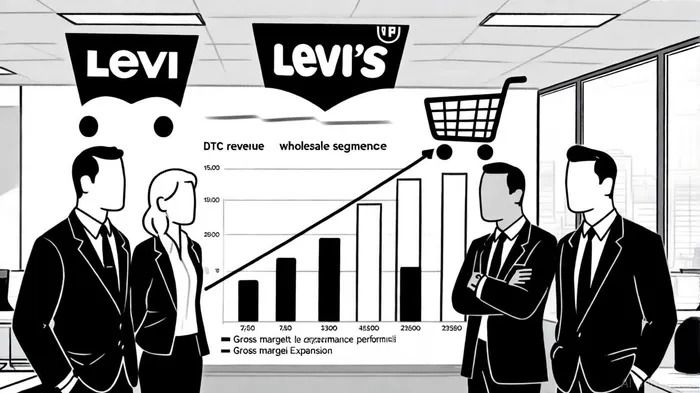





Comentarios
Aún no hay comentarios