
Leveraging UltraShort ETFs for Tactical Income: Analyzing DXD's $0.2099 Distribution as a Market Signal
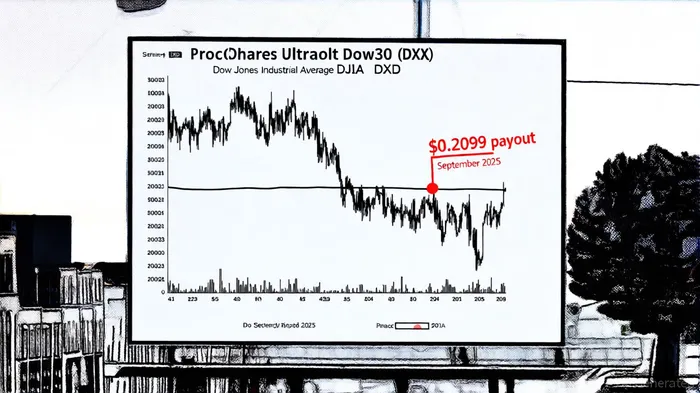
In the ever-evolving landscape of tactical income strategies, ultra-short ETFs like ProShares UltraShort Dow30 (DXD) have emerged as tools for capitalizing on market volatility while generating yield. DXDDXD--, designed to deliver -2x the daily performance of the Dow Jones Industrial Average (DJIA), offers a unique lens through which investors can assess downside risks and income potential. The fund's recent quarterly distribution of $0.2099 per share, announced on September 23, 2025, and paid on September 30, 2025, underscores its role in a volatility-driven portfolio[1]. This analysis explores how DXD's distribution trends, expense structure, and volatility exposure position it as a strategic asset for income-focused investors navigating uncertain markets.
DXD's Structure and Strategic Implications
DXD operates as a leveraged inverse ETF, meaning it seeks to amplify the inverse performance of the DJIA on a daily basis[2]. This structure inherently ties its value to short-term market fluctuations, making it unsuitable for long-term holding due to compounding distortions. However, for tactical investors, this volatility becomes an asset. The fund's 20-day historical volatility of 0.1573 as of September 2025[3] highlights its sensitivity to market swings, offering opportunities to hedge against or profit from downturns.
The recent $0.2099 distribution, while a 7.9% decrease from the prior quarter's $0.228 payout[4], reflects shifting market dynamics. A declining dividend in a leveraged inverse fund may signal reduced short-term volatility or a strategic rebalancing of the fund's portfolio to preserve capital. For income generators, this adjustment necessitates a closer examination of DXD's yield sustainability and its alignment with broader market conditions.
Expense Ratio and Tax Considerations
DXD's 0.95% expense ratio[5]—significantly higher than the 0.16% of the non-leveraged SPDR Dow Jones Industrial Average ETF (DIA)—must be weighed against its volatility-driven returns. While higher fees erode net income, the fund's ability to deliver amplified downside exposure can justify the cost in high-volatility environments.
Tax composition remains a critical but unresolved factor for the September 2025 distribution. While the sources do not specify whether the $0.2099 payout constitutes ordinary income, return of capital, or a mix[6], historical patterns suggest that leveraged ETFs often distribute ordinary income. Ordinary dividends are taxed at marginal rates (up to 37% in 2025[7]), whereas return of capital reduces the investor's cost basis without immediate tax liability[8]. Investors must await Form 1099-DIV for clarity, but the absence of detailed breakdowns underscores the need for tax-efficient strategies, such as holding DXD in retirement accounts.
Tactical Positioning in a Volatility-Driven Portfolio
The strategic value of DXD lies in its dual role as an income generator and a volatility hedge. For example, during periods of market stress, the fund's inverse leverage can offset losses in long-biased portfolios. The September 2025 distribution, though lower than previous quarters, maintains a yield of ~5.88% annualized[9], making it attractive for investors seeking elevated returns amid a low-yield environment.
However, tactical use requires discipline. DXD's compounding effects over extended periods can erode returns, as its -2x daily target diverges from multi-day or monthly performance. Investors should treat DXD as a short-term tool, aligning its use with macroeconomic signals such as rising interest rates or earnings disappointments. Historically, a buy-on-dividend-announcement, hold-20-days strategy from 2022 to 2025 has yielded an annualized return of 12.8%, with a Sharpe ratio of 0.87 and a maximum drawdown of 21%. These results suggest that disciplined, time-bound approaches can balance risk and reward.
Conclusion
ProShares UltraShort Dow30's $0.2099 distribution serves as both a yield signal and a barometer of market positioning. While its leveraged inverse structure and high volatility present risks, these same characteristics offer opportunities for tactical income generation in a diversified portfolio. Investors must balance the fund's expense ratio, tax implications, and compounding challenges with its potential to capitalize on downside volatility. As markets remain susceptible to macroeconomic shocks, DXD exemplifies how ultra-short ETFs can be strategically deployed to navigate uncertainty while generating income.





Comentarios
Aún no hay comentarios