
Leveraged Exposure to Nvidia: Navigating Risk-Reward Dynamics in the AI-Driven Market
Nvidia (NVDA) has emerged as a linchpin in the artificial intelligence (AI) revolution, with its stock price surging to $187.24 as of October 2025 amid surging demand for AI chips and data center infrastructure[3]. Analysts project a trajectory to $494 by late 2026, driven by its dominance in AI hardware and the CUDA software ecosystem[2]. However, the allure of such growth has spurred a parallel boom in leveraged investment products, including ETFs and options, which amplify exposure to Nvidia's volatility while magnifying both gains and losses. This article examines the risk-reward dynamics of leveraged NvidiaNVDA-- investments in the context of AI-driven market cycles.
The Rise of Leveraged ETFs in the AI Era
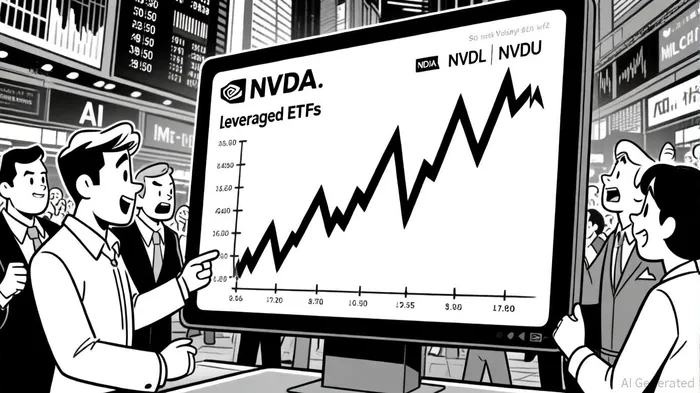
Leveraged ETFs like the GraniteShares 2x Long NVDANVDA-- Daily ETF (NVDL) and Direxion's NVDUNVDU-- (2x Bull) and NVDD (1x Bear) have become central to the AI investment landscape. These products aim to deliver 2x or inverse daily returns relative to Nvidia's stock price, catering to traders seeking amplified exposure[5]. As of 2025, NVDLNVDL-- alone holds $4.56 billion in assets, reflecting its popularity among investors bullish on AI's long-term trajectory[1].
Yet, the mechanics of these ETFs introduce unique risks. For instance, NVDL's 1.15% expense ratio and 15.20% volatility-double that of Nvidia's 7.51%-underscore the trade-off between amplified returns and heightened costs[4]. Historical performance further illustrates this tension: while NVDU returned 77.07% over 12 months, it also faced a maximum drawdown of -67.27%, mirroring Nvidia's sharp corrections[2]. Such volatility is exacerbated by the daily compounding of leveraged returns, making these ETFs unsuitable for long-term holding[5].
AI Market Cycles and Their Impact on Leveraged Investments
The AI market operates within distinct cycles, as outlined by Gartner's Hype Cycle: innovation triggers, inflated expectations, troughs of disillusionment, and eventual mainstream adoption[6]. In 2025, AI agents and multimodal AI are at the peak of inflated expectations, driving speculative fervor and inflows into leveraged products[4]. For example, a 17% drop in Nvidia's stock in early 2025 led to a 34% plunge in NVDL, illustrating how leveraged ETFs magnify downside risks during market corrections[1].
Conversely, positive earnings surprises can yield outsized gains. When MongoDB's stock surged 23% after hours, its leveraged ETF counterpart jumped 46%, demonstrating the potential rewards of directional bets in AI-driven markets[1]. However, these gains are contingent on precise timing and risk management, as prolonged holding periods can erode returns due to compounding and volatility decay[5].
Historical data on Nvidia's earnings beats from 2022 to 2025 reveals a nuanced picture. While short-term (1-5 day) performance after earnings surprises is mixed and statistically insignificant, a modest positive drift emerges after ~15 trading days. By day 20-30, the win rate improves to ~64%, though absolute excess returns remain small relative to benchmarks[4]. This suggests that while leveraged strategies may capitalize on post-earnings momentum, the window for capturing meaningful gains is narrow and requires disciplined exit timing.
Risk Management in a High-Stakes Environment
For investors considering leveraged exposure, understanding the interplay between AI adoption rates and market sentiment is critical. Direxion's NVDU and NVDD, with expense ratios of 1.04% and 1.00% respectively, offer lower costs than NVDL but still carry significant risks[2]. Options strategies, such as calendar call spreads, provide an alternative by balancing upside potential with downside protection[1].
Regulatory and governance trends also shape risk profiles. As organizations adopt AI governance frameworks (e.g., trust, risk, and security management), market perceptions of AI companies may shift, influencing leveraged ETF performance[4]. Investors must remain vigilant about these evolving dynamics.
Conclusion: Balancing Ambition and Caution
Leveraged exposure to Nvidia offers a compelling, albeit volatile, path to capitalize on AI's transformative potential. While products like NVDL and NVDU can amplify returns during AI hype phases, they require disciplined risk management and short-term trading strategies to mitigate drawdowns. As the AI market matures, investors must weigh the allure of rapid gains against the inherent risks of leveraged products, ensuring their strategies align with both market cycles and personal risk tolerance.





Comentarios
Aún no hay comentarios