
Levain Bakery's Grocery Expansion: A Sweet Play on Inflation-Resistant Brand Equity
Levain Bakery, the iconic New York-based purveyor of melt-in-your-mouth cookies, is making a bold move into national grocery retail—a strategy that positions it as a compelling investment in an era of inflationary pressures and shifting consumer preferences. By leveraging its premium brand equity, operational scalability, and a product portfolio designed to withstand cost-of-living challenges, Levain is primed to capture a growing share of the $120 billion U.S. baked goods market.
The Product Proposition: Quality Meets Convenience
Levain's expansion hinges on its frozen, ready-to-heat cookie line, which replicates its bakery-fresh experience at home. Available in three classic flavors—including a new Dark Chocolate Chocolate Chip exclusive to Whole Foods—the cookies use the same recipes as the original bakery, free of additives or preservatives. Each package ($7.99–$9.99) delivers eight two-ounce cookies, requiring just 5–7 minutes of heating to achieve their signature “melty” texture.
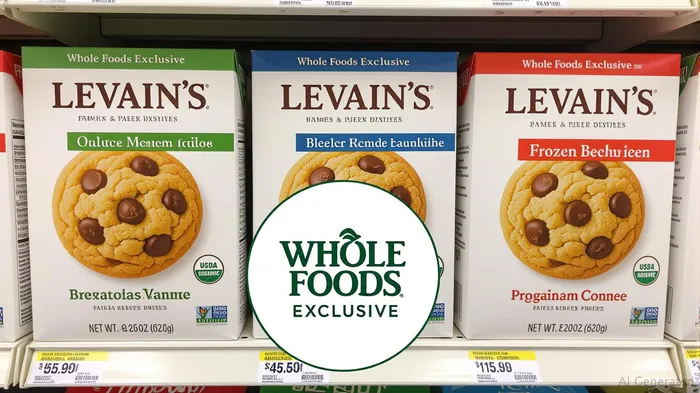
This approach strikes a balance between indulgence and practicality. The frozen format addresses consumer demand for convenience without compromising on quality—a critical edge in a market where 68% of shoppers prioritize “authenticity” in food purchases.
Inflation Resistance: A Premium Anchor in Volatile Markets
Inflation has forced consumers to trade down to cheaper alternatives, but premium brands like Levain can thrive by appealing to a loyal, price-insensitive customer base. The bakery's focus on “no compromises” aligns with a growing trend: premium packaged goods (CPG) brands grew 12% in 2023, outpacing standard CPG by 8 percentage points.
Levain's pricing strategy—$8–$10 per package—may seem steep, but its brand equity allows it to maintain margins even as input costs rise. Competitors like B&G Foods (BGS) or Flowers FoodsFLO-- (FLO) have struggled to offset inflation without losing market share, but Levain's direct-to-consumer e-commerce success (10–15% of sales) and brand halo effect provide a cushion.
Scalability: Building on Brand Equity, Not Brand Dilution
Levain's semi-regional rollout—prioritizing markets with existing brand awareness—minimizes risk while maximizing efficiency. By focusing on areas where its bakery locations or online sales have already established a following, the company avoids overextending into unfamiliar territories. This approach also aligns with its partnership with R.R. DonnelleyDFIN--, which has boosted operational efficiency by 50% through optimized packaging and warehousing.
The data is clear: brands with strong equity can scale faster. Consider that StarbucksSBUX-- (SBUX) achieved a 15% same-store sales growth in 2023 by leveraging its premium positioning, even as inflation rose. Levain's goal of contributing 18–20% of revenue from CPG within three years mirrors this trajectory, suggesting it could surpass $100 million in annual CPG sales by 2027.
Operational Mastery: The Key to Sustained Growth
Levain's partnership with R.R. Donnelley isn't just about logistics—it's about maintaining quality at scale. The 50% efficiency gain means lower costs per unit, enabling Levain to reinvest in innovation (e.g., gluten-free cookies) and geographic expansion. This contrasts sharply with competitors like Krispy KremeDNUT-- (KKD), which saw margins shrink by 14% in 2023 due to poor supply chain management.
Furthermore, Levain's decision to avoid preservatives and additives aligns with health-conscious trends, which are proving sticky even as economic conditions tighten. A Nielsen survey found that 71% of consumers now prioritize “natural” ingredients, a market Levain is already addressing.
Investment Thesis: A Sweet Spot in the Market
Levain's expansion into national retail is a low-risk, high-reward play on two enduring themes: the shift to premium CPG and the scalability of strong brand equity. While the company isn't yet public, its trajectory suggests it could become a sought-after IPO candidate, especially if it achieves its 18–20% CPG revenue target.
For now, investors can indirectly benefit by:
1. Buying into CPG ETFs: Consider the Consumer Staples Select Sector SPDR Fund (XLP), which includes Levain's retail partners like Whole Foods (WFM).
2. Backing its supply chain: R.R. Donnelley (RRD) or packaging firms like Ball CorporationBALL-- (BALL) stand to gain from Levain's growth.
3. Watching for an IPO: Levain's operational and brand strengths make it a likely candidate for a public listing within 18–24 months, offering a direct entry point.
Risks to Consider
No investment is without risks. Levain faces competition from established players like Famous Amos (owned by B&G Foods) and may struggle to maintain quality as distribution expands. Additionally, consumer spending on discretionary treats could dip if inflation spikes further.
Final Analysis: A Baked-In Opportunity
Levain Bakery's move into national grocery retail is more than a product launch—it's a masterclass in leveraging brand equity to scale in a fragmented market. With a premium price point, operational efficiency, and a product that transcends inflationary trade-offs, Levain is well-positioned to capitalize on the $2.2 trillion U.S. food retail market. For investors, this is a rare chance to back a company that combines authenticity with growth potential—a recipe for success in any economic climate.
Investors should watch this space closely. Levain isn't just selling cookies; it's building a brand that could redefine the CPG landscape.







Comentarios
Aún no hay comentarios