
Leonardo DRS Insider Sales and Corporate Governance: A Balancing Act for Market Confidence
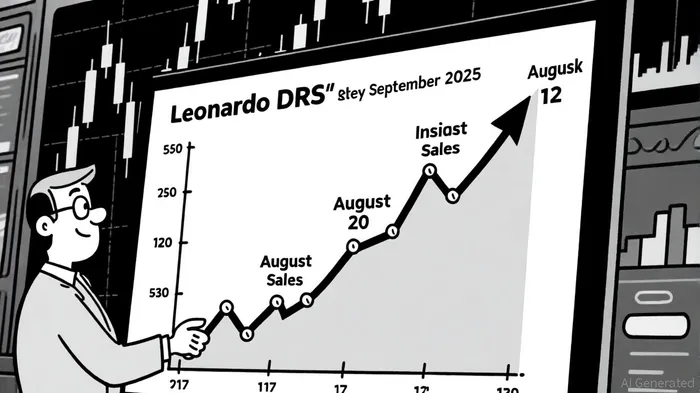
In the volatile landscape of defense contracting, Leonardo DRSDRS-- (DRS) has drawn attention for a surge in insider sales during the third quarter of 2025. These transactions, executed by executives and directors, have sparked debates about corporate governance and investor sentiment. While the company has navigated a complex regulatory environment and reported robust financial results, the pattern of insider divestment raises critical questions for shareholders.
Insider Sales: Pre-Planned or Red Flag?
According to SEC filings, Executive Vice President and COO John Baylouny sold 11,375 shares on August 20, 2025, at $41.17 per share under a Rule 10b5-1 trading plan [1]. This pre-arranged strategy, adopted on May 13, 2025, is designed to mitigate insider trading concerns by automating sales outside of material nonpublic information windows [2]. Similarly, CFO Michael Dippold liquidated 19,360 shares on September 12 at $41.65, reducing his holdings by 24.76% [3]. These transactions, while legally defensible, still prompt scrutiny.
Over the past 12 months, insiders have sold shares totaling $8.49 million, with CEO William Lynn III alone offloading $1.58 million in January 2025 [4]. Governance experts note that while Rule 10b5-1 plans can align with personal financial planning, the cumulative nature of these sales may signal skepticism about short-term stock performance [5].
Corporate Governance Reforms: A Double-Edged Sword
Leonardo DRS has simultaneously restructured its governance framework. Shareholders approved the removal of "pop-up" supermajority voting requirements in June 2025, streamlining decision-making for corporate actions [6]. This shift, supported by 250.9 million shares in favor, reflects a broader trend toward simplifying governance structures to enhance board agility [7]. However, critics argue that reducing shareholder approval thresholds could prioritize executive flexibility over long-term stakeholder interests [8].
The company's transparency efforts, including compliance with Nasdaq and SEC regulations, are lauded in its governance reports [9]. Yet, the juxtaposition of governance reforms and insider selling underscores a tension between board authority and investor trust.
Market Reactions: Resilience Amidst Uncertainty
Despite the insider activity, Leonardo DRS's stock has shown resilience. From August 20 to September 17, 2025, the stock rose from $41.06 to $41.54, with a peak of $42.59 on September 18 [10]. Analysts attribute this to strong Q2 2025 results, including a 10% revenue increase to $829 million and a $8.6 billion order backlog [11]. The company also raised full-year guidance, forecasting 1.060–1.110 EPS [12].
However, the stock's price-to-earnings ratio of 44.87, well above industry averages, has drawn valuation concerns [13]. While analysts maintain a "Moderate Buy" rating with a $46.75 average price target [14], the disconnect between insider sentiment and market optimism remains a focal point.
Implications for Investors
For investors, the interplay of insider sales and corporate governance reforms demands a nuanced approach. On one hand, the company's financial performance and strategic adjustments suggest confidence in its long-term trajectory. On the other, the frequency of insider divestment—particularly by top executives—could erode trust if perceived as a lack of alignment with shareholder interests.
The Rule 10b5-1 framework provides a legal safeguard for these transactions, but it does not eliminate the psychological impact on markets. As governance expert Dr. Emily Carter notes, "Pre-planned sales are not inherently negative, but they must be contextualized within broader corporate behavior and communication strategies" [15].
Conclusion
Leonardo DRS's recent insider activity and governance changes present a complex narrative. While the company's financials and strategic updates bolster market confidence, the pattern of insider selling warrants closer scrutiny. Investors must weigh these factors against the company's operational strengths and the evolving regulatory landscape. For now, the stock's performance suggests resilience, but the ultimate test will lie in how management addresses these governance and transparency challenges in the months ahead.







Comentarios
Aún no hay comentarios