
Lenskart's IPO and Peyush Bansal's Billion-Dollar Vision: A Strategic Analysis of Market Disruption and Investment Potential
The Indian eyewear market is on the cusp of a transformative shift as Lenskart Solutions prepares to debut on public markets with an IPO valued at ₹70,000–75,000 crore ($8–9 billion), according to Financial Express. This landmark offering, expected to raise ₹2,150 crore through a fresh issue and ₹5,850 crore via an Offer for Sale (OFS), underscores the company's ambition to redefine accessibility to affordable, tech-driven eyewear solutions. At the helm of this disruption is Peyush Bansal, the visionary co-founder and CEO whose entrepreneurial journey has turned Lenskart into a $10 billion valuation behemoth, according to Success Magazine. This analysis evaluates the IPO's implications for the Indian eyewear market, its alignment with macroeconomic trends, and the investment risks and rewards embedded in this high-stakes offering.
Lenskart's IPO: A Catalyst for Market Expansion
Lenskart's IPO is structured to accelerate its dominance in a sector where only 170 million of India's 550 million vision-impaired population currently have access to corrective eyewear, as detailed by Custom Market Insights. The company plans to allocate ₹2,150 crore from the fresh issue toward opening 620 new company-owned (CoCo) stores in FY25 alone, expanding its digital infrastructure with AI-led fulfillment systems, and bolstering brand marketing, according to IPO Central. These initiatives align with the Indian eyewear market's projected 11.93% CAGR through 2033, driven by urbanization, rising disposable incomes, and a shift toward fashion-conscious consumers, per Maximize Market Research.
The IPO's success hinges on Lenskart's ability to leverage its vertically integrated model, which spans design, manufacturing, and retail. This strategy has already yielded impressive financials: FY25 revenue surged 22.5% to ₹6,652.5 crore, with net profits of ₹297.34 crore-a stark contrast to the ₹10.15 crore loss in FY24, as reported by IPO Watch. EBITDA margins improved to 14.60%, reflecting operational efficiency. With 40% of FY25 revenue generated from international markets like Japan and Singapore, Lenskart's global ambitions further diversify its risk profile, according to Kotak Securities.
Peyush Bansal: From McGill to Billionaire
Peyush Bansal's entrepreneurial trajectory is a case study in disruptive innovation. After studying at McGill University and earning an entrepreneurship diploma from IIM Bangalore, Bansal co-founded Lenskart in 2010 with Amit Chaudhary, later joined by Sumeet Kapahi. His early ventures, including SearchMyCampus and Valyoo Technologies, honed his understanding of customer behavior and digital engagement, according to a Velocity blog. By 2025, Bansal's net worth is estimated at ₹600 crore, with the IPO poised to elevate him to billionaire status as he offloads shares through the OFS, per StartUpTalky.
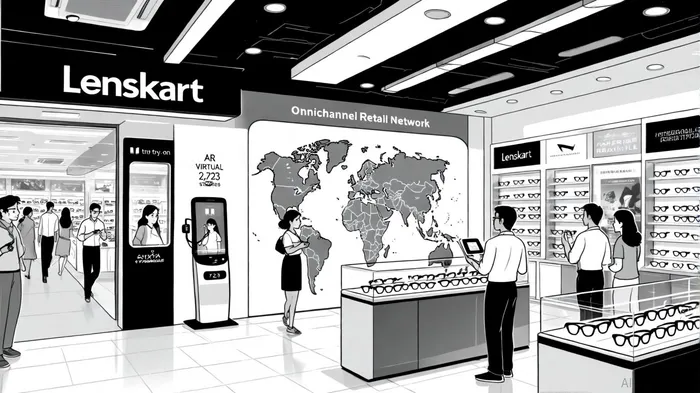
Bansal's leadership has been pivotal in democratizing eyewear through innovations like remote optometry exams and AR-powered virtual try-ons. These tools, coupled with a mobile app downloaded over 100 million times, have positioned Lenskart as a D2C (direct-to-consumer) leader. His strategic vision extends beyond India: with 656 international stores and plans to expand into 10+ countries, Lenskart aims to capitalize on the global shift toward affordable, tech-enabled healthcare, as reported by Rediff.
Market Dynamics: Competition and Challenges
The Indian eyewear market is fiercely competitive, with established players like Titan Eye+ and global giants such as Luxottica and Essilor vying for market share. However, Lenskart's omnichannel model-combining 2,067 domestic stores with a robust online platform-has disrupted traditional retail. Its focus on affordability (prices starting at ₹199 for glasses) and convenience (home eye tests) has eroded the dominance of unorganized retailers, who account for 70% of the market, according to Zion Market Research.
Jefferies analysts predict the organized retail sector will grow at a double-digit CAGR, driven by Lenskart's ability to scale, as noted in a Jefferies note. Yet challenges persist. The company's reliance on key executives, including Bansal, poses a risk, as does its exposure to supply chain disruptions and franchisee disputes. Additionally, the IPO's valuation premium-reflected in grey market pricing at ₹510 per share (implying a $10 billion valuation)-must be justified by sustained profitability and market share gains, according to Moneycontrol.
Investment Potential: Balancing Growth and Risk
For investors, Lenskart's IPO presents a high-reward opportunity in a sector poised for structural growth. The company's FY25 financials demonstrate a clear path to profitability, with EBITDA growing 44.5% to ₹971 crore. Its strategic use of IPO proceeds-targeting 450 new CoCo stores and AI-driven logistics-aligns with long-term scalability. Moreover, government initiatives like the National Programme for Control of Blindness and Visual Impairment (NPCB&VI) could further boost demand, per IMARC Group.
However, risks cannot be ignored. The IPO's success depends on Lenskart's ability to maintain margins amid aggressive expansion, manage debt, and navigate regulatory scrutiny. Retail investors, who receive a 10% allocation in the IPO, must weigh these factors against the company's strong digital engagement and first-mover advantage in AI-powered eyewear, according to Chittorgarh.
Conclusion: A Defining Moment for Indian Retail
Lenskart's IPO is more than a fundraising exercise-it is a strategic move to cement its role as a market leader in a sector ripe for disruption. With Peyush Bansal's visionary leadership and a $10 billion valuation target, the company is well-positioned to capitalize on India's $11,930 million eyewear market by 2033, according to Custom Market Insights. For investors, the IPO offers exposure to a scalable business model, but prudence is required to navigate operational and market risks. As the IPO nears its November 2025 launch, all eyes will be on whether Lenskart can deliver on its promise to make vision correction accessible to a billion Indians.







Comentarios
Aún no hay comentarios