
Lenovo's Strategic Pivot to AI: A Buying Opportunity in Enterprise Tech
The global tech landscape is undergoing a seismic shift, with artificial intelligence (AI) emerging as the new engine of growth. Lenovo Group, long a stalwart in traditional hardware, is now at a critical inflection point—its recent financials reveal a company transcending legacy constraints to capitalize on hybrid AI infrastructure and enterprise services. While headlines have fixated on near-term profit volatility, a deeper dive into Lenovo’s Q3 FY2025 results and strategic pivots reveals a compelling narrative: this is a rare opportunity to buy a leader in the $2 trillion AI ecosystem before its valuation catches up to its ambitions.
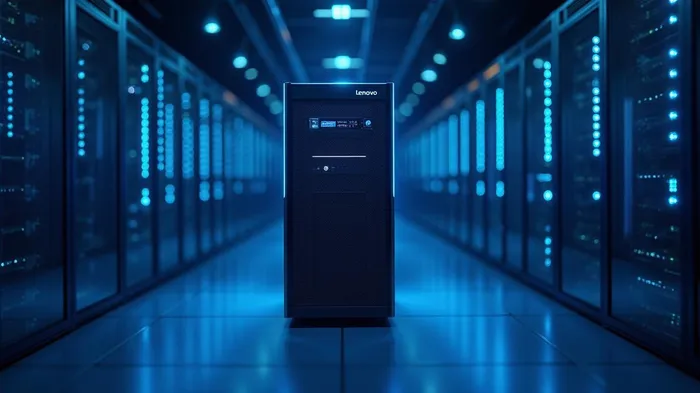
Masked by One-Time Gains, Underlying Strength Shines
Critics may point to Lenovo’s net profit “decline” in prior quarters, but the Q3 results tell a different story. While the $692.7 million net profit included a $282 million non-recurring tax credit, the core operating profit rose 12% year-on-year to $687.7 million. Stripping out the one-time gain, the company’s operational resilience is undeniable: all three segments—Intelligent Devices Group (IDG), Infrastructure Solutions Group (ISG), and Solutions & Services Group (SSG)—delivered double-digit revenue growth. This dispels the myth of a “profit decline” and underscores a structural shift toward higher-margin businesses.
AI as the New Growth Engine
Lenovo’s AI-first strategy is no longer theoretical. Its Neptune liquid cooling technology, now deployed in automotive and finance sectors, has propelled ISG revenue to a 59% YoY surge. Meanwhile, IDG’s AI-enabled PCs—such as the Aura Edition and Windows 11 Copilot+ devices—are capturing a premium market share. The Solutions & Services Group (SSG) now derives 59% of revenue from AI-powered managed services, a segment growing twice as fast as the market. Consider this: non-PC revenue now accounts for 46% of total sales, up from 38% two years ago. This is a company decisively moving beyond its PC-centric past.
Supply Chain Agility in a Fractured World
Geopolitical headwinds remain a concern. Potential U.S. tariffs of 10-25% on Chinese-made goods could pressure margins, given 80% of production is still in China. Yet Lenovo’s ODM+ manufacturing model—leveraging facilities in Mexico, Brazil, and the Middle East—buffers it against disruption. The expansion of its Alat joint venture in Saudi Arabia, combined with a 14% YoY R&D spend increase, positions Lenovo to dominate AI infrastructure even in a fragmented supply chain.
The Risk-Adjusted Case for Aggressive Buying
While bears focus on near-term margin compression (operating margin dipped to 3.7% from 3.9%), they ignore the long game. Lenovo is reinvesting heavily in AI R&D ($621 million in Q3 alone) and scaling its hybrid cloud-edge infrastructure. The Windows 11 refresh cycle, ending support for Windows 10, will further fuel PC demand, while AI server adoption is still in early innings. At a P/E ratio of just 10.5x (vs. sector average of 18x), the stock is pricing in worst-case scenarios rather than the $18.8 billion revenue juggernaut it has become.
Final Call: Buy the Dip, Own the Transition
Investors seeking exposure to AI-driven enterprise tech need look no further. Lenovo’s triple-pronged strategy—AI servers, premium devices, and recurring services—is a moat against commoditization. With geopolitical risks already discounted and a valuation near 52-week lows, now is the time to position for the next era of tech leadership. The pullback isn’t a warning—it’s a buy signal.
In a world where every company wants to be “the next AI giant,” Lenovo is already there—quietly building the hardware, software, and services that will define the next decade. This isn’t just a recovery play; it’s a generational opportunity to own a foundational piece of the AI economy.







Comentarios
Aún no hay comentarios