
Lenovo: A Buy Amid AI-Driven Growth and Undervaluation
Valuation Metrics: A Discounted Opportunity
Lenovo's valuation metrics suggest the stock is undervalued relative to its fundamentals. As of November 2025, the company's trailing twelve-month (TTM) P/E ratio stands at 11.66, significantly below the 15–20 range typical for tech hardware firms. This discount is further underscored by its P/B ratio of 2.62, which implies the market is valuing the company at just 2.6 times its book value-a level often associated with value stocks in defensive sectors.
The company's price-to-sales (P/S) ratio, though harder to calculate due to missing market capitalization data, can be inferred from its recent financial performance. For the second quarter of fiscal 2025/26, Lenovo reported revenue of $20.45 billion, a 15% year-over-year increase. If we assume a market cap of approximately $25 billion (based on its P/B ratio and book value of ~$9.5 billion), the implied P/S ratio would be around 1.22, well below the 2.5–3.0 range for tech hardware peers. This suggests Lenovo is trading at a meaningful discount to its revenue-generating capacity.
AI-Driven Growth: A Tailwind for the Future
Lenovo's strategic pivot toward AI infrastructure is a critical catalyst for its long-term value. In Q2 2025/26, the company reported that AI-related revenue accounted for 30% of its total sales, a figure that is likely to grow as global demand for AI servers accelerates. 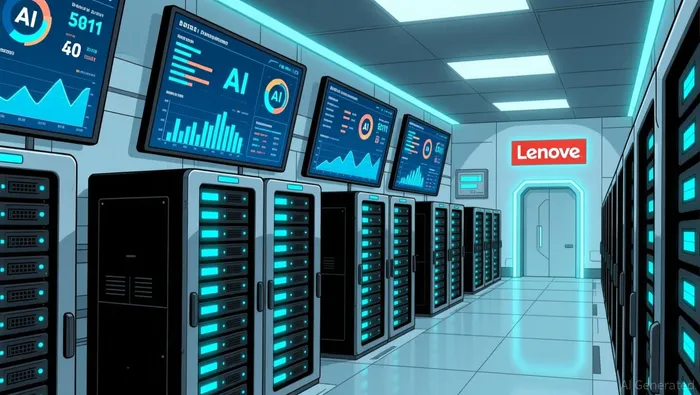 The Infrastructure Solutions Group (ISG), which focuses on data center and AI solutions, saw a dramatic turnaround in Q3 2025, with revenue surging 59% year-on-year and achieving breakeven profitability. This segment's performance highlights Lenovo's ability to monetize the AI boom, even as it invests heavily in R&D and AI-specific hardware.
Moreover, Lenovo's Intelligent Devices Group (IDG) and Solutions and Services Group (SSG) continue to deliver robust growth. The IDG, which includes PCs and workstations, benefited from a recovering PC market, while the SSG, focused on software and services, maintained double-digit growth. These diversified revenue streams provide stability as the company transitions toward higher-margin AI infrastructure.
Risks and Challenges
Despite its strengths, Lenovo faces headwinds. Rising memory-chip prices have pressured profit margins, contributing to a 5% decline in shareholder profit for Q2 2025/26. Analysts at Morgan Stanley have downgraded the stock, citing these margin pressures and macroeconomic uncertainties. Additionally, the company's share price declined in early November 2025 amid these concerns, creating a short-term discount that may not fully reflect its long-term potential.
However, these challenges appear manageable. Lenovo's strong balance sheet, with $20.45 billion in quarterly revenue and $512 million in adjusted net income, provides ample flexibility to navigate cost pressures. The company's focus on AI infrastructure-where demand is expected to grow exponentially-positions it to offset near-term margin declines with long-term volume gains.
Conclusion: A Buy for the Long-Term
Lenovo's valuation metrics, while modest, are supported by a business model that is both resilient and adaptive. The company's P/E and P/B ratios suggest it is undervalued relative to its peers, while its AI-driven revenue streams offer a clear path to growth. For investors seeking exposure to the AI revolution at a discounted price, Lenovo represents a compelling opportunity. While short-term margin pressures persist, the company's strategic alignment with one of the most transformative trends of the decade makes it a buy for those with a multi-year horizon.







Comentarios
Aún no hay comentarios