
Legend Biotech: The $77 Bet vs. the January 14 Catalyst
The immediate catalyst is clear. On the same day, RBC Capital reiterated a Buy rating on Legend BiotechLEGN-- with a price target of $77.00, a staggering premium to the stock's recent trading level. This follows Oppenheimer's recent initiation, which also highlighted the company's CAR-T therapy, CARVYKTI, and noted profitability expectations for 2026 ahead of the same key event. The setup is a classic high-risk, high-reward bet on a market mispricing.
The specific near-term catalyst is CEO Ying Huang's presentation at the 44th Annual J.P. Morgan Healthcare Conference on January 14th. This event is the focal point where sentiment on CARVYKTI's commercial performance and the company's path to profitability could shift. The stock's deep discount to analyst targets-trading around $23.03 against an average target near $77-creates a tactical opportunity. If the presentation validates the bullish profitability timeline, the stock could see a sharp re-rating. If it falls short, the gap between price and target may widen further. The event is the trigger for this setup.
The Valuation Gap: Market Discount vs. Analyst Target
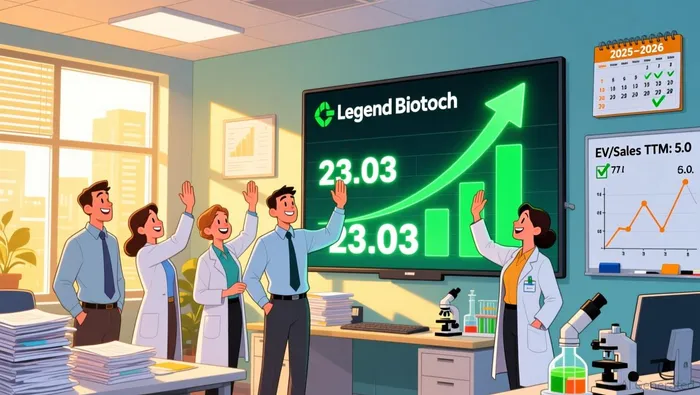
The market's skepticism is written in the stock's chart. Legend Biotech trades at $23.03, near its 52-week low of $20.21. The pain is recent and severe, with the share price down 44.63% over the past 120 days. This deep discount stands in stark contrast to the bullish consensus. The average analyst price target is $76.97, implying a premium of over 230% to the current price.
That $77 target translates into a specific valuation expectation. At that level, the market would assign an EV/Sales TTM of ~5.0. For context, the stock is currently trading at an EV/Sales multiple of about 5.0, but that valuation is attached to a company burning cash. The target requires the market to price in a future where CARVYKTI sales growth far outpaces the company's current losses. In other words, the $77 price embeds a powerful bet that the path to profitability, which analysts expect to begin in 2026, will be both rapid and credible.
This gap is the core of the high-risk, high-reward setup. The stock's collapse reflects a loss of confidence in that timeline. The upcoming J.P. Morgan presentation is the catalyst that could either validate the optimistic path or confirm the market's fears. The valuation disconnect is the opportunity-and the risk.
Business Fundamentals: CARVYTKI's Validation and Financial Reality
The bullish case rests on a single, validated product. CARVYTKI's commercial engine is firing. The therapy generated net trade sales of approximately $524 million in the third quarter, showing strong sequential growth. This momentum is backed by clinical durability, with recent CARTITUDE-4 data showing 80% of as-treated patients with standard-risk cytogenetics remained progression-free and off treatment at 30 months after a single infusion. The product has also gained regulatory validation, with label updates in both the U.S. and Europe to include overall survival benefit.
Yet the financial reality is stark. That revenue growth is being consumed by a massive commercialization cost. For the same quarter, the company posted a $125.82 million GAAP net loss. This high burn rate underscores the expensive path to profitability that analysts expect to begin in 2026. The business model is one of a high-growth, high-cost venture, where the market is betting that CARVYKTI's sales will eventually outpace these losses.
The bottom line is a company with a validated, market-leading therapy demonstrating impressive clinical durability and commercial traction. But that validation comes with a steep price tag, reflected in quarterly losses that are more than double the prior year's. The upcoming J.P. Morgan presentation will be the test of whether management can convince investors that the path from this financial reality to the promised profitability is both feasible and imminent.
Near-Term Catalysts and Risk/Reward Setup
The setup hinges on a few specific events and metrics that will validate or undermine the bullish thesis. The immediate catalyst is the J.P. Morgan presentation on January 14th. Management's ability to articulate a clear, credible path to CARVYKTI profitability by year-end and company-wide profitability in 2026 will be the primary test. Any deviation from that timeline, or lack of detail on how it will be achieved, could trigger a sharp re-rating lower.
Beyond the event, investors must monitor two key data points. First, CARVYKTI sales growth in the fourth quarter and early 2026. The therapy's momentum is clear, with net trade sales of approximately $524 million in Q3. The market will look for signs of acceleration, not just maintenance, to support the valuation premium. Any deceleration would directly challenge the profitability timeline.
Second, watch for updates on the allogeneic CAR-T candidate LUCAR-G39D. The recent data showed promising first-in-human results in lymphoma, which is critical for the long-term pipeline. Positive clinical updates here could alleviate concerns about the company's future beyond CARVYKTI. Lack of progress would reinforce the single-product dependency risk.
The primary risk is execution. The stock's 120-day decline of 44.63% reflects persistent investor anxiety over the high burn rate and the steep commercialization costs needed to reach profitability. The company's $1 billion in cash provides a runway, but the market is betting that management can navigate this expensive path flawlessly. Any misstep in commercial execution or cost control could derail the 2026 target.
Weighing this against the potential reward: a successful J.P. Morgan presentation could close the valuation gap overnight, pushing the stock toward the $77 target. The risk/reward is asymmetric in the short term. The downside is the stock's deep discount and the high probability of continued volatility. The upside is a re-rating if management can convincingly bridge the gap between current losses and promised profitability. The event is the trigger; execution is the determinant.





Comentarios
Aún no hay comentarios