
Legence's Nasdaq Debut: A Cautionary Tale of Valuation Misalignment and Market Sentiment Risks
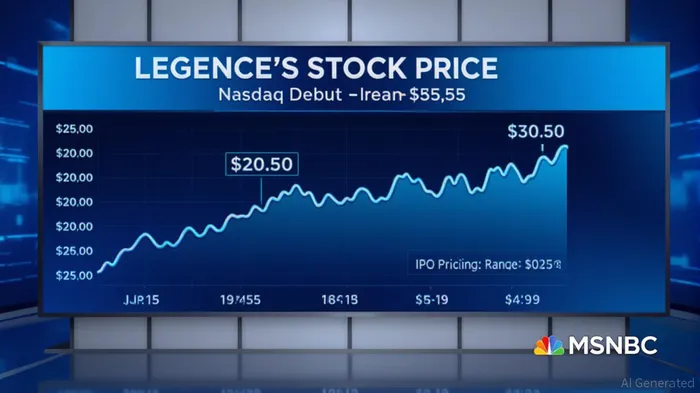
The recent Nasdaq debut of LegenceLGN--, a Blackstone-owned engineering and maintenance services firm, has sparked renewed debate about the risks of valuation misalignment in high-growth IPOs. Despite raising $728 million through the sale of 26 million shares priced at $28 apiece, the company's market capitalization of $3.2 billion at closing—nearly 10% above its pre-IPO range—has raised eyebrows among investors. This valuation, coupled with a widening net loss of $26.5 million on $1.1 billion in revenue for the first half of 2025, underscores a growing disconnect between market optimism and financial fundamentals [2].
Valuation Misalignment: A Recipe for Volatility
Legence's IPO pricing highlights a recurring theme in today's capital markets: the prioritization of growth narratives over profitability. While the company's revenue growth is commendable, its net loss nearly tripled compared to the same period in 2024 [2]. This divergence between top-line performance and bottom-line results is not uncommon in high-growth sectors, but it becomes problematic when market valuations fail to account for operational risks.
According to a report by Reuters, Legence's post-IPO valuation implies a price-to-revenue multiple of approximately 2.9x, significantly higher than the sector average of 1.8x for engineering and maintenance firms [2]. Such a premium is typically justified by robust margins or clear paths to profitability, neither of which Legence currently demonstrates. The company's reliance on BlackstoneBX-- for strategic direction—Blackstone retains 74% of the voting power post-IPO—further complicates its ability to pivot independently in response to market pressures [2].
Market Sentiment: The Double-Edged Sword
The stock's volatile debut—trading below the IPO price before closing at $30.50—exposes the fragility of investor sentiment in speculative IPOs. While the rebound suggests short-term optimism, it also reflects the influence of institutional underwriters and the company's controlling stakeholder. Goldman SachsGS-- and JefferiesJEF--, the lead book-running managers, likely played a role in stabilizing the price through greenshoe mechanisms, but such interventions mask underlying demand dynamics [2].
Market sentiment risks are amplified by Legence's business model. Engineering and maintenance services are inherently cyclical, with margins sensitive to macroeconomic shifts and client spending patterns. Yet the IPO's pricing assumes a level of resilience that may not hold if broader economic conditions deteriorate. As stated by a Bloomberg analyst, “High-growth IPOs often trade on future expectations, but when those expectations clash with reality, the correction can be swift and severe” [1].
Broader Implications for High-Growth IPOs
Legence's case is emblematic of a broader trend: the increasing prevalence of IPOs priced on speculative narratives rather than proven financial metrics. While Blackstone's backing provides a veneer of credibility, it also raises questions about the independence of corporate governance and the alignment of interests between private equity sponsors and public market investors.
For investors, the key takeaway is the need for rigorous due diligence. High valuations in IPOs often reflect market enthusiasm for growth potential, but they also create a “valuation cliff” if earnings fail to materialize. Legence's post-IPO performance will serve as a litmus test for whether the market can distinguish between sustainable growth and overhyped hype.
In conclusion, Legence's Nasdaq debut offers a cautionary tale for investors navigating the high-growth IPO landscape. While the company's engineering expertise and Blackstone's backing are assets, the valuation misalignment and market sentiment risks highlight the perils of relying on optimism over fundamentals. As the stock settles into its new public identity, all eyes will be on whether it can deliver on its growth promises—or become another casualty of the IPO bubble.





Comentarios
Aún no hay comentarios