
Legal Risks in Cryptocurrency Assets: Navigating Regulatory and Judicial Uncertainty in 2025
The Florida Bitcoin Case: A Cautionary Tale for Key Management
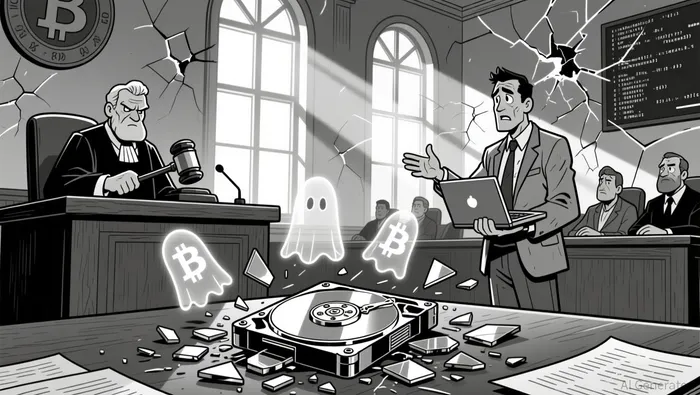
In 2025, the Eleventh Circuit Court of Appeals upheld the dismissal of Michael Prime's lawsuit, rejecting his claim to recover Bitcoin stored on a government-destroyed hard drive. The court ruled that Prime's years-long delay in asserting ownership and his repeated denials of significant cryptocurrency holdings prejudiced the government's ability to respond fairly, according to the appeals court ruling. This decision reinforces the legal principle that digital asset claims must be timely and transparent, with courts applying traditional legal standards like Rule 41(g) to cryptocurrency cases.
The case also exposed a critical operational risk: the permanent loss of private keys. Experts estimate that 11% to 18% of Bitcoin's total supply is irretrievably lost due to misplaced or destroyed keys, the article estimated. For investors, this underscores the necessity of robust key management practices, including secure backups and multi-signature wallets, to mitigate irreversible loss.
Regulatory Uncertainty and the Valuation of Crypto Assets
The Florida case is emblematic of a broader trend: regulatory and judicial uncertainty is directly impacting crypto asset valuation models. In 2025, courts and regulators continue to grapple with how to classify digital assets under existing frameworks. The SEC's aggressive application of the Howey Test to determine whether tokens qualify as securities has created a patchwork of rulings. For instance, in SEC v. Ripple Labs, Inc., a district court ruled that institutional XRP sales constituted securities, while retail sales did not, as noted in a Goodwin Law update. This nuanced approach complicates valuation models, as the regulatory status of a token can shift based on transaction context.
Meanwhile, legislative efforts like the GENIUS Act-clarifying that fiat-backed stablecoins are not securities-have introduced pockets of stability, the Goodwin update noted. However, the absence of a unified regulatory framework means that asset valuations remain volatile. For example, centralized exchanges face higher liability risks under securities laws compared to decentralized platforms, which rely on automated smart contracts Crypto Class Action Key Decisions and Trends in 2025. This distinction forces investors to weigh regulatory exposure when allocating capital.
Strategic Adaptations for Investors
Investors navigating this landscape are adopting strategies to mitigate legal and regulatory risks. Diversification across compliant projects is a priority, with a focus on tokens and platforms that align with emerging regulations. For instance, the rise of institutional-grade custodial solutions and tokenized traditional assets-facilitated by regulatory clarity in the U.S. and EU-offers new avenues for portfolio diversification, as discussed in a State Street preview.
Additionally, investors are prioritizing decentralization as a buffer against regulatory shifts. Decentralized exchanges (DEXs) and DeFi protocols, which operate without centralized intermediaries, are less vulnerable to regulatory overreach. However, this comes with trade-offs, as seen in Blockchain Association v. IRS, where the Treasury's broad "broker" reporting rules for DeFi participants are being challenged as impractical, the Goodwin update observed.
Proactive compliance is another key adaptation. With the SEC intensifying enforcement actions for fraud and market manipulation, investors are investing in robust compliance systems, including enhanced transaction monitoring and staff training, as recommended in a Hogan Lovells guide. This is particularly critical as private litigation rises, with plaintiffs' firms pursuing claims based on alleged securities law violations.
Conclusion
The Florida Bitcoin lawsuit and broader 2025 litigation trends illustrate that legal and regulatory risks are no longer peripheral concerns in crypto investing-they are central to asset valuation and strategy. As courts and regulators continue to define the boundaries of digital asset governance, investors must remain agile, prioritizing transparency, compliance, and diversification. The path forward will require balancing innovation with caution, as the crypto market evolves under the weight of judicial scrutiny and regulatory experimentation.







Comentarios
Aún no hay comentarios