
Legal Risk as a Catalyst for Institutional Interest in Undervalued Crypto Tokens
The crypto market's evolution in 2023–2025 has been defined by a paradox: legal risks, once a deterrent for institutional investors, have increasingly become a catalyst for strategic allocations into undervalued digital assets. As class-action lawsuits and regulatory battles reshaped the landscape, they inadvertently created opportunities for institutional players to capitalize on mispriced tokens, leveraging legal clarity as a signal of long-term viability.
The Surge in Litigation and Its Dual Impact
From 2023 to 2025, class-action lawsuits targeting emerging crypto tokens surged, with six new cases filed in the first half of 2025 alone-nearly matching the total for 2024, according to the Institutional Crypto Risk Management Statistics 2025. These lawsuits, often alleging unregistered securities sales or misleading disclosures, initially heightened volatility and reputational risks for defendants. For example, CoinbaseCOIN-- faced litigation over bankruptcy risks and data breaches, while Ripple's XRPXRP-- token was embroiled in a five-year SEC battle, as detailed in a Coinotag analysis. However, the resolution of these cases-particularly the dismissal of high-profile suits against Coinbase, Kraken, and Ripple-signaled a regulatory pivot toward clarity rather than punitive enforcement, according to the Goodwin litigation update. This shift, driven by the Trump administration's pro-crypto agenda and the appointment of SEC Chair Paul Atkins, transformed legal uncertainty into a framework for institutional confidence, as noted in Katten's Crypto in the Courts.
Legal Clarity as a Market Signal
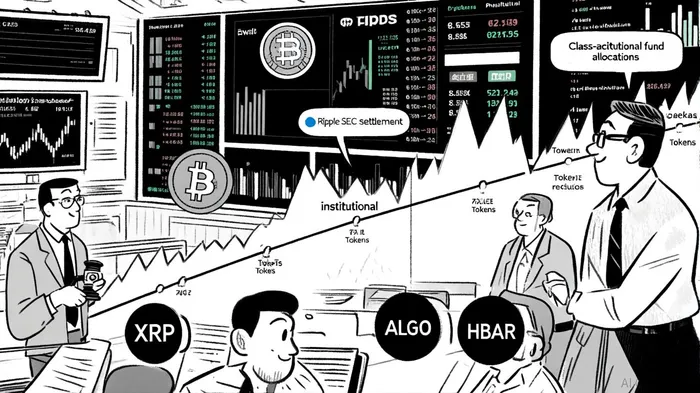
The August 2025 settlement of the SEC v. Ripple Labs case exemplifies how legal outcomes can unlock institutional interest. By reclassifying XRP as a non-security in secondary markets, the ruling removed a critical barrier to adoption. This clarity enabled the launch of the first U.S.-listed spot XRP ETF, REX-Osprey XRPR, which attracted $1.2 billion in assets under management within months. Similarly, the dismissal of the SEC's case against Coinbase in 2025 reinforced the idea that secondary market transactions might not fall under securities law, encouraging firms like Fidelity and BlackRock to expand their crypto offerings.
Institutional investors, recognizing these signals, began reallocating capital to tokens previously deemed too risky. For instance, AlgorandALGO-- (ALGO) and HederaHBAR-- (HBAR) gained traction post-2025 as their regulatory profiles solidified. Hedera's HBARHBAR--, which the SEC never classified as a security, saw a spot ETF application filed by Nasdaq, triggering a 6% price surge, according to a Binance analysis. Meanwhile, Algorand's partnerships with entities like FIFA and the Italian government highlighted its utility in enterprise blockchain applications, attracting institutional inflows despite short-term price declines.
The Role of Risk Management Frameworks
Institutional adoption was further enabled by advancements in risk management. By 2025, 68% of global institutional investors had formal crypto risk frameworks, and 65% of insurers required proof of such frameworks before offering coverage (see Institutional Crypto Risk Management Statistics 2025). These measures mitigated exposure to litigation-driven volatility, allowing investors to target undervalued tokens with greater precision. For example, the dismissal of the SEC's case against Kraken led to a 15% increase in institutional trading volume on the platform, as custodians like Coinbase and Gemini resumed XRP support, as discussed in the Katten piece.
Data-Driven Opportunities
The interplay between legal outcomes and institutional allocations is best illustrated by the XRP ETF phenomenon. Post-settlement, 11 additional XRP ETF applications were pending, with analysts projecting $5 million to $400 million in initial inflows, according to Katten. This surge underscores how litigation resolution can transform a token's perceived risk profile, turning it into an asset class with institutional-grade appeal.
Conclusion: Legal Risk as a Strategic Lever
The 2023–2025 period demonstrates that legal risks, when resolved constructively, can act as a lever for institutional capital. By creating clarity around regulatory boundaries, lawsuits and their outcomes have enabled investors to identify undervalued tokens with strong fundamentals. As the market matures, the ability to navigate legal uncertainty-rather than avoid it-will become a defining trait of successful crypto strategies.





Comentarios
Aún no hay comentarios