
Legal and Regulatory Barriers to Prediction Market Growth: Assessing Long-Term Investment Risks and Opportunities
Prediction markets, which allow participants to speculate on the outcomes of future events, have emerged as a transformative fintech innovation. However, their growth is increasingly constrained by a fragmented and evolving regulatory landscape. For investors, understanding the legal and regulatory barriers-and the opportunities they create-is critical to navigating this space.
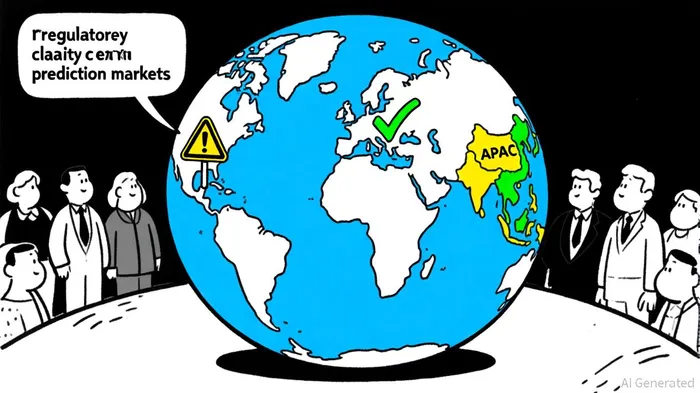
The U.S.: A Legal Crossroads
The U.S. remains a pivotal but uncertain market for prediction platforms. The Supreme Court's impending decision on the legal classification of prediction markets could redefine their regulatory status, determining whether they fall under securities laws, gambling statutes, or a new category altogether [1]. This ambiguity has led to a patchwork of state-level actions, with regulators like the Commodity Futures Trading Commission (CFTC) promoting innovation through self-certification while states such as New York and California issue cease-and-desist orders against platforms like Kalshi and Polymarket, citing unauthorized sports betting concerns [2].
Taxation further complicates the landscape. If prediction markets are classified as gambling, operators could face dual federal and state tax obligations, eroding profit margins [4]. Meanwhile, decentralized platforms leveraging blockchain technology face scrutiny over market integrity, as seen in a recent dispute over a Trump-Ukraine mineral deal contract, which highlighted the need for robust governance mechanisms [3].
The EU: Regulatory Clarity and Compliance Challenges
The EU's Markets in Crypto-Assets (MiCA) regulation, enforceable since late 2024, has created a harmonized framework for blockchain platforms but introduced stringent compliance hurdles. Under MiCA, crypto-asset service providers (CASPs) must obtain a single EU-wide license, maintain capital thresholds (€50,000–€150,000), and adhere to cybersecurity and transparency requirements [4]. While this has spurred innovation-55 European banks now offer crypto services-smaller firms face existential risks, with 75% of pre-2025 virtual asset service providers (VASPs) struggling to meet MiCA's demands [3].
Decentralized finance (DeFi) platforms, however, remain in a gray area. Fully decentralized services are exempt from MiCA, but partially decentralized models face restrictions, leading to a 16% decline in DeFi usage in the EU [2]. Conversely, stablecoin transactions have surged by 28%, benefiting from MiCA's clear 1:1 reserve requirements [4]. For investors, the EU's regulatory clarity has attracted €1.2 billion in venture capital for MiCA-compliant startups in early 2025, signaling a shift toward institutional adoption [2].
APAC: Innovation Amid Fragmentation
In the Asia-Pacific region, regulatory approaches vary widely. Japan's Payment Services Act (PSA) and Financial Instruments and Exchange Act (FIEA) have evolved to accommodate blockchain-based prediction markets, with the Financial Services Agency (FSA) proposing a new license for "Crypto-Asset Intermediary Service Providers" to support non-custodial platforms [6]. Meanwhile, Singapore's Monetary Authority (MAS) has positioned the city-state as a crypto hub through initiatives like Project Ubin and a legal framework for stablecoin issuance under the Payment Services Act (PSA) [5].
Hong Kong's 2024 licensing regime for virtual asset service providers (VASPs) and its retail crypto trading authorization reflect a cautious embrace of innovation [6]. In contrast, India's central bank maintains a restrictive stance, enforcing AML requirements while avoiding direct bans on crypto exchanges [6]. These divergent approaches create both risks and opportunities: while fragmented regulations complicate cross-border operations, they also allow agile firms to capitalize on favorable jurisdictions.
Investment Risks: Navigating Legal Uncertainty
The primary risks for investors lie in regulatory ambiguity and enforcement volatility. In the U.S., the Supreme Court's decision could either unlock a $100 billion market or trigger a regulatory crackdown. Similarly, MiCA's compliance costs-estimated at €150,000 for CASPs-pose a barrier to entry for smaller players [4]. In APAC, enforcement actions against unlicensed platforms, as seen in India and Thailand, underscore the need for rigorous due diligence [3].
Market fragmentation further complicates investment strategies. For instance, Singapore's regulatory sandbox programs contrast sharply with Japan's evolving license requirements, creating a patchwork of compliance demands for global operators [5][6].
Opportunities: Innovation in Compliant Markets
Despite these challenges, regulatory clarity in the EU and APAC has spurred growth. Singapore's "European passport" model under MiCA enables cross-border scalability, while Japan's Web3 White Paper highlights blockchain's role in national economic strategy [5][6]. Stablecoin adoption, driven by MiCA's reserve requirements, has also created a $1.2 trillion market opportunity in the EU [4].
Investors should prioritize jurisdictions with proactive regulatory frameworks, such as Singapore and Japan, where innovation is balanced with oversight. Additionally, platforms integrating AI-driven fraud detection-critical in combating synthetic fraud and deepfake threats-stand to benefit from APAC's focus on digital security [4].
Conclusion
Prediction markets sit at the intersection of fintech and regulatory evolution. While legal barriers remain significant, they also create opportunities for firms that align with emerging frameworks. Investors must weigh the risks of regulatory shifts against the potential rewards of early adoption in compliant markets. As the Supreme Court deliberates in the U.S. and MiCA's effects crystallize in the EU, the next 12–18 months will be pivotal in determining whether prediction markets become the next frontier of financial innovation-or another casualty of regulatory overreach.







Comentarios
Aún no hay comentarios