
The Legal and Practical Risks of Holding Unsecured Cryptocurrency
The Cost of Key Management Failures
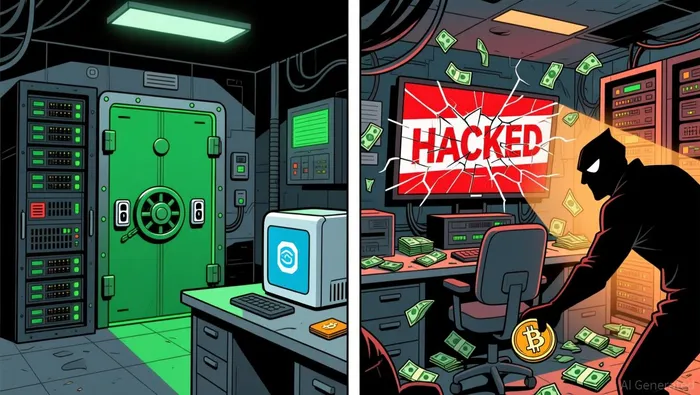
The most glaring risks stem from inadequate cryptographic key management. In June 2025, the DPRK's $1.5 billion hack of ByBit became the largest single incident in crypto history, with 69% of stolen funds traced to institutional accounts, according to the Chainalysis mid-year update. This breach, executed through sophisticated phishing and wallet compromise techniques, exposed vulnerabilities in hot wallets and multi-signature systems. Similarly, the U.S. Department of Justice fined OKX and BitMEX $604 million combined in 2025 for failing to maintain effective anti-money laundering (AML) programs, directly linking these penalties to poor key custody practices, as reported in a Fenergo report.
In response, KuCoin partnered with Cactus Custody to offer institutional-grade solutions. By enabling off-exchange settlements via cold storage and multi-signature wallets, KuCoin reduced counterparty risk and improved capital efficiency for large-scale clients. Wendy Jiang of Cactus Custody emphasized that such integrations "combine institutional-grade security with operational efficiency," a critical step in mitigating risks from unsecured holdings.
Legal Documentation Deficiencies and Enforcement Trends
Legal documentation gaps have also drawn regulatory scrutiny. The SEC's shift toward "back to basics" enforcement in 2025-focusing on fraud, misrepresentation, and accountability-has intensified penalties for institutions lacking transparent records. For example, a Singapore-based exchange was fined $18 million in 2023 for AML violations, and U.S. penalties for crypto non-compliance surpassed $5.1 billion in 2024, with 83% tied to AML/KYC deficiencies, according to the Gibson Dunn update.
High-profile cases like SEC v. Ripple Labs and SEC v. Coinbase further illustrate the legal stakes. The SEC's argument that XRPXRP-- and other tokens constitute unregistered securities under the Howey testTST-- has forced institutions to reevaluate their documentation practices, as the Katten review explains. Meanwhile, the DOJ's prosecution of Celsius Network executives for operating a Ponzi-like scheme-where $4.3 billion in deposits were misused-highlights the consequences of opaque record-keeping, a point underscored in Gibson Dunn updates.
Regulatory Evolution and Institutional Adaptation
Regulators are tightening the screws. The SEC's newly formed Crypto Task Force and Cyber and Emerging Technologies Unit (CETU) have prioritized proactive oversight, dismissing retroactive enforcement actions while emphasizing rule-based compliance, as noted in the Gibson Dunn update. In parallel, Hong Kong and Singapore are expanding institutional access to crypto products, but only for entities that demonstrate adherence to foundational security networks, according to a Lookonchain report.
Institutional custodians are adapting rapidly. Ripple-backed Evernorth Holdings, for instance, has accumulated over 473 million XRP tokens through a publicly traded treasury vehicle, ensuring regulated access and transparency, as reported in a Bitcoin.com post. Such models may set precedents for how institutions balance innovation with compliance.
Conclusion: A Call for Proactive Risk Mitigation
The lessons from 2023–2025 are clear: institutional investors must prioritize cryptographic key management and legal documentation to avoid catastrophic losses and regulatory penalties. As Galaxy Digital revised its BitcoinBTC-- price target downward to $120,000 in 2025-citing slowed institutional absorption and leveraged liquidations-the sector's stability now hinges on addressing these foundational risks, according to a Coinotag report.
For institutions, the path forward lies in adopting advanced custodial solutions, AI-driven risk assessments, and proactive legal frameworks. The cost of inaction, as recent cases demonstrate, is not just financial but existential.





Comentarios
Aún no hay comentarios