
The Legal and Market Implications of the Tornado Cash Case for Privacy-Focused Crypto Projects
The Tornado CashTORN-- case has become a watershed moment for privacy-focused crypto projects, reshaping the legal and regulatory landscape for decentralized, open-source financial tools. As the U.S. Department of the Treasury withdrew sanctions against Tornado Cash in March 2025 following a landmark Fifth Circuit Court of Appeals ruling, the case exposed critical vulnerabilities in traditional regulatory frameworks and forced the industry to grapple with the unique challenges of governing decentralized systems. For investors, the implications are profound: the future viability of privacy-centric protocols hinges on their ability to navigate evolving legal risks while innovating within a fragmented global regulatory environment.
Legal Implications: A New Frontier for Decentralized Systems
The core legal question in the Tornado Cash case revolved around whether immutableIMX-- smart contracts could be classified as "property" under the International Emergency Economic Powers Act (IEEPA). The Fifth Circuit's November 2024 ruling declared that OFAC had overstepped its authority, emphasizing that smart contracts-once deployed-cannot be owned or controlled by any individual or entity. This decision marked a significant limitation on regulatory agencies' ability to sanction decentralized protocols, particularly those lacking a centralized operator.
Meanwhile, the criminal trial of Tornado Cash co-founder Roman Storm in August 2025 underscored the ambiguity of developer liability. While a jury convicted Storm of conspiracy to operate an unlicensed money transmitting business, it deadlocked on more severe charges of money laundering and sanctions violations. The mixed verdict highlighted the difficulty of applying traditional financial regulations to decentralized platforms, where intent and control are inherently diffuse. For privacy-focused projects, this signals a critical risk: developers may face criminal exposure for enabling misuse of their tools, even if they lack direct involvement in illicit activities.
Market Reactions: Sanctions, Resilience, and the Limits of Enforcement
The market response to Tornado Cash's sanctions in 2022 was immediate and severe, with transaction volumes and user diversity plummeting across major blockchains like EthereumETH-- and BNBBNB-- Smart Chain. However, the decentralized and immutable nature of the platform limited the long-term effectiveness of regulatory intervention. When sanctions were lifted in March 2025, activity partially rebounded, but the platform's core functionality had already been altered by the regulatory pressure.
Studies by the Swiss National Bank and the Federal Reserve Bank of New York further revealed the mixed efficacy of sanctions. While transaction volumes initially dropped, net flows into Tornado Cash's smart contracts eventually recovered and even exceeded pre-sanction levels for most pools. At the settlement layer, the evidence of cooperation was inconsistent, with a shrinking number of actors processing transactions-a trend that raises concerns about the sustainability of censorship resistance in decentralized systems.
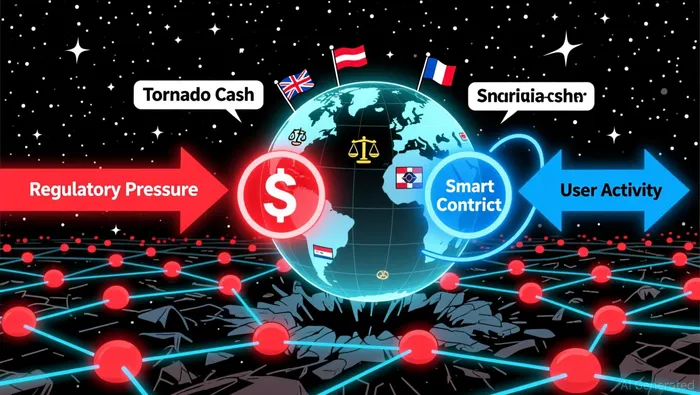
Regulatory Risk Frameworks: From Enforcement to Structured Compliance
The Tornado Cash case has accelerated the evolution of regulatory risk frameworks for decentralized technologies. In 2025, the U.S. introduced the GENIUS Act, imposing strict reserve requirements and transparency standards for stablecoins, indirectly influencing privacy-focused protocols to adopt institutional-grade compliance measures. Similarly, the European Union's Markets in Crypto-Assets (MiCA) and Digital Operational Resilience Act (DORA) regimes emphasized accountability and operational resilience, requiring crypto service providers to operate through identifiable, authorized entities.
Jurisdictional shifts have also become a key adaptation strategy. Privacy projects are increasingly relocating to regulatory hubs like Hong Kong and the UAE, where selective clarity attracts institutional players while enforcing AML/KYC and tax transparency measures. These jurisdictions offer a middle ground: they prioritize innovation under enforceable rules, allowing privacy tools to operate within structured frameworks rather than in regulatory ambiguity.
Future Viability: Innovation Amidst Uncertainty
Privacy-focused crypto projects are now pivoting toward technologies that balance privacy with regulatory expectations. One emerging solution is Privacy Pools, which differ from earlier anonymity tools like Tornado Cash by offering privacy protections while aligning with compliance standards. Additionally, tokenization and DeFi integration are enabling institutional-grade compliance frameworks, attracting conservative capital and fostering interoperability with traditional financial systems.
Geographic segmentation and third-party audits are also gaining traction as risk-mitigation strategies. Projects are adopting localized compliance measures to navigate aggressive enforcement regimes in the U.S. and EU, while leveraging regulatory convergence in other regions as highlighted in recent analyses. Meanwhile, high-profile court cases like SEC v. Ripple Labs and SEC v. Coinbase are expected to clarify how securities laws apply to digital assets, potentially reshaping compliance strategies for privacy projects.
Conclusion: Navigating the New Normal
For investors, the Tornado Cash case underscores a critical reality: the future of privacy-focused crypto projects depends on their ability to innovate within a rapidly evolving regulatory landscape. While the Fifth Circuit's ruling limited OFAC's authority over decentralized systems, it also exposed the legal risks faced by developers and operators. The path forward requires a delicate balance-leveraging technological advancements to enhance privacy while proactively aligning with structured compliance frameworks.
As global regulators continue to refine their approaches, privacy projects must remain adaptable. Those that succeed will be the ones that embrace jurisdictional agility, adopt institutional-grade compliance, and innovate in ways that align with both user privacy and regulatory expectations. In this new era, the most resilient projects will not only survive but thrive, proving that privacy and compliance can coexist in the decentralized financial ecosystem.






Comentarios
Aún no hay comentarios