
The Legal and Market Implications of the Pump.fun Lawsuit on Solana and Meme Coin Ecosystems
The Pump.fun lawsuit, a landmark case filed in 2025, has cast a long shadow over the SolanaSOL-- blockchain and its memeMEME-- coin ecosystem. This class-action litigation, now presided over by Judge Colleen McMahon, alleges a coordinated scheme involving Pump.fun, Solana Labs, and Jito Labs to exploit maximal extractable value (MEV) practices, resulting in estimated losses of $4 to $5.5 billion for retail investors. The case, which includes over 5,000 private chat logs as evidence of collusion, has not only intensified regulatory scrutiny but also triggered a reevaluation of the long-term viability of Solana-based meme coin platforms.
Legal Allegations and Market Manipulation
At the heart of the lawsuit is the accusation that Solana's high-speed blockchain infrastructure, combined with tools developed by Jito Labs, enabled insiders to front-run trades during meme coin launches. Plaintiffs argue that these practices violated the Securities Act of 1933, RICO laws, and money transmission regulations. The top 10 holders of the PUMP token, for instance, control approximately 70% of the circulating supply, a concentration that critics claim facilitates price manipulation and undermines fair trading.
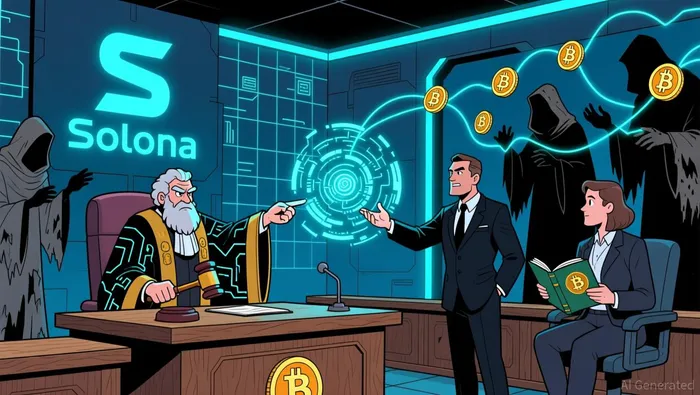
The legal theory hinges on the argument that Solana's proof-of-history and proof-of-stake mechanisms, while designed for efficiency, inadvertently created opportunities for validators and insiders to access launch data milliseconds ahead of retail traders. This has led to comparisons with traditional financial markets, where such practices would be deemed securities fraud. As one legal expert notes, "The case could redefine how courts interpret MEV in the context of securities law, potentially setting a precedent for future enforcement actions."
Market Reactions and Investor Behavior
The lawsuit has already triggered a shift in investor behavior. Following the filing of the case, the PUMP token dropped by 39.3%, while traders migrated to alternative platforms like BONKBONK--.fun. The latter's market capitalization nearly doubled to $241 million within 24 hours of the lawsuit's announcement, illustrating the fragility of the Solana meme coin ecosystem. By mid-2026, Pump.fun still generated $50 million in daily transaction volume, but the broader memecoinMEME-- sector had lost 65% of its value since its December 2024 peak, reflecting widespread disillusionment.
This exodus highlights a critical vulnerability: while Solana's infrastructure democratizes token creation, it also fosters speculative behavior and high volatility. Over 98.6% of tokens launched on Pump.fun have failed to retain value, a statistic that underscores the ecosystem's reliance on hype rather than sustainable utility.
Regulatory Scrutiny and Future Implications
Regulators have taken note. The U.S. Securities and Exchange Commission (SEC) has signaled a potential tightening of rules around MEV practices, particularly if courts find evidence of market rigging. While the SEC has not yet issued specific enforcement actions targeting Solana in Q4 2025, its focus on investor protection and fraud-related cases suggests a shift toward targeted enforcement. This could lead to stricter validator rules, mandatory KYC checks, or even the shutdown of platforms deemed to facilitate unfair trading.
The legal outcome also has broader implications for the classification of memecoins under securities law. While most memecoins currently avoid the Howey test's criteria, the case could prompt regulators to scrutinize tokens with unique features that resemble investment contracts. This uncertainty may deter institutional participation, further limiting the ecosystem's growth potential.
Expert Analysis and Long-Term Viability
Experts remain divided on the future of Solana's meme coin ecosystem. On one hand, the platform's accessibility has enabled millions to create and trade tokens with minimal barriers. On the other, the high failure rate and legal risks pose existential challenges. As one analyst observes, "The ecosystem is a high-risk, high-reward environment. If courts rule against Pump.fun, it could force a reckoning with transparency and fairness."
The sustainability of alternatives like BONK.fun remains unproven. While its short-term success demonstrates demand for alternatives, long-term viability will depend on whether these platforms can avoid the same pitfalls of concentration and manipulation.
Conclusion
The Pump.fun lawsuit represents a pivotal moment for Solana and the broader meme coin market. Legally, it tests the boundaries of securities law in the context of blockchain innovation. Market-wise, it has exposed structural weaknesses in an ecosystem built on speculative fervor. For investors, the case underscores the need for caution: while Solana's speed and scalability remain appealing, the legal and regulatory risks could reshape the landscape in 2026 and beyond. The outcome of this litigation-and its regulatory aftermath-will likely determine whether the Solana meme coin ecosystem evolves into a legitimate asset class or collapses under the weight of its own volatility.






Comentarios
Aún no hay comentarios