
The Legal and Market Implications of Costco's Tariff Refund Lawsuit
The legal and economic landscape of U.S. trade policy is undergoing a pivotal test as Costco Wholesale Corp.COST-- challenges the Trump administration's global tariff regime. This lawsuit, filed in the U.S. Court of International Trade, seeks to clarify whether businesses will be entitled to refunds if the Supreme Court ultimately rules the tariffs unlawful. For investors, the case underscores the risks and opportunities inherent in a shifting trade policy environment, where legal outcomes can reshape corporate earnings, market dynamics, and global supply chains.
Legal Uncertainty and Corporate Strategy
Costco's legal action centers on the uncertainty surrounding refund eligibility under the International Emergency Economic Powers Act (IEEPA), which the Trump administration used to justify tariffs on imported goods. The company argues that the U.S. Customs and Border Protection's denial of its request to extend tariff determination timelines threatens its ability to secure full refunds if the tariffs are invalidated. This uncertainty is not unique to Costco; a growing coalition of businesses has joined similar suits, questioning the executive branch's authority to impose such tariffs unilaterally.
The Supreme Court's fast-tracked hearing on November 5, 2025, has intensified scrutiny of the legal foundations of these tariffs. Prediction markets now assign only a 24% probability of the tariffs being upheld, reflecting skepticism among legal scholars and investors about their constitutionality. If the Court rules against the administration, it could curtail future presidents' ability to invoke emergency powers for tariff imposition, fundamentally altering the legal architecture of U.S. trade policy.
Market Implications: Clarity vs. Volatility
Historical precedents suggest that tariff-related legal outcomes often trigger short-term market volatility but eventually lead to stabilization. For instance, when the U.S. imposed tariffs on solar panels and washing machines, affected sectors experienced sharp declines-9% and 5–7%, respectively-before partially recovering as companies adapted by shifting production to tariff-exempt regions according to historical data. Similarly, the "Liberation Day" tariffs under the 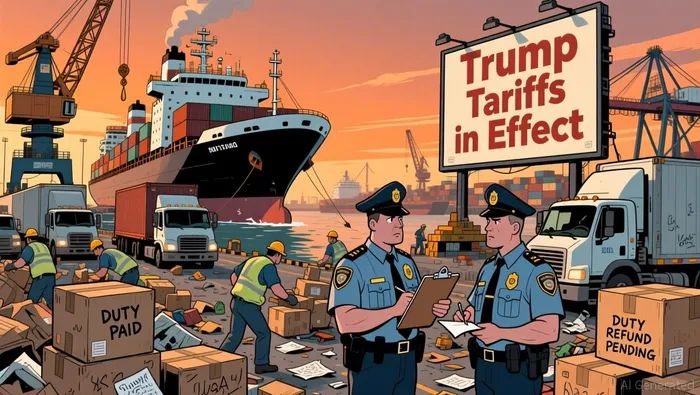 Trump administration disrupted global supply chains, raising input costs for retailers like Walmart and Amazon.
The potential invalidation of Trump's tariffs could create a "windfall" for corporations through refunds, particularly for companies like CostcoCOST-- that have paid significant duties. However, such outcomes may also introduce temporary volatility as markets adjust to new legal clarity. Analysts note that much of the uncertainty has already been priced into equity indices, with the S&P 500 rebounding 36% in 2025 after an initial 20% drop amid tariff-related fears. This suggests that while short-term jitters are possible, long-term market impacts may be muted.
Investment Strategies in a Shifting Landscape
Investors navigating this environment must balance risk mitigation with strategic opportunities. Defensive sectors have historically outperformed in prolonged tariff regimes, as they are less exposed to supply chain disruptions. Conversely, trade-sensitive industries like technology and manufacturing face heightened volatility, necessitating diversification and hedging strategies.
Corporate adaptation is another critical factor. Costco, for example, has proactively reduced supplier numbers and increased local sourcing to mitigate tariff risks. Such strategies reflect broader trends among businesses recalibrating supply chains to avoid overreliance on U.S. trade policies. Investors should monitor companies that demonstrate agility in reshaping operations, as these firms are better positioned to weather legal and economic uncertainties.
The Road Ahead
The Supreme Court's decision will likely serve as a litmus test for the durability of executive power in trade policy. If the tariffs are struck down, the ruling could prompt a wave of refund claims and reshape corporate financial reporting. Conversely, an upholding of the tariffs would reinforce the executive branch's authority but may invite further legal challenges and retaliatory measures from trading partners according to market analysts.
For investors, the key takeaway is the importance of resilience. As noted by Morgan Stanley, sectors like software, cybersecurity, and defense tech-less affected by tariffs-may benefit from AI-driven momentum and regulatory tailwinds according to Morgan Stanley research. Meanwhile, asset allocators may favor gold, long-term bonds, and hedge funds to hedge against geopolitical risks according to research findings.
In conclusion, Costco's lawsuit highlights the interplay between legal uncertainty and market dynamics in a rapidly evolving trade policy landscape. While the Supreme Court's ruling will provide critical clarity, investors must remain vigilant in assessing both the risks and rewards of a world where trade policies are increasingly subject to judicial and political scrutiny.







Comentarios
Aún no hay comentarios