
The Legal and Investment Risks of Emerging Prediction Markets
The rise of prediction markets has introduced a new frontier in financial innovation, blending speculative trading with event-based forecasting. However, this nascent sector is fraught with legal and investment risks, driven by regulatory fragmentation and market instability. As platforms like Kalshi and Polymarket navigate a patchwork of federal and state laws, investors must grapple with the dual threats of regulatory overreach and volatile market dynamics.
U.S. Regulatory Scrutiny: A Legal Minefield
The U.S. regulatory landscape for prediction markets is a battleground between federal oversight and state-level gambling laws. While the Commodity Futures Trading Commission (CFTC) classifies these markets as derivatives under federal jurisdiction, states like New York and Connecticut have aggressively challenged this framework. New York's ORACLE Act, introduced in late 2025, seeks to prohibit sports-related and event-based prediction markets, framing them as unlicensed gambling operations. Similarly, Connecticut regulators issued cease-and-desist letters to Robinhood, Kalshi, and Crypto.com, arguing that their platforms violate state gaming laws.
Legal precedents further complicate the matter. In Nevada, a federal judge reversed an earlier ruling that had allowed Kalshi to operate sports betting lines, stating the platform must comply with state gaming regulations. Maryland courts similarly denied Kalshi's preemption argument, asserting that state laws apply. These conflicting rulings highlight a critical risk: the lack of a unified legal framework leaves operators vulnerable to jurisdictional arbitrage and sudden regulatory shifts.
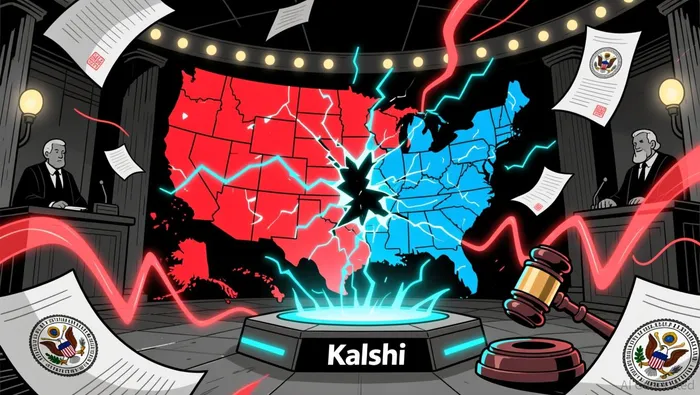
The tension between federal and state authorities also raises the specter of a U.S. Supreme Court showdown. If lower courts continue to diverge, the Supreme Court may be forced to resolve whether the Commodity Exchange Act (CEA) preempts state gambling laws-a decision that could redefine the sector's viability. For now, investors face a fragmented environment where platforms may be legal in one state and illegal in another.
UK and EU Regulatory Developments: Indirect but Looming
While the UK and EU have not yet introduced direct regulations for prediction markets, broader financial reforms signal potential future risks. The UK's Financial Conduct Authority (FCA) is modernizing its regulatory approach, emphasizing digital tools and streamlined authorizations. However, its focus on market integrity and anti-money laundering (AML) controls in private markets could indirectly impact prediction platforms. The FCA's consultation on a market abuse regime for cryptoassets (MARC) and admissions and disclosures (A&D) also hints at a tightening regulatory perimeter.
In the EU, the Markets in Crypto-Assets Regulation (MiCA), which took effect in late 2024, mandates transparency and consumer protection for digital financial instruments. Though MiCA does not explicitly address prediction markets, its emphasis on operational resilience and AML compliance may shape future EU approaches. The Digital Operational Resilience Act (DORA) further underscores the region's focus on systemic risk mitigation, which could extend to event-based trading platforms.
Market Instability: Legal Uncertainty and Behavioral Risks
Regulatory ambiguity has already triggered market instability. Kalshi's legal setbacks in Nevada and Maryland created uncertainty that dampened investor confidence. The platform's initial legal victories in New Jersey had spurred institutional interest, with firms like Interactive Brokers and FanDuel entering the space. However, subsequent rulings have forced operators to reassess their business models, with some delaying expansion plans.
Liquidity risks are compounded by behavioral biases. Retail traders, drawn to the novelty of prediction markets, often exhibit herd behavior and overconfidence, amplifying volatility. For example, contracts tied to viral events or misinformation can experience rapid price swings, complicating surveillance for manipulation. The integration of prediction market data into mainstream platforms like Google Finance further normalizes speculative trading, potentially attracting risk-averse investors unaware of the sector's instability.
Investment Implications and the Path Forward
For investors, the risks are twofold: regulatory overreach and market volatility. The U.S. legal battles underscore the danger of sudden policy shifts, while the UK/EU's indirect regulatory focus highlights the potential for future compliance burdens. Liquidity risks, meanwhile, are exacerbated by the lack of standardized frameworks and the influence of behavioral biases.
The path forward requires a balance between innovation and oversight. Congressional intervention in the U.S. could clarify the sector's legal status, but political polarization makes this unlikely in the near term. In the absence of federal clarity, investors must adopt a cautious approach, prioritizing platforms with robust legal defenses and diversified geographic exposure.
As prediction markets evolve, their success will hinge on achieving regulatory harmony and investor trust. Until then, the sector remains a high-risk, high-reward proposition-one where legal and market instability are as much a part of the equation as the events being predicted.







Comentarios
Aún no hay comentarios