
Legal & General's Strategic Reinvention: A Blueprint for Long-Term Value Creation in a Shifting Financial Landscape
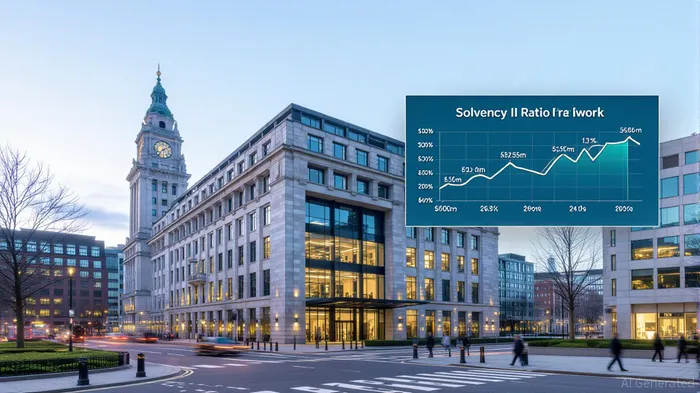
In the ever-evolving world of finance, companies that thrive are those that adapt with both foresight and precision. Legal & General (L&G) has emerged as a case study in strategic reinvention, leveraging its 2025 transformation to position itself as a leader in sustainable growth and shareholder value creation. With a Solvency II ratio of 217% as of H1 2025, a robust capital return framework, and a clear focus on core businesses, L&G is demonstrating how disciplined execution can align financial resilience with long-term ambition.
The Strategic Core: Simplification and Synergy
L&G's 2025 strategy is anchored in three pillars: Institutional Retirement, Asset Management, and Retail. By consolidating its investment arms—merging Legal & General Investment Management (LGIM) and Legal & General Capital (LGC) into a unified Asset Management division—the company is creating a scalable, international platform capable of navigating both public and private markets. This integration is not merely operational but philosophical: it reflects a commitment to delivering complex, responsible investment solutions that cater to the evolving demands of institutional and retail clients alike.
The partnership with BlackstoneBX--, a $465 billion credit powerhouse, further amplifies this ambition. By combining L&G's $122.5 billion annuities book with Blackstone's private credit expertise, the collaboration aims to unlock hybrid investment products that bridge the gap between traditional and alternative assets. For investors, this signals a strategic pivot toward high-growth, fee-based income streams, which are less volatile than asset valuation swings.
Solvency and Stability: A Buffer Against Uncertainty
L&G's financial health is a cornerstone of its long-term value proposition. The company's Solvency II ratio of 217% (as of June 30, 2025) provides a significant buffer against macroeconomic headwinds, including rising interest rates and geopolitical volatility. This ratio, calculated by dividing Available Capital Resources (ACR) by Solvency Capital Requirement (SCR), underscores L&G's ability to absorb shocks while maintaining its commitments to policyholders and shareholders.
Moreover, L&G's capital generation of £729 million in H1 2025—a 3% increase year-over-year—highlights its disciplined capital allocation. This strength is critical in a sector where liquidity and leverage can quickly erode trust. By maintaining a low debt profile and prioritizing long-dated, low-correlation assets (such as affordable housing and infrastructure), L&G is insulating itself from the short-term volatility that plagues many peers.
Capital Returns: A Shareholder-Focused Framework
L&G's capital return framework is as ambitious as it is methodical. The company has committed to returning over £5 billion to shareholders over the next three years, with £500 million in share buybacks already announced for 2025. This aligns with a broader strategy to return 40% of its total market valuation to shareholders, a move that signals confidence in its evolving business model.
Dividend growth is equally structured. A 5% increase in 2024 dividends was followed by a target of 2% annual growth from H1 2025 onward. This predictability is a boon for income-focused investors, who value consistency in an unpredictable market. The company's recent £20.34p dividend and £200 million buyback in 2024 further reinforce its commitment to balancing reinvestment in core businesses with direct returns to shareholders.
The Road Ahead: Risks and Rewards
While L&G's strategy is compelling, it is not without risks. The integration of LGIM and LGC, as well as the Blackstone partnership, requires seamless execution. Additionally, private market liquidity and interest rate sensitivity remain near-term challenges. However, the company's strong solvency position and diversified earnings base provide a buffer against these risks.
For investors, the key question is whether L&G's transformation can sustain its current trajectory. The answer lies in its ability to execute its cost-cutting initiatives, expand fee-based income, and maintain its Solvency II buffer. If successful, L&G could achieve its 2028 targets of £500–600 million in operating profit, with 70–75% of Asset Management earnings derived from fees.
Investment Implications
Legal & General's strategic transformation and capital return framework present a compelling case for long-term value creation. Its focus on simplification, disciplined capital allocation, and shareholder returns aligns with the principles of sustainable growth. For investors seeking a balance between income and capital appreciation, L&G offers a rare combination of stability and ambition.
However, prudence is warranted. Investors should monitor the company's progress in integrating its core businesses, the performance of its Blackstone partnership, and its ability to maintain its Solvency II ratio amid macroeconomic shifts. Those who believe in the power of strategic reinvention—and the discipline to execute it—may find L&G's journey a rewarding one.
In the end, Legal & General's story is not just about numbers. It's about a company redefining its role in a world where financial institutionsFISI-- must serve both shareholders and society. And in that duality, it may yet find its greatest strength.





Comentarios
Aún no hay comentarios