
Legal Clarity as a Catalyst for Institutional Investment in Asia-Pacific Crypto Markets
The Asia-Pacific (APAC) crypto markets have emerged as a beacon of recovery and institutional adoption in 2025, driven by a wave of regulatory clarity that has transformed legal uncertainty into investor confidence. As global crypto markets grapple with macroeconomic volatility and geopolitical tensions, APAC's proactive regulatory frameworks-particularly in Hong Kong, Singapore, Japan, and South Korea-have positioned the region as a hub for institutional capital. This analysis explores how these developments are catalyzing market rebounds and unlocking new investment opportunities.
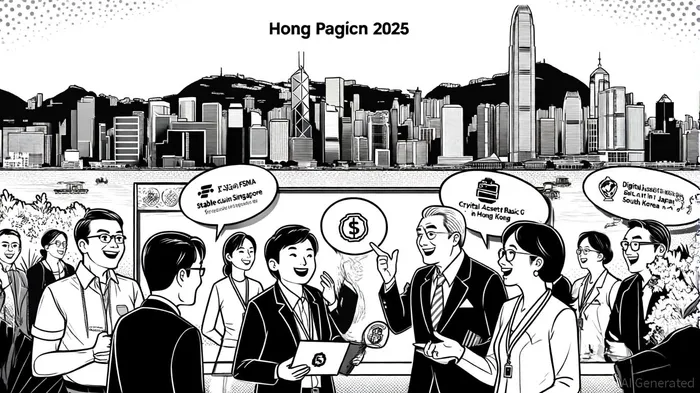
Regulatory Frameworks: From Ambiguity to Attraction
In 2025, APAC regulators prioritized creating structured environments to attract institutional players. Hong Kong's stablecoin licensing regime, effective August 2025, exemplifies this shift. By requiring stablecoin issuers to obtain licenses under the Virtual Asset Service Provider (VASP) framework, the city aims to attract global giants like Ant Group and Standard Chartered, ensuring compliance while fostering innovation, according to the Asia Crypto Regulation Review. Similarly, Singapore's expansion of the Financial Services and Markets Act (FSMA) to include overseas clients has enforced reserve requirements for stablecoins and prohibited promotional incentives for retail investors, reinforcing institutional trust, the review noted.
Japan's introduction of a licensing category for crypto-asset brokerages and its allowance of low-risk asset reserves for stablecoins have further solidified its reputation as a mature market, the review added. Meanwhile, South Korea's proposed Digital Asset Basic Act (DABA) seeks to legalize spot crypto ETFs and establish licensing regimes for stablecoin issuers, addressing gaps in secondary market trading and distribution. These reforms collectively signal a commitment to balancing innovation with accountability, a critical factor for institutional entry.
Institutional Investment Flows: Metrics of Recovery
The impact of these regulatory shifts is evident in institutional investment trends. Japan's on-chain value received surged by 120% year-on-year through June 2025, driven by yen-backed stablecoins and regulatory clarity, according to a Blockchain.News report. South Korea's stablecoin trading volumes reached $59 billion in the same period, reflecting growing use cases for liquidity and hedging. India, already a crypto adoption leader, saw its on-chain transaction volumes peak at $244 billion in December 2024, fueled by grassroots adoption and fintech integration (as noted in the Asia Crypto Regulation Review).
Singapore and Hong Kong have leveraged their regulatory rigor to attract institutional capital. Singapore's Project Guardian and Hong Kong's digital bond issuances are integrating tokenization and crypto liquidity into traditional finance, while frameworks for KRW-backed stablecoins in South Korea and Japan highlight the region's structural demand for digital assets, according to APAC's Crypto Adoption. By Q2 2025, APAC's total crypto market capitalization had rebounded to $3.28 trillion, with Bitcoin's dominance rising to 64% as institutional allocations shifted toward blue-chip assets, according to the H1 2025 Crypto Market Report.
Market Recovery: Sentiment and Structural Shifts
Despite macroeconomic headwinds, APAC's Fear & Greed Index fluctuated between 40 and 65 in H1 2025, indicating cautious optimismOP-- (per the H1 2025 Crypto Market Report). This resilience is underpinned by structural demand shifts, including tokenized equity pilots, staking programs, and crypto custody services, which have been facilitated by APAC's regulatory guardrails (as discussed in the Asia Crypto Regulation Review). For instance, Hong Kong's exploration of DAO recognition models and Singapore's emphasis on high compliance standards have attracted institutional allocations to tokenized assets and DeFi protocols, according to Regulatory Shifts in Crypto.
Global regulatory benchmarks, such as the U.S. GENIUS Act and Europe's MiCA, have also influenced APAC's approach, creating harmonized frameworks that reduce ambiguity for cross-border investors. This alignment has spurred a 69% year-on-year increase in APAC's total crypto trading volume, reaching $2.36 trillion by mid-2025 (reported by Blockchain.News).
Challenges and Future Outlook
While APAC's progress is notable, challenges remain. Interoperability between diverging regulatory regimes-such as Hong Kong's stablecoin rules versus South Korea's KRW-backed frameworks-could hinder seamless market integration (as noted in APAC's Crypto Adoption). Additionally, institutional concerns around reputational risk and cybersecurity persist, requiring continued innovation in compliance tools and infrastructure (the APAC's Crypto Adoption analysis also highlights these points).
Looking ahead, the four-year BitcoinBTC-- halving cycle and the maturation of APAC's regulatory ecosystems will likely drive further institutional entry. Countries that prioritize clear, adaptive frameworks-while addressing gaps in secondary market trading and distribution-will capture the lion's share of this capital.
Conclusion
The Asia-Pacific region's regulatory clarity has become a linchpin for crypto recovery and institutional adoption. By transforming legal ambiguity into structured frameworks, markets like Hong Kong, Singapore, Japan, and South Korea have attracted billions in institutional capital, driving on-chain growth and market resilience. As global crypto markets navigate uncertainty, APAC's approach offers a blueprint for balancing innovation with accountability-a critical factor for sustained recovery and long-term investment success.






Comentarios
Aún no hay comentarios