
Leadership Transitions and Shareholder Impact at Fidelity D & D Bancorp
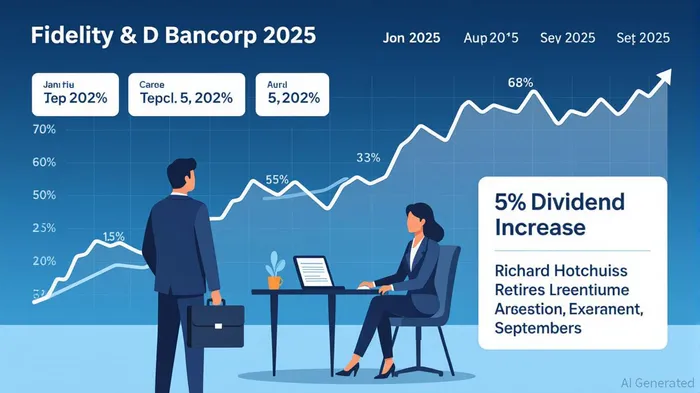
Leadership transitions at regional banks often spark investor scrutiny, as governance continuity directly impacts strategic execution and risk management. At Fidelity D & D Bancorp (FDBC), recent changes—including the retirement of Director Richard Hotchkiss on September 16, 2025[1]—have raised questions about institutional memory and board stability. However, a closer look at the company's governance structure, financial performance, and shareholder communication reveals a nuanced picture of resilience and confidence.
Governance Continuity: A Mixed Bag
Hotchkiss's departure marks the end of a 25-year banking career, during which he played pivotal roles in FDBC's post-2020 merger integration and credit administration[1]. His retirement, coupled with Kristin O'Donnell's exit in 2023[3], underscores a deliberate shift in board composition. Yet, FDBC's leadership core remains intact. Daniel J. Santaniello, CEO since 2010, and other executives like CFO Salvatore DeFrancesco and Chief Credit Officer Michael Pacyna Jr., continue to steer operations[2]. This continuity mitigates risks of operational disruption, a critical factor for regional banks reliant on localized expertise.
The board's governance framework further bolsters stability. A dedicated Information Technology Steering Committee oversees cybersecurity—a top priority in financial services—and aligns with FFIEC and NIST standards[4]. The Chief Information Security Officer's direct reporting line to the SVP and General Counsel ensures rapid risk mitigation, a feature that could reassure investors wary of digital threats[4].
Financial Performance: A Tailwind for Investor Confidence
Despite leadership changes, FDBC's financials have remained robust. In Q1 2025, net income surged 19% year-over-year to $5.99 million, driven by a 28% profit margin[5]. The company also announced a 5% dividend increase in January 2025, signaling confidence in its capital position. These results, combined with a 10-year streak of dividend growth, highlight a disciplined approach to shareholder returns.
Historically, FDBC's dividend announcements have shown a modest positive impact. A backtest of dividend events from 2022 to 2025 reveals a median 5-day return of +0.95% with a 60% win rate, though the effect tends to fade after 20 days.
Stock valuation metrics, however, tell a more complex story. FDBC's P/E ratio of 11.58 trails both the finance sector and broader market averages[5], suggesting undervaluation. Yet, the stock has declined 2.7% over the past year, trading at $47.49 as of September 2025[5]. This modest drop may reflect broader market conditions rather than governance concerns, as short interest in FDBCFDBC-- has fallen by 9.13% recently[5], indicating improving sentiment.
Insider Dynamics and Institutional Ownership
Insider ownership at FDBC remains significant, with insiders holding 21% of shares compared to 20.05% institutional ownership[5]. While this concentration could imply alignment with long-term stakeholders, it also raises questions. Insiders sold $39,390 worth of shares in the three months preceding Hotchkiss's retirement, versus $12,430 in purchases[5]. Such activity, though not uncommon, may test investor trust in management's commitment to shareholder value.
Strategic Resilience and Future Outlook
FDBC's strategic focus on community engagement and credit growth appears to insulate it from volatility. In 2024, the company reported $2.6 billion in assets, up from $2.4 billion in 2023[3], while net interest income climbed to $61.9 million[3]. These trends, paired with a strong cybersecurity posture, position FDBC to weather macroeconomic headwinds. Santaniello's emphasis on “healthy credit metrics” and expense management[5] further reinforces this narrative.
Conclusion: Balancing Risks and Rewards
Leadership transitions at FDBC, while notable, have not derailed its trajectory. The company's governance continuity, financial discipline, and strategic focus on cybersecurity and community banking provide a solid foundation for investor confidence. However, the lack of new board appointments to replace departed directors and insider selling warrant cautious optimism. For investors, FDBC's undervalued P/E ratio and strong dividend yield (3.37%)[5] present compelling opportunities, provided the board prioritizes transparent succession planning and stakeholder alignment in the coming months.





Comentarios
Aún no hay comentarios