
Leadership Transitions at Lundin Gold: Management Continuity and Equity Valuation Dynamics
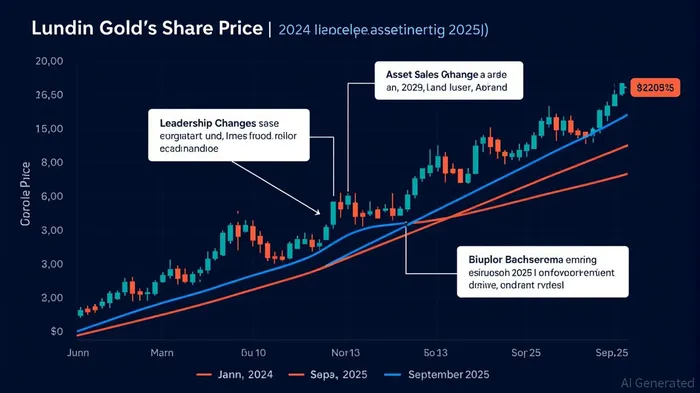
In the volatile landscape of the global mining sector, leadership transitions often serve as pivotal catalysts for equity valuation shifts. For Lundin Gold (LUG), the 2024–2025 period has been marked by strategic realignments, executive appointments, and asset divestments, all of which intersect with broader industry dynamics tied to the energy transition. This analysis examines how these leadership changes and continuity strategies have influenced investor sentiment, stock price volatility, and long-term equity valuations.
Leadership Transitions and Strategic Realignments
Lundin Gold's recent leadership changes underscore a deliberate effort to align governance with evolving market demands. The appointment of Victoria McMillan to the Board of Directors in February 2025[2] brought a wealth of financial expertise, particularly in mining-sector capital management, following the retirement of Juliana Lam. Concurrently, Ian Gibbs assumed the role of CEO, signaling a transition from Adam Lundin's long-standing leadership[1]. These moves occurred amid significant operational developments, including the expansion of mineralization at Trancaloma and the discovery of a copper-gold porphyry system at Sandia[1].
The strategic sale of Neves-Corvo and Zinkgruvan to Boliden for $1.6 billion[3] further illustrates a shift toward consolidating high-potential assets while divesting older, carbon-intensive operations. Such decisions align with a broader industry trend of restructuring portfolios to prioritize materials critical to the energy transition, such as copper[4].
Investor Confidence and Stock Price Volatility
Lundin Gold's equity valuation has experienced pronounced swings, reflecting both optimism and caution. Over the past year, the stock surged by 182.27%, reaching a 52-week high of CA$662.00[1]. However, this growth was not linear. In early 2024, the stock faced a 21% undervaluation period following price declines[1], raising questions about short-term volatility.
Investor confidence appears tied to management continuity and insider activity. For instance, the chairman's CA$24 million stock purchase in January 2025[1] and the president's CA$485,000 acquisition in March[1] signaled strong executive backing. Conversely, insider selling by the CFO and other executives[1] introduced uncertainty, highlighting the dual-edged nature of leadership dynamics.
The September 2025 US$0.79 per share dividend[1] represents a key component of Lundin Gold's shareholder return strategy. However, historical data from dividend announcements since 2022 reveals a mixed picture. A backtest of LUG's performance around dividend events shows that, on average, the stock underperformed its benchmark by approximately 3.5 percentage points over a 30-day holding period, with win rates declining to as low as 20% by day 10[5]. This suggests that while dividends may stabilize valuations in theory, their historical impact on LUG has been neutral to negative for short-term holders.
Strategic Shifts and Industry Trends
The energy transition has amplified demand for copper, a key focus for Lundin Mining (LUN), the parent company. Its joint venture with BHPBHP-- on the Filo del Sol copper project[2] exemplifies this pivot. While Lundin Gold remains gold-centric, the broader Lundin Group's emphasis on copper underscores a sector-wide realignment. This interplay between gold and copper equities complicates valuation models but reflects a coherent long-term strategy.
Lundin Gold's dividend policy also plays a role in stabilizing valuations. The September 2025 US$0.79 per share payout[1] and Lundin Mining's CAD$0.09 quarterly dividend[4] demonstrate a commitment to shareholder returns, which can mitigate volatility during leadership transitions.
Conclusion
Leadership continuity at Lundin Gold, marked by strategic appointments and asset reallocations, has both stabilized and challenged equity valuations. While insider confidence and dividend policies provide a floor for investor trust, the sector's inherent volatility and the energy transition's demands create headwinds. For investors, the key lies in balancing short-term fluctuations with long-term strategic clarity. As the mining sector continues to evolve, Lundin Gold's ability to maintain governance stability while adapting to market shifts will remain critical to its valuation trajectory.







Comentarios
Aún no hay comentarios