
Leadership Transition at Ryan Specialty Group: Strategic Implications for Shareholder Value and Operational Continuity
Leadership Transition at Ryan SpecialtyRYAN-- Group: Strategic Implications for Shareholder Value and Operational Continuity
The recent leadership transition at RyanRYAN-- Specialty Group has sparked significant interest among investors and analysts, as the company restructures its executive team to align with its strategic goals of sustainable growth and operational efficiency. On October 8, 2025, Ryan Specialty announced the appointment of Steve Keogh and Brendan Mulshine as Co‑Presidents, splitting the role into Chief Operating Officer (COO) and Chief Revenue Officer (CRO) positions, according to an FT Markets release. This move marks a departure from the single President model led by Jeremiah Bickham, who will transition to a strategic advisor role until January 1, 2026. The reorganization underscores the company's commitment to balancing operational rigor with revenue innovation, a strategy that could have profound implications for shareholder value and long-term stability.
Strategic Rationale: Operational Efficiency and Revenue Synergy
The decision to split the President role reflects Ryan Specialty's focus on addressing two critical pillars of growth: operational efficiency and revenue generation. Steve Keogh, who joined the company in May 2025, brings over 30 years of insurance experience, including leadership roles at Aon, and his appointment as COO signals a prioritization of streamlining internal processes, reducing costs, and enhancing integration of recent acquisitions. Meanwhile, Brendan Mulshine, a 13‑year Ryan Specialty veteran, assumes the CRO role, leveraging his expertise to drive organic growth and expand the company's market share in the excess and surplus (E&S) insurance sector.
This dual leadership structure is designed to mitigate the risks of siloed decision‑making. By separating operational and revenue responsibilities, Ryan Specialty aims to foster cross‑functional collaboration while maintaining clear accountability. According to a Panabee report, the reorganization is part of a broader strategy to achieve a 15% organic revenue growth rate in 2025 and integrate two or more firms to bolster specialty capabilities. The company also plans to consolidate systems and reduce processing times, which could yield synergy‑driven margin improvements, as the Panabee report details.
Shareholder Value: Margin Expansion and Digital Innovation
Ryan Specialty's leadership transition is closely tied to its financial objectives, particularly the goal of increasing Adjusted EBITDAC margins by 150 basis points through cost discipline and integration synergies, as previously reported by Panabee. Analysts have highlighted the potential for margin expansion as a key driver of shareholder value. For instance, Morgan Stanley recently lowered its price target for RYAN to $65.00 from $68.00 but maintained an "Overweight" rating, citing the company's focus on operational efficiency, according to a MarketBeat forecast. Meanwhile, the average price target among 12 analysts stands at $73.42, implying a 26.69% upside from the current stock price of $57.95, per the MarketBeat data.
The company's investment in digital innovation further strengthens its value proposition. Ryan Specialty plans to launch a centralized data platform and deploy AI‑powered tools to enhance underwriting and claims processing, initiatives noted in the Panabee coverage. These initiatives align with broader industry trends toward data‑driven decision‑making and could position Ryan Specialty as a leader in the E&S market. A SWOT analysis cited by Panabee suggests the company's digital advantage is expected to differentiate it from competitors while reducing long‑term operational costs.
Operational Continuity: Talent Retention and Strategic Advisement
A critical concern during leadership transitions is the potential disruption to operational continuity. However, Ryan Specialty's approach appears to mitigate this risk. The FT Markets release emphasized Jeremiah Bickham's transition to a strategic advisor role until January 1, 2026, which helps ensure institutional knowledge remains accessible during the handover. This gradual transition period allows Keogh and Mulshine to build on existing frameworks without abrupt shifts in strategy.
Moreover, the company's strong employee retention rates and focus on talent development provide additional safeguards. Internal data cited in the Panabee analysis indicate Ryan Specialty has maintained a 90% retention rate among key personnel, a metric that bodes well for maintaining operational momentum. The leadership team's emphasis on innovation and growth also aligns with employee engagement, reducing the likelihood of attrition during the transition.
Market Reaction and Investor Sentiment
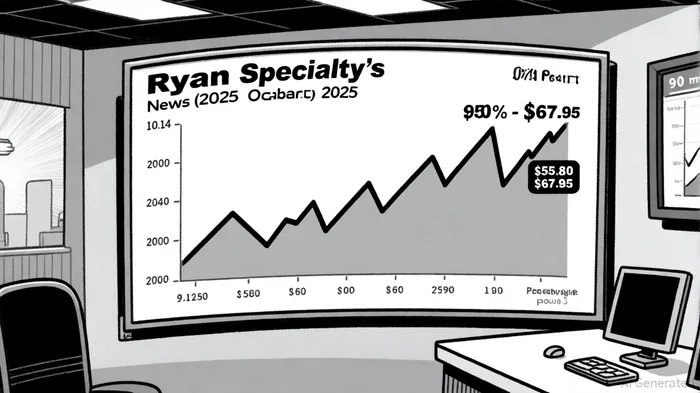
The market's response to the leadership change has been cautiously optimistic. On October 8, 2025, RYAN shares rose 0.14% to close at $58.29, outperforming broader market indices, according to a StocksTelegraph forecast. Analysts project a short‑term price increase of up to 6.79%, with the stock potentially reaching $62.54 by October 21, 2025, and for the 90‑day period RYAN is expected to trade between $55.80 and $67.95, with an average forecast of $60.50, per the StocksTelegraph projection.
Investor sentiment is overwhelmingly positive, with a sentiment score of 100 out of 100 on major investing forums, according to AltIndex sentiment. This score reflects a bullish consensus, driven by confidence in the new leadership's ability to execute on strategic priorities. Ryan Specialty also ranks in the 79th percentile compared to its industry peers, indicating superior sentiment relative to competitors, as the AltIndex data show.
Conclusion: A Calculated Bet on Growth
Ryan Specialty's leadership transition represents a calculated bet on operational efficiency and revenue innovation. By appointing two seasoned executives with complementary skill sets, the company is positioning itself to navigate macroeconomic risks while capitalizing on growth opportunities in the E&S market. The strategic emphasis on margin expansion, digital transformation, and talent retention further reinforces its long‑term value proposition.
For investors, the transition appears to be a positive catalyst. While short‑term volatility is always a possibility, the alignment of leadership with clear financial and operational goals suggests a strong foundation for sustainable growth. As Ryan Specialty moves forward, the success of this reorganization will ultimately hinge on its ability to execute on these strategic priorities-and deliver on the promise of enhanced shareholder value.





Comentarios
Aún no hay comentarios