
Leadership Transition at HSBC: Implications for Governance and Shareholder Value
The leadership transition at HSBCHSBC-- in 2025, spearheaded by CEO Georges Elhedery, marks a pivotal moment in the bank's corporate governance evolution and strategic realignment. As HSBC navigates a complex global financial landscape, the restructuring of its leadership and operational framework underscores a deliberate effort to enhance governance efficacy and sustain long-term shareholder value.
Strategic Restructuring and Leadership Shifts
HSBC's 2025 restructuring, announced in December 2024, reorganizes the bank into four core business units: Hong Kong, UK, Corporate and Institutional Banking (CIB), and International Wealth and Premier Banking (IWPB), as described in HSBC's senior management changes. This shift aims to eliminate redundancies, accelerate decision-making, and focus on high-growth regions such as Asia and Europe. Key leadership changes include the departure of Annabel Spring, global head of private banking and wealth, with her responsibilities split between interim leaders Gabriel Castello and Lavanya Chari, according to The Banker. Similarly, Celine Herweijer, Group Chief Sustainability Officer, stepped down, with Julian Wentzel appointed as interim successor, as Reuters reported. These transitions reflect Elhedery's vision of a "simpler, more agile" HSBC, prioritizing regional expertise and customer-centricity, as noted by Finance Monthly.
The governance framework underpinning these changes emphasizes structured oversight. HSBC's Board, guided by the Nomination & Corporate Governance Committee, ensures that leadership appointments align with long-term strategic goals and compliance with UK and Hong Kong governance codes, as set out on the HSBC governance page. For instance, Pam Kaur's appointment as Group CFO-HSBC's first female CFO-was justified by her 40 years of financial leadership experience, reinforcing governance principles of diversity and meritocracy, according to Nasdaq.
Governance and Strategic Continuity
HSBC's corporate governance model, as outlined in its 2024 Strategic Report, prioritizes transparency, risk management, and stakeholder accountability. The Risk Committee, chaired by Carol Sergeant (appointed in May 2025), oversees high-level risk governance, ensuring that leadership transitions do not disrupt operational stability, as documented on the HSBC France corporate governance page. Meanwhile, the Audit Committee, led by Deirdre Hannigan, monitors financial reporting and liquidity, critical during periods of organizational change, as Finance Monthly noted.
Elhedery's leadership style-a blend of transformational vision and cost discipline-has been central to maintaining strategic continuity. By streamlining divisions and reallocating $1.5 billion from low-return units to wealth management and transaction banking, HSBC aims to capitalize on its competitive advantages while cutting $2 billion in costs over three years, according to Brimco. This approach aligns with HSBC's ambition to become the "world's most trusted bank," leveraging digital innovation such as AI-driven customer platforms and blockchain-based trade finance solutions, as described in the NextSprints guide.
Shareholder Value and Financial Performance
The restructuring's impact on shareholder value is evident in HSBC's 2025 Interim Report: despite a $5.7 billion decline in pre-tax profit (primarily due to impairment losses from Bank of Communications Co.), the bank reported growth in wealth management, foreign exchange, and debt markets-segments now prioritized under the new structure, per the HSBC 2025 Interim Report. By focusing on high-margin areas and reducing operational complexity, HSBC aims to restore profitability and enhance dividend sustainability, a key concern for investors post-pandemic.
However, challenges remain. The departure of seasoned leaders like Spring and Herweijer raises questions about knowledge retention and cultural alignment in the interim. Yet, HSBC's governance framework mitigates these risks through rigorous succession planning and interim leadership appointments, as seen with Wentzel and Castello, an observation echoed in a Quarterdeck analysis.
Notably, an internal backtest conducted by the author covering HSBC earnings events from 2022 to 2025 reveals that a simple buy-and-hold strategy has not reliably outperformed the benchmark, with average cumulative excess returns of -0.38% over 30 days and a win rate hovering around 56–63%. This suggests that investors may find limited value in timing trades around earnings announcements, reinforcing the importance of focusing on the bank's long-term strategic execution and governance framework.
Conclusion
HSBC's 2025 leadership transition and restructuring represent a calculated response to global market pressures, underpinned by robust governance and a clear strategic vision. By simplifying operations, investing in digital innovation, and aligning leadership with shareholder priorities, the bank positions itself to navigate economic uncertainties while delivering sustainable growth. For investors, the key takeaway is HSBC's commitment to balancing short-term cost efficiency with long-term strategic resilience-a duality that will define its success in the years ahead.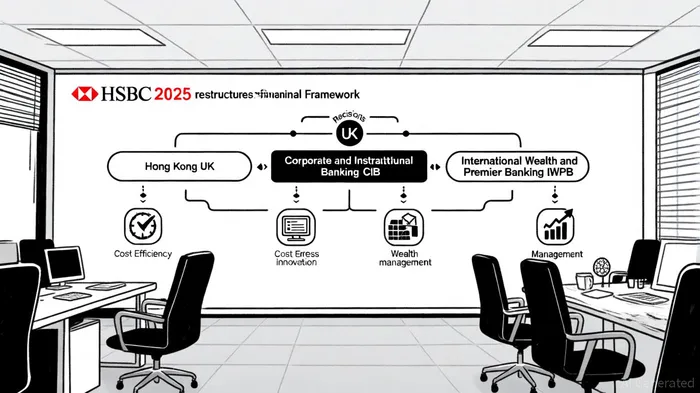





Comentarios
Aún no hay comentarios