
LBTC on Solana: A New Paradigm for Yield-Generating Bitcoin Exposure
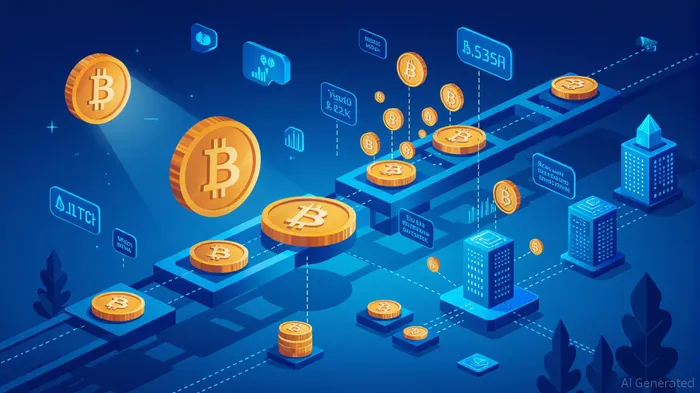
The integration of Lombard Finance’s yield-bearing BitcoinBTC-- token (LBTC) onto the SolanaSOL-- blockchain represents a pivotal shift in how investors and developers approach Bitcoin’s utility. By combining Bitcoin’s store-of-value properties with Solana’s high-performance infrastructure, LBTC unlocks a new era of cross-chain capital efficiency and composable DeFi strategies. This innovation addresses two critical pain points in the crypto market: Bitcoin’s historical lack of yield generation and the scalability limitations of traditional blockchain networks.
Solana’s High-Performance Infrastructure: The Foundation for LBTC’s Success
Solana’s technical architecture—rooted in its hybrid Proof of History (PoH) and Proof of Stake (PoS) consensus—enables it to process up to 65,000 transactions per second with sub-100ms finality and fees under $0.01 [1]. This performance is unmatched by EthereumETH-- or Bitcoin, making Solana an ideal host for LBTC’s yield-generating capabilities. For context, Ethereum’s Layer-2 solutions (e.g., Arbitrum, Optimism) struggle to match Solana’s throughput, while Bitcoin’s base layer remains ill-suited for frequent, low-cost transactions [2]. By anchoring LBTC on Solana, Lombard Finance leverages this infrastructure to create a seamless bridge between Bitcoin’s value and Solana’s DeFi ecosystem.
LBTC’s design further enhances capital efficiency. Fully backed by BTC and secured by a decentralized validator network of 14 institutions, LBTC allows users to stake Bitcoin and earn approximately 1% BTC-denominated yield while using the asset as collateral in protocols like Jupiter, Drift, and Kamino [3]. This dual utility—yield generation + liquidity provision—transforms Bitcoin from a passive asset into a productive capital vehicle. For example, a user could deposit LBTC into a Solana-based lending protocol to earn interest while simultaneously using the same token as collateral for leveraged trading. Such composability is a hallmark of Solana’s DeFi innovation.
Cross-Chain Innovation: Bridging Bitcoin’s Value with Solana’s Ecosystem
The LBTC-Solana integration is not merely a technical feat but a strategic leap in cross-chain interoperability. Lombard Finance’s use of LayerZero and RedStone Oracles ensures real-time proof of reserves and cross-chain asset transfers, mitigating risks like liquidity blackholes and oracleORCL-- manipulation [3]. This infrastructure also enables LBTC to interact with Solana’s thriving DeFi projects, such as Marinade Finance (staking derivatives) and STEPN (gaming), creating a flywheel effect for Bitcoin’s adoption in decentralized applications.
Moreover, Solana’s Nakamoto Coefficient of 20—a metric measuring decentralization by counting the minimum number of entities required to halt the network—suggests a robust validator ecosystem [4]. This contrasts with Bitcoin’s Nakamoto Coefficient of 14, highlighting Solana’s ability to balance scalability with decentralization. For LBTC, this means a secure, censorship-resistant environment where users can trust the network’s resilience.
Market Adoption and Competitive Positioning
While LBTC’s adoption metrics for Q2 2025 remain unspecified, the broader Solana ecosystem has demonstrated explosive growth. Solana’s Total Value Locked (TVL) in DeFi protocols surged to $2.5 billion in Q2 2025, with trading volume increasing by 30.54% quarter-over-quarter [5]. This trend positions LBTC to capture a significant share of Bitcoin’s $1.3 trillion market cap by enabling yield generation in a high-liquidity environment.
Comparatively, other DeFi platforms like ChainlinkLINK-- and SuiSUI-- have seen mixed results. Chainlink’s Total Value Secured (TVS) hit $89 billion in Q2 2025, but its focus on oracle services limits its ability to compete with Solana’s native asset composability [6]. Sui’s TVL peaked at $2.5 billion, yet its growth has been constrained by a less mature developer ecosystem. LBTC’s integration into Solana’s established DeFi infrastructure gives it a clear edge in attracting both retail and institutional capital.
Risks and Mitigations
Despite its promise, LBTC faces challenges. Centralization risks persist if liquidity becomes concentrated in a few nodes, as seen in the Lightning Network’s channel jamming vulnerabilities [7]. However, Solana’s validator diversity and Lombard’s decentralized validator network (14 institutions) reduce this risk. Additionally, smart contract flaws could expose LBTC to exploits, but Lombard’s use of RedStone Oracles and LayerZero’s cross-chain security mitigates this threat.
Conclusion: A Paradigm Shift in Bitcoin’s Utility
LBTC on Solana redefines Bitcoin’s role in the crypto economy. By enabling yield generation, composability, and cross-chain interoperability, it addresses Bitcoin’s long-standing limitations while leveraging Solana’s high-performance infrastructure. For investors, this represents a unique opportunity to combine Bitcoin’s value preservation with Solana’s innovation-driven growth. As the crypto market evolves, assets like LBTC will likely become cornerstones of a more efficient, interconnected financial system.
Source:
[1] Solana (SOL) In-Depth Research: An Emerging Power in the Blockchain Space [https://www.gate.com/learn/articles/solana-sol-in-depth-research-an-emerging-power-in-the-blockchain-space/7996]
[2] Lightning Network: Everything You Need To Know [https://hacken.io/discover/lightning-network/]
[3] LBTC Comes to Solana: Yield-Bearing Bitcoin Meets High Performance DeFi [https://www.lombard.finance/blog/lbtc-comes-to-solana-yield-bearing-bitcoin-meets-high-performance-de-fi/]
[4] Solana (SOL) Staking Insights and Analysis: First Half 2025 [https://everstake.one/crypto-reports/solana-staking-insights-and-analysis-first-half-of-2025]
[5] Sui Q2 2025 DeFi Roundup [https://blog.sui.io/q2-2025-defi-roundup/]
[6] Chainlink Quarterly Review: Q2 2025 [https://blog.chain.link/quarterly-review-q2-2025/]
[7] Bitcoin in a flash: An intro to the Bitcoin Lightning Network [https://www.cointracker.io/blog/lightning-network]







Comentarios
Aún no hay comentarios