
Layer-2 Scaling Solutions: The Key to 10x Returns in Cryptocurrencies by Mid-2026
The L2 Landscape: ZK-Rollups vs. Optimistic Rollups
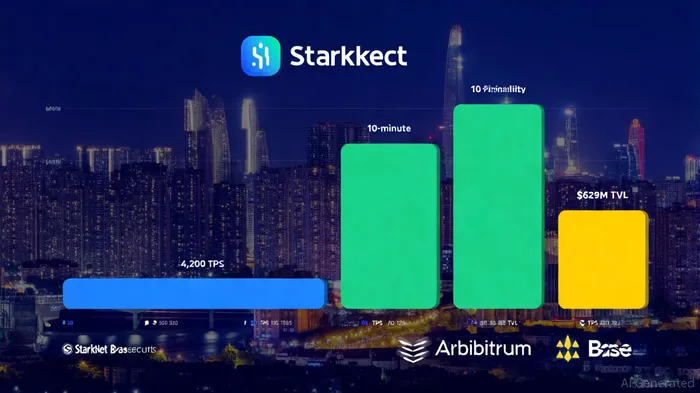
The L2 arms race is split between two dominant architectures: ZK-Rollups and Optimistic Rollups. ZK-Rollups, which use cryptographic proofs to validate transactions, offer faster finality (10–20 minutes) and stronger security guarantees, according to a Mitosis analysis. By mid-2026, ZK-Rollups are projected to capture 50–60% of the L2 market share, driven by projects like StarkNet and zkSync Era, per an ASAP Drew ranking. StarkNetSTRK--, for instance, processes 4,200 transactions per second (TPS) with finality in 10 minutes, per the Markaicode benchmark, while zkSyncZK-- Era's Hyperchains model enables customizable blockchains for DeFi and gaming, as detailed in a CABCD report (see below).
Optimistic Rollups, on the other hand, prioritize EVM compatibility and developer ease. Arbitrum and Base dominate this category, with Arbitrum's TVL reaching $20 billion and Base's retail-focused onboarding attracting 793,550 active users in Q1 2026, according to the Currency Analytics report. However, their reliance on 7-day fraud challenges for finality and centralized sequencers creates long-term risks, a point highlighted by the Mitosis analysis.
Network Effects and Adoption Metrics: The 10x Criteria
To identify projects with 10x potential, three metrics are critical: TVL growth, active user base, and transaction volume.
- TVL and Liquidity:
- Arbitrum remains the DeFi powerhouse, with $19 billion in TVS (Total Value Staked) and 1.13 million weekly active addresses, per the Markaicode benchmark. Its integration with UniswapUNI-- and AaveAAVE-- ensures sustained liquidity.
- Base, Coinbase's L2, leverages its parent company's fiat onramps to attract retail users, achieving $15 billion in TVL as reported by Currency Analytics. This retail-driven growth could accelerate as crypto adoption expands.
StarkNet and zkSync Era are closing the gap, with TVLs of $629 million and $800 million, respectively, according to the Markaicode data. Their focus on privacy and compute-heavy applications (e.g., NFT minting) positions them for niche dominance.
Transaction Volume and Cost Efficiency:
- EIP-4844 has reduced L2 fees to near-zero levels, with Base's simple transfers costing $0.005, a trend captured in the Markaicode benchmarks. This has driven 2.8 billion monthly transactions in Q2 2025, a 280% YoY increase, as detailed in the CABCD report.
Immutable X, a Validium (off-chain data storage), processes 9,000 TPS at $0.001 per NFT mint, according to the Markaicode data, making it ideal for gaming and NFTs. However, its security trade-offs limit broader adoption.
Validator Distribution and Decentralization:
- ZK-Rollups like Polygon zkEVM and StarkNet lead in validator distribution, offering decentralized governance, a point underscored by the Markaicode analysis. This reduces centralization risks compared to more centralized Validiums like ImmutableIMX-- X.
High-Potential Projects for 10x Returns
1. StarkNet (STRK):
StarkNet's Cairo VM and 4,200 TPS make it a top contender for DeFi and privacy-focused applications. With $629 million in TVL and a growing ecosystem of compute-intensive dApps, per the Markaicode benchmarks, STRK's tokenomics and StarkWare's enterprise partnerships (e.g., with MetaMask) suggest strong upside.
2. Base (ETH):
Backed by CoinbaseCOIN--, Base's retail onboarding and $15 billion TVL reported by Currency Analytics position it as a gateway for mainstream crypto adoption. Its integration with Coinbase's 100 million users creates a flywheel effect, making it a safe bet for 10x growth.
3. zkSync Era (ZK):
zkSync's Hyperchains model allows developers to create custom blockchains, targeting gaming and DeFi. With $800 million in TVL and partnerships like PancakeSwapCAKE-- noted in the Markaicode data, ZK's EVM compatibility and low fees could drive mass adoption.
4. Arbitrum (ARB):
Despite its 7-day finality, Arbitrum's $20 billion TVL and 750,000 daily active wallets, noted in the Currency Analytics report, make it a dominant force in DeFi. Its Superchain strategy and Coinbase's Base integration ensure long-term relevance.
Risks and Considerations
While ZK-Rollups are poised for growth, they face challenges in EVM compatibility and computational costs, as the Mitosis analysis explains. Optimistic Rollups, though mature, risk obsolescence if ZK-Rollups achieve full EVM parity. Validiums like Immutable X remain niche players, limited by security trade-offs.
Conclusion
The L2 race is a defining investment opportunity for 2026. Projects that balance scalability, security, and network effects-such as StarkNet, Base, and zkSync Era-offer the most compelling 10x potential. As Ethereum's roadmap aligns with ZK-Rollups and EIP-4844's benefits compound, early adopters who prioritize these metrics will likely reap outsized rewards.





Comentarios
Aún no hay comentarios