
Larsen & Toubro: Pioneering India's Renewable Energy Future with the Gandhisagar Pumped Storage Project
India's push toward net-zero emissions by 2070 hinges on scalable renewable infrastructure, and Larsen & Toubro (L&T) is at the forefront of this transition. The company's recent leadership in the Gandhisagar Pumped Storage Project (PSP)—a 1.9GW behemoth in Madhya Pradesh—underscores its strategic shift toward clean energy infrastructure. This project is not just an engineering marvel but a catalyst for L&T's growth in a sector poised for exponential demand. Let's dissect its significance, technical prowess, and implications for investors.
The Gandhisagar PSP: A Technical Masterstroke
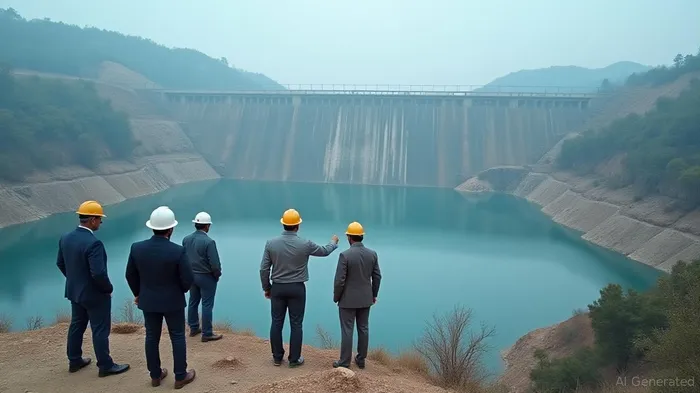
The Gandhisagar PSP, set to commission by 2025, is a testament to L&T's prowess in heavy civil infrastructure (HCI). The project leverages the existing Gandhisagar reservoir as its lower reservoir while constructing an upper reservoir 35 meters high, connected by 860-meter tailrace tunnels and 400kV transmission lines. Its storage capacity of 10,080 MWh (equivalent to six hours of power) enables it to deliver 11GWh daily—critical for stabilizing grids powered by intermittent solar and wind energy.
The technical complexity lies in integrating variable-speed Francis turbines (for both generation and pumping) and ensuring seamless power evacuation via indoor gas-insulated switchgear. This infrastructure isn't just a one-off project; it's a blueprint for India's 500GW renewable target by 2030. By 2025, the plant will generate over 8,000GWh annually, reducing reliance on fossilFOSL-- fuels and proving pumped hydro storage's viability in a fragmented grid.
Why L&T's Competitive Edge Matters
L&T's ability to execute such projects under tight timelines (30 months for Gandhisagar) is unmatched. The company's heavy civil segment—accounting for 38% of its revenue—has built a reputation for precision in high-stakes projects, from hydropower to nuclear facilities. Partnerships with global firms like ANDRITZ (supplier of electromechanical equipment) further cement its technical credibility.
Crucially, pumped hydro storage projects like Gandhisagar offer recurring revenue streams. Unlike solar or wind farms, which generate power only when conditions permit, pumped storage facilities can be cycled daily, earning revenue from both energy generation and grid stabilization services. This model aligns with L&T's shift toward EPC (engineering, procurement, and construction) contracts with embedded operational upside, a theme likely to dominate its growth pipeline.
Scalability in a Resilient Market
India's renewable energy ambitions are clear: Prime Minister Narendra Modi has set a target of 500GW renewable capacity by 2030, with pumped hydro storage forming a key pillar for grid stability. L&T's early dominance in this space—through projects like Gandhisagar—positions it to capture a disproportionate share of this demand.
Pumped hydro's scalability also outshines alternatives like lithium-ion batteries, which face material shortages and shorter lifespans. A 2024 report by Bridge To India estimates that India needs 150GW of storage capacity by 2030 to meet its renewable targets, creating a multi-billion-dollar opportunity for L&T.
Valuation: Premium for a Growth Story, But Risks Lurk
L&T's stock trades at a P/E of 35.59x, nearly triple the engineering sector's average of 12.24x. While this premium reflects investor optimism about its clean energy pivot, it's not without risks. The company's debt-to-equity ratio of 1.35 exceeds industry norms, raising concerns about financial flexibility.
However, L&T's profitability remains robust, with a 13.96% year-on-year net profit growth in Q4 2024. Analysts' strong buy consensus (13 Strong Buy, 13 Buy ratings) and a 12-month target of ₹3,886.20 (16.98% upside from current prices) suggest the market is pricing in long-term upside. The stock's current dip to ₹3,259.20—a 4.67% decline from recent highs—could present a buying opportunity if the company delivers on Gandhisagar's timeline and wins new projects.
The Investment Thesis
L&T's pivot to renewable infrastructure is a high-conviction play on India's energy transition. The Gandhisagar project exemplifies its ability to execute technically complex, timeline-sensitive projects—critical as governments prioritize grid stability. With recurring revenue models and a pipeline of similar projects, L&T's growth trajectory is underpinned by resilient demand in clean energy.
Risks remain, particularly L&T's leverage and valuation multiples. Yet, with analyst forecasts projecting a ₹4,210 price target by late 2025 and India's net-zero goals accelerating, the stock appears attractively positioned for long-term capital appreciation. Investors seeking exposure to India's energy future should consider L&T as a core holding—provided they acknowledge the risks and monitor execution closely.
In a world racing to decarbonize, L&T is proving that old-line engineering giants can indeed lead the charge. The Gandhisagar PSP isn't just a project; it's a blueprint for the next era of energy.







Comentarios
Aún no hay comentarios