
Large Bitcoin Movements and Institutional Market Dynamics: Identifying Institutional Entry and Market Implications Through On-Chain Activity
The BitcoinBTC-- market of 2023–2025 has undergone a seismic transformation, driven by institutional adoption that has redefined its role in global finance. No longer a niche asset, Bitcoin is now a core component of diversified portfolios, corporate treasuries, and even sovereign wealth strategies. This shift is evident in on-chain metrics, which reveal a clear pattern of large-scale capital flows and strategic accumulation by institutional actors. By analyzing these movements, investors can gain critical insights into market dynamics and anticipate future trends.
The Rise of Institutional Bitcoin: A Data-Driven Transformation
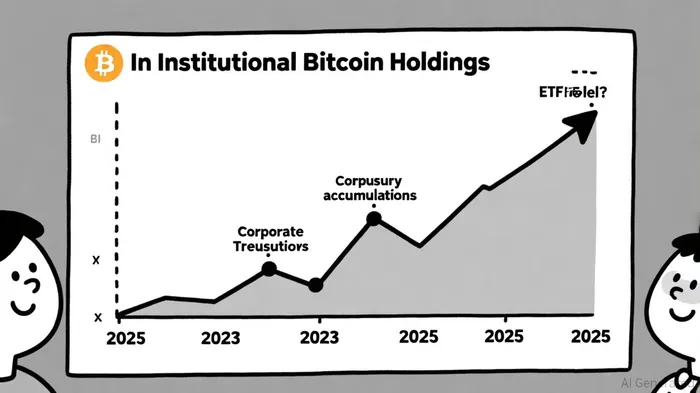
Institutional participation in Bitcoin has accelerated dramatically since 2023, fueled by regulatory clarity, macroeconomic pressures, and technological advancements. U.S. spot Bitcoin ETFs, for instance, have become a cornerstone of this adoption. According to a CoinGecko report, these ETFs have accumulated over 1.29 million BTC-approximately 6% of the total supply-since their 2024 launch, with BlackRock's IBIT dominating the market, securing 52.6% of the share by August 2025. This institutional inflow has not only stabilized Bitcoin's price but also reduced its volatility to levels comparable to traditional assets like gold and the S&P 500, as noted in a Cointelegraph article.
Corporate treasuries have mirrored this trend. Over 102 publicly listed companies now hold 1,001,953 BTCBTC-- collectively, with MicroStrategy (rebranded as "Strategy") leading the charge by acquiring 11,000 BTC ($1.1 billion) in Q1 2025 alone, according to an Amberdata blog. Sovereign wealth funds (SWFs) have also entered the fray, leveraging Bitcoin as a hedge against geopolitical risks and monetary inflation, according to Pinnacle Digest. These developments underscore Bitcoin's evolution from a speculative asset to a strategic reserve.
On-Chain Metrics: The New Lens for Institutional Activity
On-chain analytics have become indispensable for tracking institutional movements. Platforms like Glassnode, WooCharts, and Checkonchain employ advanced tools such as wallet clustering, transaction flow analysis, and large-wallet monitoring to identify institutional behavior. For example, graph-based wallet clustering uses AI to map relationships between addresses, revealing hidden liquidity shifts and large transfers, as explained in a Medium post.
Key metrics highlight this institutional footprint:
- Large Wallet Activity: The number of Bitcoin addresses holding ≥1,000 BTC increased by 3.5% since April 2024, with 76 new entities added in just two months, according to a Mitosis alert.
- Exchange Flows: Inflows to custody services like Coinbase and Kraken surged in Q1 2025, with a single 3,704 BTC withdrawal from Kraken valued at $315 million, a movement highlighted by MitosisMITO--.
- Transaction Value: While daily transactions declined to 320k–500k in 2025, the average transaction value rose to $36.2k, with 89% of settlement volume concentrated in transactions over $100k, as reported by Glassnode.
These metrics indicate that institutions are prioritizing long-term accumulation over short-term trading, using volatility as an opportunity to build positions.
Case Studies: Institutional Moves and Market Impact
The market impact of institutional entry is best illustrated through specific examples. In Q1 2025, Bitcoin reached a historic high of $109,000, driven by ETF inflows and corporate buying. MicroStrategy's expansion of its Bitcoin holdings to 461,000 BTC exemplified this trend, while ETFs like IBIT attracted $54.4 billion in assets under management (AUM) by August 2025, according to the CoinGecko report.
Another telling case is the 2025 mid-tier holder expansion. Wallets holding 100–1,000 BTC increased their share of the total supply from 22.9% to 23.07%, signaling sustained institutional confidence despite market consolidation, as noted in the CoinGecko report. Meanwhile, Mitosis cited IntoTheBlock data showing a single day with $480 billion in high-value Bitcoin transactions, underscoring the scale of institutional activity.
Future Implications and Strategic Considerations
As institutions continue to integrate Bitcoin into their portfolios, the market's structure is evolving. The reduced volatility and increased liquidity have made Bitcoin more attractive for hedging and long-term allocation. Analysts project prices could reach $240,000 by 2026, supported by a CryptoNews analysis.
For investors, the key takeaway is clear: on-chain metrics are no longer optional tools but essential for understanding institutional behavior. By monitoring large wallet movements, exchange flows, and transaction patterns, market participants can anticipate trends and position themselves ahead of major price shifts.





Comentarios
Aún no hay comentarios