
LanzaTech's Strategic Transformation and Financial Viability Amid Deepening Losses
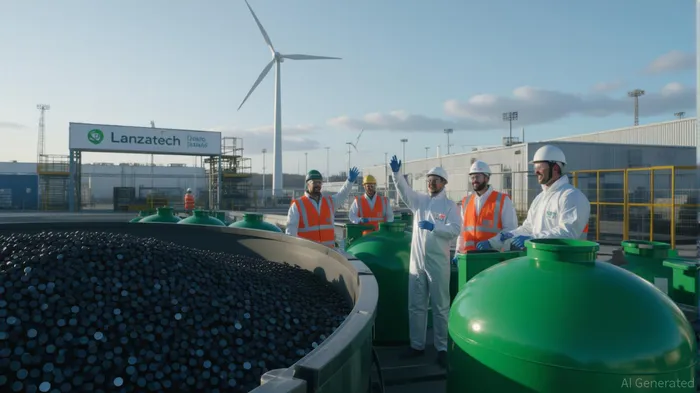
LanzaTech Global (NASDAQ: LNZA) is navigating a precarious crossroads. The company's Q2 2025 financial results underscore a stark reality: total revenue plummeted 47.7% year-over-year to $9.1 million, while net losses widened to $32.5 million. Adjusted EBITDA losses also deteriorated to $29.7 million, driven by higher operating expenses and a shift in revenue mix toward lower-margin CarbonSmart sales. Yet, amid these challenges, LanzaTech's strategic pivot to sustainable aviation fuel (SAF) and aggressive cost-cutting measures could yet unlock long-term value for investors—if the company can execute its vision effectively.
The Financial Dilemma: A Company in Transition
LanzaTech's financial struggles are no secret. The collapse in licensing revenue—from $8.5 million to $1.1 million—reflects the end of a R&D-centric era. While CarbonSmart revenue grew to $3.8 million, it remains a niche segment with thin margins. The company's cash burn of $42.8 million in operating activities over six months highlights its reliance on external financing. However, a $40.0 million preferred equity infusion in May 2025 and a £6.4 million UK government grant for its DRAGON 1 and 2 projects have provided a lifeline, boosting cash reserves to $39.6 million.
The question for investors is whether these funds can catalyze a turnaround. LanzaTech's management has acknowledged the need for a “commercial execution” overhaul, including leadership changes and workforce reductions. These steps, while painful, are critical to aligning costs with a business model that prioritizes scalability over innovation. The challenge lies in balancing short-term financial discipline with long-term R&D investments in SAF technology.
The DRAGON Projects: A High-Stakes Bet on SAF
LanzaTech's DRAGON 1 and 2 projects represent its most ambitious foray into commercial-scale SAF production. DRAGON 1, set to begin operations in Port Talbot by 2026, will convert recycled ethanol into SAF using its proprietary LanzaJet Alcohol-to-Jet (AtJ) process. DRAGON 2, a Power-to-Liquid (PtL) facility, will generate ethanol from CO₂ and green hydrogen, further diversifying feedstock sources. Together, these projects aim to produce 102 million liters of SAF annually, contributing to the UK's 10% SAF mandate by 2030.
The UK government's £6.4 million grant is a vote of confidence in LanzaTech's technology and its alignment with decarbonization goals. However, the absence of detailed revenue projections for these projects raises questions about their financial viability. While the global SAF market is projected to grow at a 39.9% CAGR through 2032, LanzaTech's current cost structure—highlighted by a $29.7 million Adjusted EBITDA loss in Q2 2025—suggests it is still in an early-stage investment phase.
Strategic Shifts: Cost Efficiency and Capital-Light Growth
LanzaTech's transition from a research-driven entity to a commercially focused business is evident in its cost-cutting measures. Workforce reductions and leadership changes in 2025 aim to streamline operations, while a focus on licensing and partnerships reduces capital intensity. This approach mirrors successful models in the renewable energy sector, where companies like TeslaTSLA-- leveraged partnerships to scale production without shouldering full CAPEX burdens.
However, the company's reliance on government grants and external financing introduces execution risks. The DRAGON projects must achieve technical milestones and secure long-term offtake agreements with airlines or refiners to generate consistent revenue. For now, LanzaTech's balance sheet remains fragile, with cash reserves barely covering six months of operating expenses.
Investment Implications: Balancing Risk and Reward
For investors, LanzaTech presents a high-risk, high-reward proposition. The company's ethanol-to-jet technology is a proven differentiator, and the UK's aggressive SAF targets create a captive market. Yet, the path to profitability is fraught with challenges:
- Execution Risk: Delays in DRAGON 1's 2026 timeline or technical hurdles in PtL production could derail revenue expectations.
- Market Competition: The SAF space is attracting heavyweights like Neste and ShellSHEL--, which may outpace LanzaTech in scaling production.
- Regulatory Dependency: The UK's Advanced Fuels Fund grant is a lifeline, but future policy shifts could impact funding.
Despite these risks, the company's strategic alignment with decarbonization trends and its capital-light model offer a compelling long-term thesis. If LanzaTech can secure additional partnerships and reduce production costs through economies of scale, its DRAGON projects could become cash-generative by 2027.
Conclusion: A Gamble on the Future of Aviation
LanzaTech's Q2 2025 results paint a grim picture, but they also reveal a company in motion. The DRAGON projects and cost-cutting measures are not just survival tactics—they are foundational steps toward a future where SAF is a cornerstone of the aviation industry. For patient investors willing to tolerate near-term volatility, LanzaTech's transformation could yield outsized returns if it successfully navigates the next 18–24 months.
In the end, the question is not whether LanzaTech can turn a profit, but whether it can outpace its peers in a market that is poised to grow from $2.7 billion in 2025 to $28.6 billion by 2032. For those who believe in the power of innovation and the urgency of decarbonization, the answer may already be clear.





Comentarios
Aún no hay comentarios