
LandSpace's $1B IPO: A Growth Investor's Play for the $1.8T Space Market
The investment choice before us is stark. In early 2026, China's LandSpace will go public on the STAR Market at a $1 billion valuation. At the same time, its mentor, SpaceX, is prepping for an initial public offering projected to value it at $1.5 trillion. That's a 1,500x difference in price for what appears to be a remarkably similar product: a reusable, Falcon 9-like rocket.
This isn't just a gap between two companies; it's a choice between paying a premium for a dominant, but still private, growth engine, or investing early in a competitor building the same technology. LandSpace, founded in 2015, is arguably the best privately owned space company in China and the closest thing to a domestic SpaceX. Its Zhuque-3 rocket, modeled directly on the Falcon 9, reached orbit in December 2025 and aims to perfect landings in 2026. The company plans twelve launches this year, a clear signal of its scaling ambition.
The math of this opportunity hinges on the massive market ahead. The global space economy is projected to be worth $1.8 trillion by 2035. Both LandSpace and SpaceX are positioning to capture a piece of that expanding "backbone" and "reach" economy, from satellite launches to enabling services across industries. For a growth investor, the valuation gap frames a simple question: do you pay for proven dominance at a sky-high price, or buy a similar, cheaper ticket to the same long-term growth story?
Scalability and Growth Trajectory: Can LandSpace Catch Up?
LandSpace is building a Falcon 9 lookalike rocket, the Zhuque-3, to capture a share of the commercial launch market-a key segment of the $330 billion backbone space economy. The company's plan is straightforward: reach orbit, land the first stage, and repeat. It successfully reached orbit in December 2025, and its 2026 target is twelve launches, with a focus on perfecting landings. This is the classic scaling playbook for a new entrant in a capital-intensive industry.
The company is not yet profitable, and its revenue figures are not yet material. That's the defining characteristic of this growth phase. It's a high-investment, high-reward model where current earnings are secondary to future market penetration. The entire business is geared toward achieving the economies of scale that will make reusable rockets a routine, low-cost service. For a growth investor, the question isn't about today's bottom line, but about whether LandSpace can execute its launch cadence and drive down costs fast enough to become a major player.
The underlying market provides a powerful tailwind. The U.S. space economy alone could add $428 billion in value over the next decade, signaling a massive expansion in demand for launch services and related infrastructure. This growth is not theoretical; it's being fueled by a surge in satellite constellations and new applications across industries. 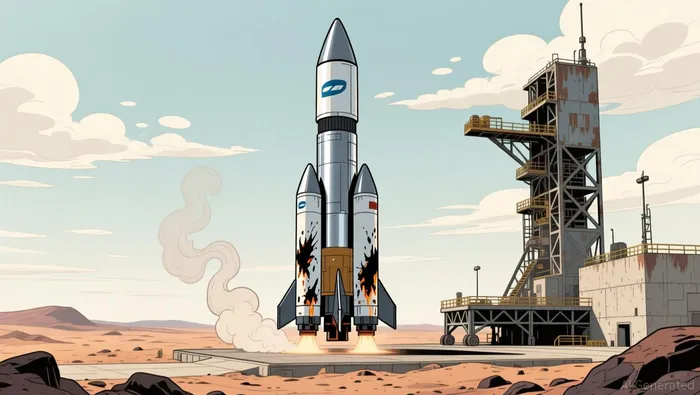 LandSpace's ambition to match SpaceX's launch rate is a direct bet on capturing a slice of this expanding pie. The scalability of its business model-reusing the same rocket for multiple missions-aligns perfectly with the secular trend toward cheaper, more frequent access to space. The company's path to dominance will be measured in launch numbers, not quarterly profits.
Growth Investor's Perspective: Market Capture vs. Price
For a growth investor, LandSpace represents a classic bet on capturing a portion of the orbital economy's hardware-led expansion. The market is heating up, and 2025 was a clear inflection point. That year saw trailing 12-month venture capital investment surge to $10.4 billion, reinforcing that the sector is accelerating beyond a niche experiment. This capital is flowing overwhelmingly toward hardware-heavy infrastructure, the very foundation LandSpace is building. The company's plan to execute twelve launches in 2026 is a direct attempt to scale into this growing market, aiming to secure a recurring revenue stream from commercial and potentially government customers.
The primary risk here is execution. LandSpace must successfully scale its production and launch cadence while securing firm contracts to justify its valuation. It operates in a field where the dominant player, SpaceX, has already demonstrated a path to massive scale and profitability. SpaceX's financial engine is now powered by its Starlink internet constellation, which is projected to generate $12.8 billion in revenue in 2025 and is a key driver behind its planned $1.5 trillion IPO. Success for LandSpace will be measured by its ability to achieve a similarly high launch cadence and, more importantly, to secure the recurring revenue contracts that can fuel its own growth trajectory. The company is not yet selling internet services from orbit, but its hardware is the essential first step.
Viewed through a growth lens, the investment thesis hinges on market capture, not current earnings. The $1 billion valuation is a bet on LandSpace's potential to become a major player in a sector where the total addressable market is projected to be worth $1.8 trillion by 2035. The company's path to justifying that price will mirror the playbook of its mentor: achieve operational scale, drive down costs through reusability, and lock in long-term contracts. For now, the focus is on launch numbers and contract wins, not quarterly profits.
Catalysts, Risks, and What to Watch
The immediate catalyst for LandSpace is its own public debut. The company's $1 billion IPO in early 2026 is the essential first step to validate its growth thesis. The funds raised will directly fuel its scaling plan, providing the capital needed to execute its ambitious launch cadence and perfect reusability. Success here is not just about going public; it's about using the market's validation to secure future contracts and accelerate its path to becoming a major launch provider.
The primary risk is execution. LandSpace must translate its technical progress-like the Zhuque-3 rocket reaching orbit in December 2025-into reliable, cost-effective operations. The company plans twelve launches this year, a clear target for scaling. Any significant delays or failures would directly challenge its ability to capture market share and justify its valuation. This risk is compounded by intense competition. It faces established domestic players and the looming shadow of its mentor, SpaceX, which is preparing for a $1.5 trillion IPO in the same year. The global space sector is also a geopolitical battleground, with nations like the U.S. and China pouring billions into sovereign capabilities, which could affect market dynamics and access.
For investors, the forward view hinges on a few key metrics. Watch quarterly revenue growth, which will signal commercial traction. More critically, track the number of successful launches and, eventually, successful landings and reflights. These are the leading indicators of operational maturity and the core of LandSpace's scalable, reusable business model. Any announcements of new commercial or government contracts will be a direct measure of its market penetration. The bottom line is that LandSpace's journey from a $1 billion valuation to a dominant player in the $1.8 trillion space economy will be measured in launch counts, not quarterly profits.







Comentarios
Aún no hay comentarios