
Lands' End ICR Fireside: Assessing the Amazon/TikTok Surge vs. Core Decline
The immediate test arrives today. Lands' End's stock has been on a recent climb, driven by narrow but powerful positive catalysts from its third-quarter results. The company reported a 120 basis point improvement in gross margin and a 28% jump in adjusted EBITDA. For a tactical investor, these are the numbers that move shares-signs of operational discipline and profitability hitting the bottom line. Yet, this momentum exists against a clear tension in the core business. While the company managed to boost margins, its net revenue was essentially flat year-over-year, and its critical U.S. e-commerce revenue declined approximately 3%. The gains are coming from efficiency, not top-line expansion.
This is the setup for the tactical event. The fireside chat at the 28th Annual ICR Conference on January 12, 2026 is not a routine update. It is a direct test of management's ability to articulate a credible path forward. The market is asking: Can these profitability gains offset the underlying decline in core consumer sales? Can the company's recent success in third-party marketplaces-where AmazonAMZN-- and Macy's sales are up about 40%-be sustained and scaled to drive meaningful growth? Or are they a temporary, high-margin tailwind that masks a deeper challenge?
The chat is the catalyst to assess sustainability. If management can provide a clear, forward-looking narrative that ties its margin strength to a scalable growth engine-perhaps by detailing how its new channels and B2B partnerships like the Delta Air Lines uniform deal will fuel future revenue-the current momentum could be validated. If the discussion remains focused on cost cuts and margin maintenance without a convincing growth story, the stock's recent pop may prove fragile. Today's event will separate a tactical opportunity from a fleeting reaction.
The Mechanics: Amazon/TikTok Surge vs. Core Decline
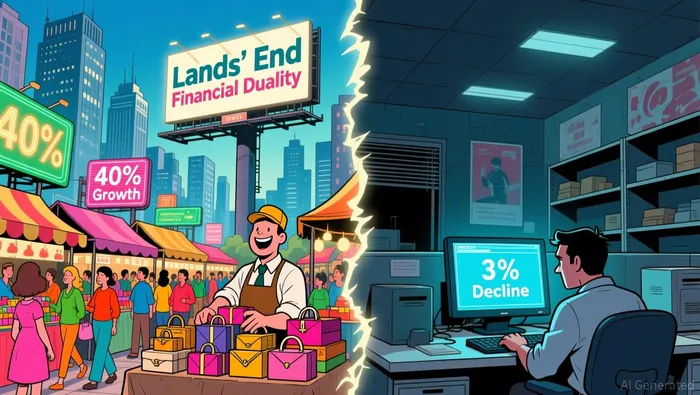
The performance split is stark. Lands' End's recent financials are built on two opposing forces: a powerful surge in third-party marketplaces and a persistent decline in its core digital channel.
On one side, the high-margin engine is firing. Third-party marketplace sales grew approximately 34% year over year, with Amazon and Macy's up about 40%. This channel is the primary driver of top-line growth, providing a crucial offset to weakness elsewhere. The company has clearly found a profitable niche here, leveraging curated assortments to attract customers outside its own e-commerce site.
On the other side, the core business is under pressure. Despite the overall revenue flatness, the critical U.S. e-commerce revenue declined approximately 3% last quarter. This is a direct channel headwind, indicating that Lands' End's own digital storefront is struggling to retain or attract customers. The decline in the U.S. digital segment, which includes the core e-commerce business, highlights a vulnerability in its primary customer relationship.
The profitability gains, meanwhile, are a story of operational discipline, not top-line expansion. The company achieved a gross margin improvement of approximately 90 basis points in the second quarter, with the full-year gross margin hitting nearly 52%. This was driven by improved promotional productivity and a disciplined approach to inventory. Management has reduced inventory for the ninth consecutive quarter, a key lever for margin improvement. Yet, inventory levels still rose 3% year over year, partly due to tariff pressures, showing the cost of doing business remains a friction.
The bottom line is a tension between channels. The surge in marketplaces provides a vital, high-margin growth vector that is currently lifting the stock. But the core e-commerce decline suggests a deeper challenge in customer engagement and brand relevance. For the tactical investor, the key question is whether the marketplace success can be scaled to meaningfully offset the core decline, or if it remains a tactical, high-margin tailwind that masks a structural problem.
Valuation and Scenario Implications
The current valuation hinges on a single, critical question: is the recent margin strength a one-time benefit from inventory reduction or the start of a structural improvement? The company's guidance for full-year adjusted net income of $21 million to $25 million implies a multiple on the high end of that range. That outlook may be optimistic given the flat top-line growth and persistent core decline. For the stock to support that multiple, the market must believe the current profitability gains are sustainable and will eventually drive top-line expansion.
A key scenario that could validate the valuation is the potential for the Delta uniform relaunch to materialize as a significant B2B revenue stream. Lands' EndLE-- secured a long-term partnership to design and manufacture uniforms for over 60,000 Delta employees, a deal that could provide a stable, high-margin contract. However, the company is still in the wear-testing phase for summer 2026. Until that product is fully launched and its financial contribution is visible, this remains a speculative catalyst, not a current earnings driver.
The vulnerability in the setup is clear. If investors view the recent margin improvement as a one-time benefit from the ninth consecutive quarter of reduced inventory, the stock's recent pop could unravel. The evidence shows inventory levels still rose 3% year-over-year, partly due to tariff pressures, indicating the cost of doing business remains a friction. In that case, the guidance for a 120 basis point gross margin improvement would be seen as a peak, not a new plateau.
The bottom line for tactical positioning is one of high-stakes scenario analysis. The valuation appears to price in a successful turnaround, but the near-term catalysts are either already priced in (the marketplace surge) or still in the future (the Delta relaunch). The stock's path will be dictated by whether management can demonstrate that its operational discipline can be applied to grow the core business, or if the recent gains are simply a temporary mispricing that will correct as the underlying decline reasserts itself.
Catalysts and Risks: What to Watch at the ICR
The fireside chat is the immediate catalyst. Management's commentary on the sustainability of its margin gains and the path to top-line growth will be critical. The market has rewarded operational discipline, but it needs a credible growth story to justify the valuation. Watch for forward-looking signals that tie the company's profitability to scalable revenue expansion.
A major risk is the continued decline in core US e-commerce revenue, which fell approximately 3% last quarter. This is a direct channel headwind that threatens the company's digital strategy and brand relevance. If management cannot articulate a plan to reignite this core consumer growth, the stock's recent pop may prove fragile.
Key catalysts to watch include updates on the Delta uniform collection's timeline and potential revenue impact. Lands' End secured a long-term partnership to design and manufacture uniforms for over 60,000 Delta employees, a deal that could provide a stable, high-margin contract. However, the company is still in the wear-testing phase for summer 2026. Any new initiatives to reignite core consumer growth, perhaps through the new Delta collection or other B2B partnerships, will be scrutinized as potential offsetting vectors to the core decline.
The bottom line is a high-stakes test of narrative. The stock's path will be dictated by whether management can demonstrate that its operational discipline can be applied to grow the core business, or if the recent gains are simply a temporary mispricing that will correct as the underlying decline reasserts itself.





Comentarios
Aún no hay comentarios