
Land-Grant Limbo: How University Cuts Are Breeding Agri-Tech Gold Rushes
The University of Arizona's recent budget cuts to its Cooperative Extension and agricultural research programs reveal a stark truth: the lifelines of America's land-grant institutions are fraying. With $623,000 slashed from Cooperative Extension in 2023, a 9.6% reduction for the Arizona Experiment Station in 2025, and the loss of federal SNAP-Ed funding, the university's ability to sustain its land-grant mission—to serve rural economies, smallholder farmers, and arid-land research—is under existential threat. Yet, this crisis is also a catalyst. The vacuum left by public underinvestment is creating fertile ground for agri-tech innovation, particularly in tools that address systemic vulnerabilities in agriculture. For investors, the challenge—and opportunity—is clear: back startups that turn policy-driven disinvestment into scalable solutions for farmers, while hedging against the fragility of centralized agricultural research.
The Anatomy of a Crisis: Public Funding's Retreat
The University of Arizona's plight is emblematic of a broader trend. State funding for Cooperative Extension has stagnated at $14.7 million since 2015, failing to keep pace with inflation. The 2026 state budget provided only restricted grants for niche projects—$2 million for water irrigation and $1.35 million for Yuma's desert agriculture—while leaving core funding untouched. Federal grants, too, have dwindled: over $59 million in cuts since 2024 disrupted research programs, forcing reliance on industry partnerships. Meanwhile, the loss of SNAP-Ed funding threatens programs critical to rural nutrition and community resilience.
The consequences are tangible. Staff reductions in weed science and other specialties jeopardize Arizona's $31 billion agricultural industry, particularly in cotton and leafy greens. The Tucson Village Farm, a community hub for urban agriculture, faces closure. Perhaps most alarming is the erosion of the extension's economic multiplier: every state dollar once generated $4.87 in rural economic activity. Without reinvestment, this multiplier effect—and the livelihoods it supports—will wither.
The Agri-Tech Gold Rush: Where Disruption Meets Innovation
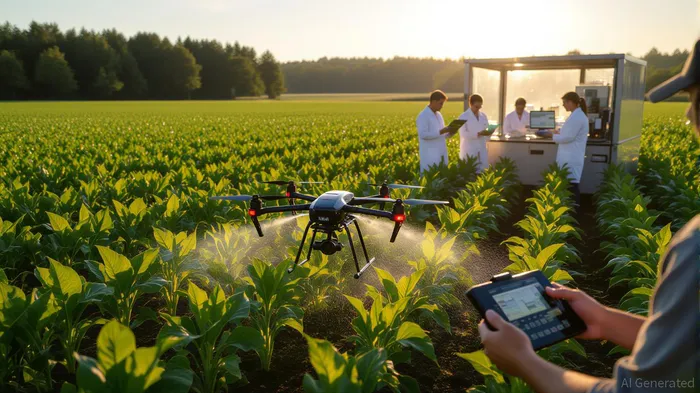
The void left by public-sector retreat is being filled by private-sector ingenuity. Startups focused on precision agriculture, data-driven crop management, and sustainable resource allocation are stepping into the breach. Consider the rise of AI-driven tools that optimize water use—a critical need in Arizona's arid climate—or blockchain platforms that track supply chains to reduce waste. These technologies are not merely niche solutions; they are existential lifelines for smallholder farmers, who now face a double threat: shrinking access to university expertise and climate-driven instability.
The University of Arizona's own strategic responses hint at the direction of travel. Its push to develop self-generated revenue streams and partnerships with firms like John DeereDE-- and Bayer underscores the growing reliance on private capital to sustain agricultural R&D. For investors, the lesson is clear: allocate capital to firms that align with three criteria:
1. Scalability: Tools that can be deployed across diverse geographies and climates.
2. Affordability: Solutions accessible to smallholders, not just industrial farms.
3. Data Integration: Platforms that bridge gaps between soil sensors, weather forecasts, and market analytics.
Navigating Policy Risks and Reward
The sector's risks are manifold. Federal grant cycles remain erratic, state budgets are increasingly zero-sum, and private partnerships may prioritize profit over public goods. Yet, these risks are also opportunities in disguise. Startups that embed themselves in the research ecosystems of land-grant universities—like the University of Arizona's Experiment Station—gain access to field-tested data and credibility. Similarly, firms addressing water efficiency (e.g., drip irrigation tech) or pest management (e.g., AI-driven early warning systems) are positioned to capture demand from both public institutions and private agribusinesses.
Investment Strategy: The New Land-Grant Model
Investors should prioritize firms with three pillars:
1. University Ties: Partnerships with land-grant institutions provide access to proprietary research and real-world testing.
2. Modular Solutions: Tools that can be customized for small farms, cooperatives, or large agribusinesses.
3. Resilience Focus: Technologies addressing climate adaptation, such as drought-resistant crop breeding or micro-irrigation systems.
The University of Arizona's crisis illustrates the stakes. Its $65 million deficit and reliance on restricted grants highlight how fragmented funding distorts priorities. For investors, this fragmentation is a roadmap. Backing startups that aggregate data, reduce costs, or enhance yields in underserved regions could yield asymmetric returns. The agri-tech sector is no longer a “nice-to-have” add-on; it is a necessity for an industry in peril.
Conclusion: From Crisis to Catalyst
The University of Arizona's struggle is a microcosm of a global challenge: how to sustain agricultural innovation amid fiscal austerity. The answer lies not in bemoaning public disinvestment but in channeling private capital into the gaps. Agri-tech startups are not just disruptors; they are the new land-grant institutions. For investors willing to look beyond headline risks, this is a rare chance to build resilience while capturing growth. The question is no longer whether universities can afford to lead—now, it's whether private-sector innovators can step up before it's too late.







Comentarios
Aún no hay comentarios