
Lam Research's Pivotal Role in Enabling AI and HPC Growth
In the race to power the next generation of artificial intelligence (AI) and high-performance computing (HPC), semiconductor equipment manufacturers are emerging as critical enablers of technological progress. Among them, Lam Research Corporation (NASDAQ:LRCX) stands out as a strategic linchpin, leveraging its leadership in deposition, etch, and clean technologies to address the escalating demands of AI-driven chipmaking. With 2025 financial results underscoring robust growth and a forward-looking R&D strategy, Lam ResearchLRCX-- is not only adapting to industry shifts but actively shaping the future of semiconductor manufacturing.
Financial Resilience and Strategic Reinvestment
Lam Research's 2025 financial performance reflects a company in high gear. Total revenue surged to $18.4 billion, a 24% year-over-year increase, reversing a 15% decline in 2024, according to Lam Research's 2025 earnings report. This rebound was fueled by strong demand in memory and foundry sectors, with Q2 2025 gross margins hitting 50.3%, up from 49.0% in Q1, according to Lam's Q2 2025 results. By Q3, net income had grown 40% year-over-year to $1.33 billion, demonstrating operational efficiency, as detailed in its Q3 2025 financial report.
The company's Customer Support Business Group (CSBG), which provides maintenance and services, now accounts for 38% of total revenue, reaching $6.9 billion in 2025, according to the earnings report. This recurring revenue stream not only stabilizes cash flows but also deepens customer relationships, ensuring long-term value. Meanwhile, Lam's $10 billion share repurchase program and 10% increase in R&D spending to $2.1 billion in 2025 (also reported in the earnings report) signal confidence in both capital returns and innovation.
Technological Leadership in AI/ML Chipmaking
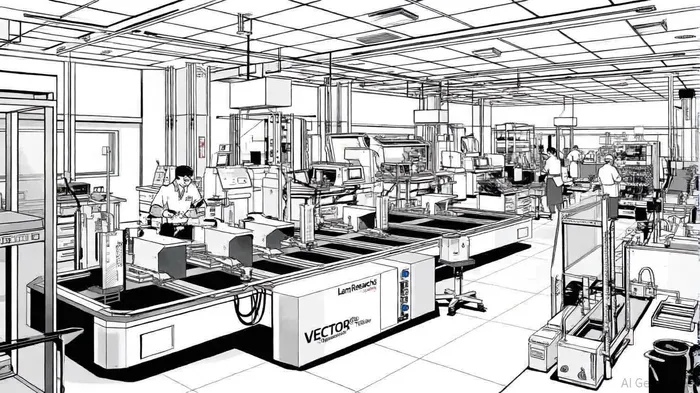
Lam Research's strategic positioning is anchored in its ability to solve complex manufacturing challenges for AI/ML chips. In September 2025, the company introduced the VECTOR® TEOS 3D, a deposition tool designed to address bottlenecks in 3D stacking and advanced packaging. This tool deposits ultra-thick, void-free dielectric films up to 60 microns thick, enabling chipmakers to build denser, more efficient architectures for AI accelerators. By reducing process time by 70% and improving cost of ownership by 20%, TEOS 3D directly addresses the scalability needs of HPC and AI workloads, a claim outlined in the company announcement.
Collaborations further amplify Lam's competitive edge. A non-exclusive agreement with JSR Corporation and Inpria Corporation in late 2025 accelerates the adoption of dry resist technology for extreme ultraviolet (EUV) lithography, as noted in the press release. This partnership integrates JSR/Inpria's patterning materials with Lam's Aether® dry resist equipment, simplifying the creation of intricate patterns required for sub-3nm nodes. Such innovations are critical as traditional lithography approaches physical limits, and Moore's Law demands new approaches to scaling, according to the earnings report.
Geopolitical Adaptability and Market Expansion
Lam Research's geographic diversification underscores its resilience. While U.S. export controls reduced China's revenue contribution from 42% in 2024 to 34% in 2025, per the earnings report, the company offset this by expanding in Taiwan, where its revenue share grew from 11% to 19%, also noted in that earnings report. This shift aligns with global trends toward regionalizing semiconductor supply chains, particularly as TSMC and Intel ramp up AI chip production in Asia.
The company's deferred revenue of $1.55 billion as of March 2025, highlighted in the Q3 report, also points to strong order backlogs, suggesting sustained demand for its tools in 2026. With AI and HPC markets projected to grow at double-digit rates, Lam's ability to deliver scalable, high-precision solutions positions it to capture a disproportionate share of this expansion.
Untapped Upside Potential
Despite its current success, LamLRCX-- Research remains undervalued relative to its long-term potential. The semiconductor equipment sector is poised for a renaissance as AI/ML adoption accelerates, and Lam's focus on AI-enhanced control systems and predictive maintenance, according to a Cash Platform article, ensures it stays ahead of competitors. For instance, its AI-driven automation reduces downtime and optimizes yield, directly improving chipmakers' ROI.
Moreover, the company's $10 billion share repurchase program (reported in the Q3 report) and $2.1 billion R&D investment (detailed in the earnings report) suggest a disciplined approach to capital allocation. With deferred revenue and CSBG growth providing stable cash flows, Lam has the flexibility to reinvest in breakthrough technologies like high NA EUV patterning and metal oxide resists, as noted in the earnings report, which are essential for sustaining Moore's Law.
Conclusion
Lam Research's 2025 performance and technological roadmap position it as a cornerstone of the AI/ML revolution. By combining financial discipline, strategic partnerships, and cutting-edge R&D, the company is not only meeting today's demands but also future-proofing its role in the semiconductor ecosystem. For investors, the untapped upside lies in its ability to capitalize on the AI/HPC boom while navigating geopolitical risks with agility. As the industry moves toward 3D stacking and sub-3nm nodes, Lam Research's tools and innovations will remain indispensable-making it a compelling long-term investment.





Comentarios
Aún no hay comentarios