
Lam Research: Leveraging AI-Driven Semiconductor Demand to Justify a Premium Valuation
The semiconductor industry is undergoing a seismic shift, driven by the insatiable demand for AI infrastructure and advanced memory solutions. At the heart of this transformation is Lam ResearchLRCX-- (LRCX), a company whose strategic positioning in the AI semiconductor value chain has sparked both optimism and skepticism. While critics question whether its valuation reflects long-term growth potential, a closer look at its market share, technological innovation, and financial performance reveals a compelling case for its premium pricing.
Strategic Positioning in AI Infrastructure and Memory Markets
Lam Research has cemented itself as a critical enabler of AI-driven semiconductor manufacturing. Its etch and deposition systems are foundational to producing advanced AI chips and high-bandwidth memory, with the systems business growing by 58% year-on-year in Q2 2025. This growth is underpinned by the company's leadership in gate-all-around (GAA) nodes and advanced packaging technologies, which are essential for next-generation AI and cloud computing applications according to industry analysis.
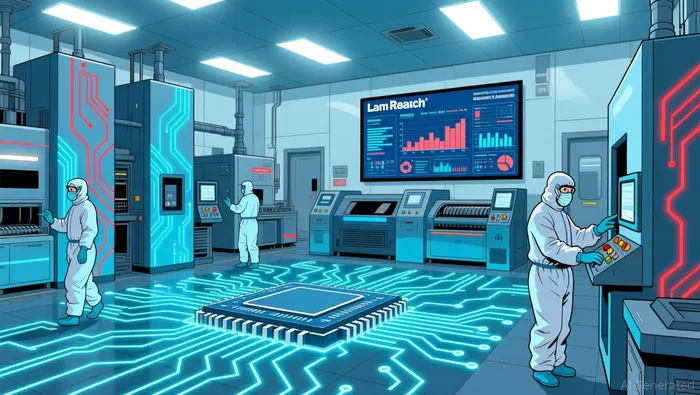 Recent investments further underscore its commitment to this space. A $65 million expansion in Tualatin, Oregon is accelerating R&D and production capacity, while institutional investors like BURNEY CO/ have increased their stake by 51,967 shares, signaling confidence in Lam's role in the AI cycle according to market reports. The company's FY2025 revenue of $18.44 billion was driven by robust demand for AI-related manufacturing and services as financial data shows, aligning with broader industry trends as firms like Oracle and OpenAI announce multi-billion-dollar AI infrastructure contracts according to recent announcements.
Competitive Landscape: LamLRCX-- vs. ASML and TSMC
Lam's competitive edge lies in its complementary role to industry giants like ASML and TSMC. While ASML dominates EUV lithography-a critical technology for 5nm and 3nm chips-its growth has been tempered by U.S.-China export restrictions and a 0.7% year-over-year revenue decline in Q3 2025. In contrast, Lam's 45% market share in etch equipment and leadership in deposition systems position it as a less geopolitically exposed player in the AI supply chain.
TSMC, the world's largest pure-play foundry, faces its own challenges despite a 60.7% year-on-year net income surge in Q2 2025. Its valuation premium (trading at a higher P/E than Lam) reflects both its scale and the risks of operating in a geopolitically volatile region. Lam, meanwhile, benefits from a more diversified revenue stream, combining equipment sales with recurring services that offer stability according to industry analysis.
Valuation Skepticism and Analyst Insights
Critics argue that Lam's forward P/E of 29.52-lower than the industry average of 34.89 according to market data-does not fully reflect its growth potential. However, recent analyst reports suggest otherwise. Morningstar raised its fair value estimate for Lam to $100 per share, while Oppenheimer, Susquehanna, and BofA increased price targets, citing its leadership in 3D stacking and record profitability according to recent reports.
Financial performance has also exceeded expectations. Q1 2025 revenue surged 28% year-on-year to $5.32 billion, with non-GAAP EPS jumping 46.5%. Management's raised 2025 wafer fab equipment spending outlook to $105 billion according to company statements further reinforces confidence in AI-driven demand. While some analysts, like Morningstar, currently view the stock as overvalued according to market analysis, the consensus is shifting toward optimism, with Zacks projecting a 14.1% revenue increase for fiscal 2026 according to recent forecasts.
Risks and the Road Ahead
Lam is not without risks. Geopolitical tensions and potential slowdowns in China-related revenue remain concerns, and its reliance on cyclical semiconductor demand means it is vulnerable to industry downturns. However, its diversified product portfolio, strong cash flow with 50%+ margins, and critical role in AI infrastructure mitigate these risks.
For investors, the key question is whether Lam's valuation reflects its ability to sustain growth in a rapidly evolving market. Given its technological leadership, strategic investments, and alignment with AI megatrends, the answer leans toward yes. While ASML and TSMC remain indispensable, Lam's unique position in the value chain offers a compelling alternative for those seeking exposure to the AI semiconductor boom without the same level of geopolitical or valuation risk.







Comentarios
Aún no hay comentarios