
The U.S. Labor Market's Stagnation: A Warning Sign for Investors
The U.S. labor market, once a cornerstone of economic resilience, has entered a period of stagnation that raises critical concerns for investors. In Q4 2025, the labor market added just 50,000 jobs-well below the projected 73,000-marking a stark slowdown in hiring momentum. The unemployment rate, while falling to 4.4%, masks a broader trend of cautious employer behavior and a decline in job openings. This divergence between headline metrics and underlying labor market dynamics signals a structural shift, driven by factors such as AI-driven productivity gains, demographic aging, and policy uncertainty. For investors, these developments are not merely economic trivia but urgent signals to reassess portfolio allocations in light of emerging recession risks.
A Labor Market in Transition: Lessons from History
Historical patterns underscore the importance of vigilance. During the Great Recession (2007–2009), the labor market deteriorated rapidly, with unemployment surging to 10% and long-term unemployment doubling. Similarly, the 2000–2001 slowdown saw a 31-month exodus from equities as manufacturing and construction payrolls collapsed. Today's labor market, while not collapsing, exhibits troubling parallels: a flattening labor force participation rate (stagnant at 62.3%), rising private-sector layoffs, and a "low-hire, low-fire" environment. These conditions often precede broader economic contractions, as seen in 2007 and 2008, when cyclical job losses in construction and manufacturing triggered systemic portfolio reallocations.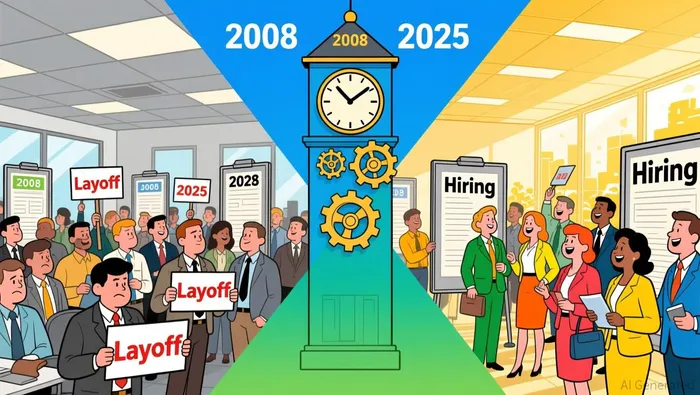
The current slowdown, however, is compounded by structural forces. AI adoption, for instance, has created a paradox: while it boosts productivity, it also suppresses hiring as firms prioritize automation over labor. This dynamic, coupled with immigration restrictions and an aging workforce, has led to a labor market that is both more selective and less responsive to traditional monetary stimulus.
Strategic Reallocation: Defensive Sectors and Global Diversification
Investors navigating this environment must prioritize resilience over growth. Historically, defensive sectors-such as utilities, healthcare, and consumer staples- have outperformed during labor slowdowns, as seen in 2000 and 2008. Fixed income, particularly high-quality corporate bonds, also offers a buffer against volatility, with global aggregate bonds rising 7% in 2025 amid tight credit spreads and strong fundamentals. Non-U.S. equities, meanwhile, have shown surprising strength, with the MSCI All Country World Index ex-U.S. surging 28% in 2025, driven by robust performance in China, the Eurozone, and Japan. This shift reflects a broader reallocation of capital toward markets where AI-driven productivity gains are already translating into tangible economic returns.
The Federal Reserve's accommodative stance further supports a defensive tilt. With two rate cuts in late 2025 and more expected in 2026, investors should prepare for a prolonged period of low yields and muted inflationary pressures. However, the Fed's tools may prove less effective this time, as AI-driven productivity gains complicate traditional demand-side interventions.
Early 2026 Indicators: A Mixed Picture
The latest leading economic indicators (LEI) and yield curve data paint a nuanced picture. The LEI declined in early 2026, projecting GDP growth to fall from 1.8% in 2025 to 1.5% in 2026. Meanwhile, the U.S. yield curve steepened to 139 basis points-the steepest since November 2021-reflecting market expectations of future rate cuts and persistent inflationary pressures. While a steep curve typically signals growth optimism, it also highlights rising long-end risk premia linked to fiscal deficits and inflation concerns. The probability of a 2026 recession stands at 17.1%, a moderate but non-trivial risk.
For investors, this duality demands a balanced approach. Defensive assets remain critical, but opportunities may also arise in sectors poised to benefit from AI-driven productivity, such as semiconductors and cloud infrastructure.
Conclusion: Preparing for the Inevitable
The U.S. labor market's stagnation is not a fleeting anomaly but a harbinger of deeper structural shifts. While a full-blown recession remains unlikely, the risks are rising, particularly as policy uncertainty and demographic headwinds persist. Investors must act now to reallocate portfolios toward defensive sectors, global equities, and high-quality fixed income. As the Fed navigates this complex landscape, agility-not complacency-will be the hallmark of successful strategies in 2026.







Comentarios
Aún no hay comentarios