
The U.S. Labor Market Slowdown and Implications for Fed Policy and Equity Sectors
The U.S. labor market has entered a period of uncertainty, marked by slowing job growth, rising unemployment, and structural shifts in employment patterns. November 2025's employment report revealed a mere 64,000 nonfarm payroll additions, a sharp contrast to the robust growth seen earlier in the year. The unemployment rate climbed to 4.6%, a four-year high, driven in part by disruptions in data collection during a six-week federal government shutdown according to the BLS report. These trends, coupled with a 105,000-job loss in October-largely due to federal government employment cuts-have intensified pressure on the Federal Reserve to recalibrate its policy stance according to NPR analysis. This analysis examines the sustainability of the Fed's rate-cutting trajectory amid deteriorating labor market conditions and evaluates sector-specific investment opportunities in manufacturing, retail, and AI-driven industries.
Fed Policy: Navigating a Fragile Labor Market and Inflationary Pressures
The Federal Reserve's December 2025 policy response included a 25-basis-point cut to the federal funds rate, bringing the target range to 3.50–3.75% according to Bloomberg reporting. This move reflects the central bank's acknowledgment of a "rapidly softening" labor market, where wage growth has cooled and labor force participation has declined due to reduced immigration and demographic shifts according to SF Fed analysis. However, the Fed remains divided on the appropriate path forward. While some officials advocate for further rate cuts to cushion the labor market, others caution against overreacting to temporary data distortions, such as those caused by the government shutdown.
Inflation remains a critical constraint. According to Federal Reserve Bank of Atlanta President Raphael Bostic, core inflation has exceeded the 2% target for nearly five years and is unlikely to decline meaningfully until mid-2026 according to Atlanta Fed speech. Tariffs and global supply chain dynamics continue to exert upward pressure on goods prices, though services inflation has remained relatively stable according to SSGA analysis. This duality-softening labor demand versus persistent inflation-has forced the Fed into a delicate balancing act. As of late 2025, the central bank appears to prioritize price stability over aggressive stimulus, with projections suggesting only two additional rate cuts in early 2026 if the labor market weakens further according to Conference Board forecast.
Sector-Specific Opportunities and Risks
Manufacturing: AI and Tax Incentives as Tailwinds
The manufacturing sector, long vulnerable to trade policy uncertainty, may find new opportunities in 2026. The One Big Beautiful Bill Act (OBBBA) includes tax provisions that could incentivize domestic investment, particularly in industries adopting smart technologies like agentic AI according to Deloitte outlook. According to Deloitte, AI-driven automation is expected to enhance productivity and offset labor shortages in manufacturing, where wage growth has outpaced pre-pandemic levels despite rising unemployment according to JPMorgan research.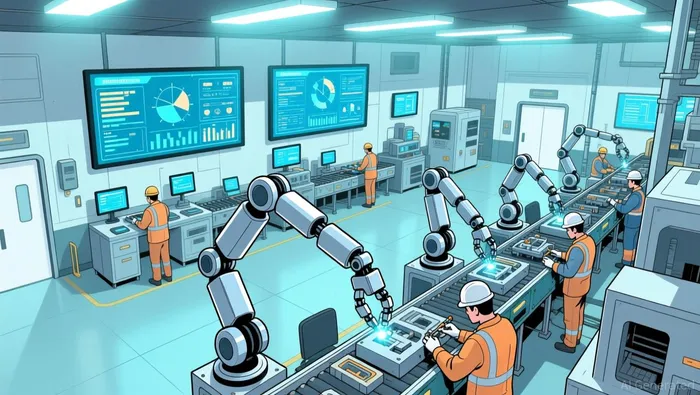 However, the sector remains exposed to global tariff pressures and supply chain disruptions, which could temper near-term gains according to Equiti analysis.
Retail: Resilience Amid Structural Challenges
Retail sales in October 2025 were flat, underscoring consumer resilience despite a weakening labor market according to Invesco analysis. This stability is partly attributable to fiscal stimulus, including tax refunds under the OBBBA, which have supported discretionary spending according to Forbes analysis. Analysts suggest that further Fed rate cuts in early 2026 could bolster retail employment, particularly in regions with high retail labor turnover according to Schwab research. However, the sector faces long-term headwinds, including automation-driven job displacement and shifting consumer preferences toward e-commerce according to Yahoo Finance reporting.
#### AI-Driven Industries: A Defining Investment Theme
Artificial intelligence is emerging as a cornerstone of global economic growth. U.S. AI-related capital expenditures (CapEx) are projected to surge to $519 billion in 2026, driven by demand for cloud infrastructure and generative AI tools. Hyperscalers and emerging markets-particularly China, India, and Taiwan-are poised to benefit from this boom, supported by government incentives and favorable macroeconomic conditions according to Investopedia analysis. For investors, AI-driven sectors offer dual advantages: cyclical growth from Fed rate cuts and structural gains from productivity-driven innovation according to Invesco outlook. However, risks include regulatory scrutiny and overvaluation in speculative tech stocks according to SSGA analysis.
Conclusion: A Cautious Path Forward
The Fed's rate-cutting trajectory appears sustainable in the short term but is contingent on a nuanced assessment of labor market data and inflationary risks. While further cuts are likely in early 2026, their efficacy in revitalizing employment remains uncertain, particularly given structural challenges like demographic shifts and immigration restrictions according to Bloomberg reporting. For investors, the key lies in hedging against macroeconomic volatility by prioritizing sectors with strong tailwinds-such as AI-driven industries and manufacturing-and avoiding overexposure to labor-intensive retail segments. As the U.S. economy navigates this crosscurrent of policy uncertainty and technological disruption, a disciplined, sector-specific approach will be critical to capturing value in 2026 and beyond.







Comentarios
Aún no hay comentarios