
U.S. Labor Market Slowdown and the Fed's Tightrope: How Revised Employment Data Reshapes Rate-Cut Expectations and Asset Allocations
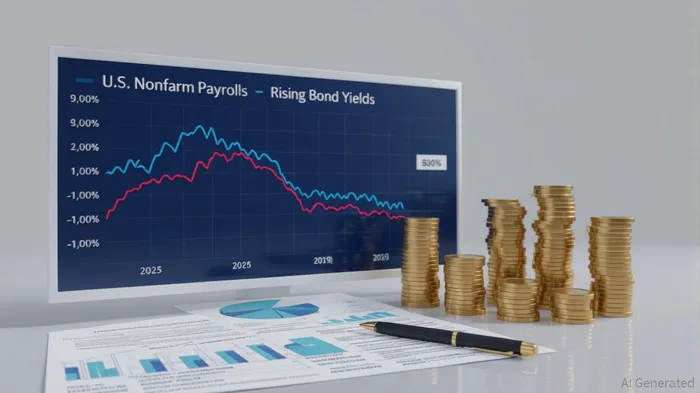
The U.S. labor market is signaling a dramatic shift, with revised employment data for 2025 painting a picture of a sharply slowing economy and growing pressure on the Federal Reserve to pivot from its hawkish stance. The July 2025 jobs report, which added just 73,000 nonfarm payrolls—far below expectations—coupled with massive downward revisions to prior months, has become a flashpoint for investors and policymakers alike. These revisions, which stripped 258,000 jobs from May and June's totals, reveal a labor market that is not only losing momentum but also facing structural imbalances, such as a shrinking labor force and sector-specific job losses. For investors, the implications are clear: the Fed's next move may be a rate cut, and asset classes like equities and bonds are already pricing in this shift.
The Data That Broke the Fed's “Wait-and-See” Stance
The July 2025 employment report was a seismic event. Nonfarm payrolls grew by a mere 73,000 jobs, a fraction of the 100,000 economists had forecasted. But the real shock came from the revisions to May and June data. May's initial estimate of 144,000 jobs was slashed to 19,000, and June's 147,000 was reduced to 14,000. This 258,000-job correction is the largest downward revision in decades and underscores a labor market that has been overestimated for months.
The broader context is equally concerning. The labor force participation rate has fallen to 62.2%, the lowest since late 2022, while long-term unemployment (27 weeks or more) has surged to 1.82 million. These trends suggest a growing number of discouraged workers, which could eventually drive up wages and inflation—a scenario the Fed has long sought to avoid. Meanwhile, President Donald Trump's aggressive trade policies, including tariffs on imports, have created a climate of uncertainty, paralyzing businesses and dampening hiring.
How the Fed's Dilemma Reshapes Rate-Cut Expectations
The Federal Reserve now faces a classic dilemma: balancing its dual mandate of maximum employment and price stability. The July data has tilted the scales toward employment, with the labor market showing signs of weakening. Futures markets now price in a 75.5% probability of a 25-basis-point rate cut at the September 2025 meeting, up from 40% before the report. This shift is driven by two key factors:
- A Cooling Labor Market: The sharp drop in job growth and revised downward figures indicate that the labor market is no longer in “balance,” as Fed Chair Jerome Powell described it earlier in 2025. With wage growth slowing and hiring concentrated in narrow sectors like healthcare, the Fed's mandate for maximum employment is under threat.
- Inflationary Pressures from Tariffs: While the Fed has been cautious about cutting rates due to inflation, the tariffs implemented by the Trump administration have pushed the PCE index above 2.6%. However, analysts argue that these price increases are one-time adjustments and not indicative of sustained inflation. This opens a window for the Fed to act preemptively without jeopardizing its inflation goals.
The Fed's internal debate is also heating up. Two members of the FOMC dissented at the July meeting in favor of a rate cut, the first such dissent since 1993. Governors like Christopher Waller and Michelle Bowman have publicly argued that the labor market is deteriorating and that waiting for further data could lead to policy lag. Meanwhile, Trump's vocal criticism of Powell and his demand for “immediate” rate cuts add political pressure to an already volatile situation.
The Ripple Effects on Equities and Bonds
The bond market has been the most immediate barometer of the Fed's potential pivot. U.S. Treasury yields plummeted after the July report, with the 10-year yield dropping 13 basis points to 4.236% and the 2-year yield falling over 25 basis points to 3.698%. These declines reflect a sharp re-pricing of expectations for rate cuts and a flight to safety amid economic uncertainty.
Equities, on the other hand, have been more volatile. The S&P 500 fell 1.6% in the wake of the jobs report, with the Nasdaq Composite dropping 2.2%. The sell-off was driven by two factors: the weak labor data and the implementation of Trump's tariffs, which have created a “one-two punch” for corporate earnings. Sectors like manufacturing and construction, which have seen job losses, are particularly vulnerable. However, defensive sectors such as healthcare and utilities have held up better, as investors shift toward stable cash flows.
For bond investors, the current environment offers a compelling case for duration extension. With the Fed likely to cut rates in September, long-duration assets like 30-year Treasuries could outperform as yields fall further. Similarly, high-yield corporate bonds may benefit from a more accommodative monetary policy, though their risk profile remains elevated due to economic uncertainty.
Equity investors, meanwhile, should consider a defensive tilt. Sectors like healthcare and consumer staples, which added jobs in July, may offer resilience. Conversely, cyclical sectors like industrials and materials could face headwinds if the labor market continues to weaken. A tactical shift toward dividend-paying stocks could also provide downside protection in a low-growth environment.
The Path Forward: A Fed in a Tightrope
The Fed now finds itself walking a tightrope between supporting the labor market and managing inflation. While the July data has tilted the scales toward rate cuts, the central bank remains cautious about the inflationary risks posed by tariffs. However, with the labor force participation rate declining and long-term unemployment rising, the Fed may have little choice but to act.
For investors, the key takeaway is to prepare for a more dovish Fed and a potential easing cycle. This means adjusting portfolios to favor bonds, particularly long-duration Treasuries, and defensive equities. It also means staying nimble, as the interplay between trade policy, labor market data, and Fed action could create sudden volatility.
In the coming months, watch for the August and September employment reports. If the trend of weak job growth continues, the Fed may be forced to adopt a more aggressive stance, with multiple rate cuts priced in by year-end. For now, the markets are betting on a September cut—and history suggests they may not be wrong.







Comentarios
Aún no hay comentarios