
The Labor Market Resilience and Its Implications for Equity Sectors
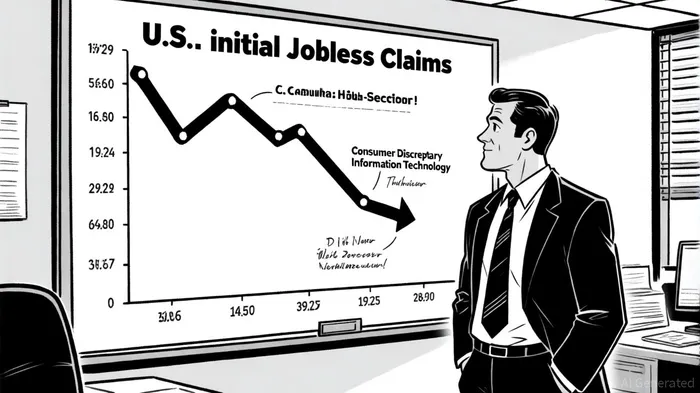
The U.S. labor market has demonstrated unexpected resilience in 2025, as evidenced by a sharp decline in jobless claims. According to a report by Reuters, initial claims fell to 231,000 for the week ending September 13, 2025, a 33,000 drop from the prior week and below the consensus forecast of 240,000 [1]. This marked the largest weekly decline in nearly four years, signaling a softening labor market amid broader economic uncertainty. However, the four-week moving average of 240,000 suggests some stabilization, indicating that while layoffs are slowing, the labor market remains fragile [1].
This resilience has significant implications for equity sectors, particularly high-beta ones sensitive to macroeconomic conditions. High-beta sectors—such as Financials, Industrials, Consumer Discretionary, and Information Technology—tend to amplify market movements during periods of economic expansion or contraction. Recent data suggests these sectors are benefiting from the labor market's relative strength, even as the Federal Reserve navigates a delicate balance between inflation control and employment support [2].
Financials: Leveraging Interest Rate Dynamics
The Financials sector has historically thrived in environments of rising interest rates, and 2025 is no exception. As the Federal Reserve resumed its rate-cutting cycle in response to labor market softening, banks and insurers benefited from higher lending margins and returns on premiums [3]. For instance, the S&P 500 Financials Index rose 4.2% in Q3 2025, outperforming the broader market. This performance aligns with Charles Schwab's August 2025 sector outlook, which highlighted Financials as a key beneficiary of the Fed's accommodative stance [3].
Industrials: Capitalizing on Business Confidence
The Industrials sector has also shown strength, driven by improved business confidence and infrastructure spending. A report by Bloomberg notes that the sector's performance in Q3 2025 was bolstered by renewed optimism in manufacturing and construction, sectors that are closely tied to employment trends [4]. For example, companies involved in industrial equipment and logistics saw their stock prices rise by 5.8% in September 2025, reflecting investor bets on a rebound in capital expenditures [4].
Consumer Discretionary: Riding the Back of Strong Employment
Consumer Discretionary stocks, which are highly sensitive to job growth and consumer confidence, have outperformed in 2025. Data from Fidelity indicates that the sector's ETFs, such as the Consumer Discretionary Select Sector SPDR (XLY), gained 6.3% in Q3 2025, driven by robust retail sales and a 4.2% unemployment rate [5]. The “Magnificent Seven” tech firms—Alphabet, Amazon, Apple, Meta, Microsoft, Nvidia, and Tesla—were pivotal in this outperformance, with their combined market capitalization growing by $1.2 trillion year-to-date [5].
Information Technology: AI-Driven Momentum
The Information Technology sector has emerged as a standout performer, fueled by AI-related productivity gains and corporate investment in digital infrastructure. According to a report by LSEG, the sector's beta coefficient of 1.3 in Q3 2025 underscored its volatility relative to the S&P 500 [6]. This aligns with the sector's 7.1% gain in September 2025, as companies like NVIDIA and AMD capitalized on surging demand for AI chips and cloud computing solutions [6].
Conclusion: Strategic Implications for Investors
The labor market's resilience in 2025 has created a favorable backdrop for high-beta sectors, particularly those tied to economic expansion and technological innovation. While the Federal Reserve's rate-cutting cycle introduces uncertainty, the outperformance of Financials, Industrials, Consumer Discretionary, and Information Technology suggests that investors should remain positioned for sector-specific opportunities. As the labor market continues to evolve, monitoring jobless claims and sector ETF performance will be critical for capitalizing on these trends.





Comentarios
Aún no hay comentarios