
U.S. Labor Market Resilience and Federal Reserve Policy: A New Era of Stability and Slow Growth
The U.S. labor market in 2025 is navigating a complex transition, marked by a "low-hiring, low-firing" dynamic that signals a structural shift toward a more stable but slower-growth economy. This evolution, driven by technological disruption, policy uncertainty, and demographic trends, has profound implications for investors and policymakers alike.
Structural Shifts in the Labor Market
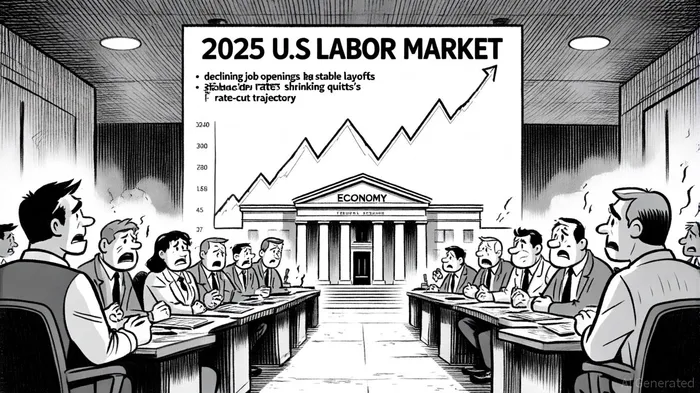
According to the Bureau of Labor Statistics' JOLTS report, job openings in the U.S. fell from 7.4 million in April 2025 to 7.18 million by July, with further declines to 7.2 million in August. Sectors like healthcare, retail trade, and leisure and hospitality have seen significant reductions in vacancies, while roles in information technology and professional services show modest resilience, according to a World Economic Forum report. The quits rate, a key indicator of worker confidence, has stabilized at 2% but dropped to 1.9% in August, reflecting a "Great Stay" phenomenon where employees are hesitant to leave their current positions, according to Financial Content.
This trend is not merely cyclical but structural. The World Economic Forum report highlights that AI and automation are reshaping employment, with 60% of businesses expected to adopt AI-driven workflows by 2030, displacing roles in administrative and clerical fields while creating demand for AI specialists and data analysts. Meanwhile, demographic shifts, such as an aging population, are driving growth in healthcare but exacerbating labor shortages in other sectors, as CNBC reports.
Federal Reserve's Policy Response
The Federal Reserve has responded to these dynamics with a series of rate cuts aimed at stabilizing the labor market. At its September 2025 meeting, the FOMC reduced the federal funds rate by 25 basis points to 4.00%–4.25%, with officials projecting two additional cuts by year-end, potentially bringing the rate to 3.5%–3.75%, as noted in a Federal Reserve press release. This easing cycle reflects concerns over slowing job creation-only 22,000 jobs were added in August 2025-and the risk of prolonged unemployment disparities, according to a Bloomberg feature.
However, the Fed faces a delicate balancing act. While inflation remains above its 2% target, the labor market's "Great Rebalancing" has shifted power back to employers, reducing wage pressures and easing inflationary risks, according to a Financial Content analysis. A Bloomberg analysis notes that the Fed's rate cuts are designed to encourage hiring by lowering borrowing costs for businesses, but their effectiveness may be constrained by structural headwinds like AI-driven productivity gains and trade policy uncertainties.
Investment Implications
For investors, the transition to a slower-growth economy necessitates a strategic realignment. Sectors poised to benefit from structural trends-such as healthcare, green energy, and AI-driven industries-offer long-term growth potential. Conversely, traditional sectors like manufacturing and federal contracting face headwinds due to policy shifts and automation, according to Cresset Capital.
The labor market's "low-churn" environment also suggests reduced volatility in employment data, which could stabilize corporate earnings but limit upside surprises. Investors should monitor the Fed's data-dependent approach, particularly the October 2025 rate cut, as a signal of broader economic confidence, according to a Forbes outlook.
Conclusion
The U.S. labor market is undergoing a profound transformation, with low turnover and sectoral imbalances reshaping the economic landscape. While the Federal Reserve's rate cuts aim to mitigate risks and support employment, the path forward is one of cautious adaptation rather than aggressive growth. For investors, the key lies in aligning portfolios with structural trends and maintaining flexibility in the face of evolving policy and technological shifts.







Comentarios
Aún no hay comentarios