
Labor Market Instability and Equity Valuations: Reevaluating High-Growth Sectors
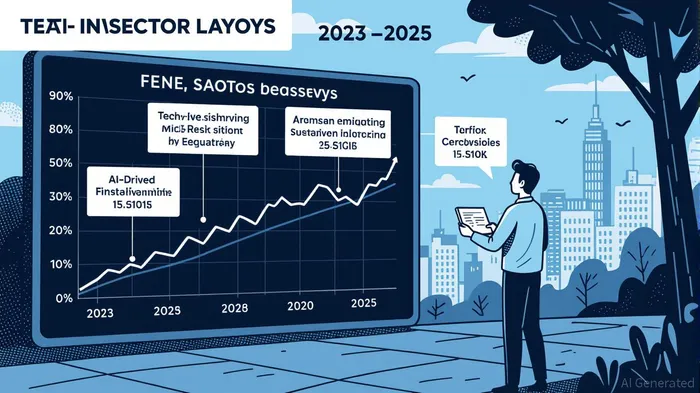
The U.S. labor market in 2025 has become a battleground of contradictions. While the ADP National Employment Report noted a mere 54,000 private-sector job additions in August 2025—a stark slowdown from earlier in the year—certain sectors like leisure and hospitality added 50,000 jobs, underscoring uneven growth[1]. Meanwhile, tech, retail, and services sectors grappled with layoffs driven by AI integration and automation. Over 22,000 tech workers were laid off in 2025 alone, with companies like CiscoCSCO-- and PelotonPTON-- cutting roles in customer support and operations[2]. These shifts have sent ripples through equity valuations, particularly in high-growth industries reliant on employment-driven consumer spending.
The Tech Sector: AI-Driven Restructuring and Valuation Compression
The tech sector's 2025 layoffs were not merely cost-cutting measures but strategic pivots toward AI and automation. For instance, KlarnaKLAR-- and DuolingoDUOL-- reduced staff in customer experience teams to redirect resources toward generative AI tools[2]. While this shift has spurred demand for AI-specific roles—job postings in generative AI surged 111% year-on-year—traditional roles in marketing and operations have been decimated[2].
Equity valuations in the sector reflect this duality. The forward P/E ratios of major tech firms like MicrosoftMSFT-- and AmazonAMZN-- dropped significantly in early 2025, as investors recalibrated expectations amid layoffs and economic uncertainty[4]. The Magnificent 7, once the bedrock of the bull market, faced a sell-off triggered by trade war escalations, with high-growth stocks trading at a 57% premium over value counterparts[1]. However, this premium has since eroded, as value stocks in cyclical sectors like Industrials and Energy outperformed[1].
Retail and Services: Consumer Caution and Structural Shifts
Retailers and service providers are navigating a landscape of cautious consumer spending. Deloitte's ConsumerSignals report noted that 74% of global respondents remained concerned about rising prices in 2025, though this figure had dipped from earlier in the year[3]. Despite this, real consumer spending grew at a 2.6% annualized rate, driven by leisure and hospitality[5].
Equity valuations in retail reflect this mixed picture. Apparel Retail and Grocery Stores sectors traded at average P/E ratios of 16.87 and 18.3, respectively, indicating moderate investor optimism[1]. However, margins remain under pressure. Bain & Company projected U.S. retail sales to grow 4% in 2025, with nonstore sales rising 10% as e-commerce persists post-pandemic[3]. Retailers leveraging AI for demand forecasting and loyalty programs—such as Sephora's Beauty Insider—have shown resilience, but those failing to adapt face margin compression[5].
Labor Market Dynamics and Macroeconomic Risks
The OECD Employment Outlook 2025 highlighted a critical tension: real wage growth in 33 of 37 OECD countries averaged 2.5% in Q1 2025, yet wages in half these nations remained below 2021 levels[6]. This wage stagnation, coupled with trade policy uncertainty, has dampened consumer purchasing power—a key driver of equity valuations in discretionary sectors.
For example, the U.S. Consumer Report Card noted deteriorating sentiment due to tariff hikes, even as real spending held up[5]. This divergence between sentiment and behavior has created volatility in consumer discretionary stocks, which saw a -3.7% six-month performance in 2025 but a 21.7% annual gain[5]. The sector's future hinges on its ability to balance cost efficiency with innovation, particularly in AI-driven personalization.
Investment Implications and Strategic Adjustments
Investors must now reevaluate high-growth sectors through the lens of labor market instability. Tech firms with robust AI integration and scalable automation are likely to outperform peers, while those reliant on traditional labor models face valuation headwinds. In retail, companies that modernize supply chains and prioritize customer retention—via loyalty programs or omnichannel strategies—will better weather macroeconomic shocks[3].
Conclusion
The interplay between labor market instability and equity valuations in 2025 reveals a market in flux. As AI reshapes employment and consumer behavior, investors must prioritize adaptability. High-growth sectors that align with structural trends—such as AI-driven productivity and sustainable consumer engagement—are poised to thrive, while those clinging to outdated models risk being left behind.





Comentarios
Aún no hay comentarios