
Labor Market Fragility and the Case for Defensive Sectors in 2025
The U.S. labor market in 2025 has entered a period of fragility, marked by a "low-hire, low-fire" dynamic that reflects both economic caution and uncertainty about the future according to market analysis. While workers remain confident in their individual skills-89% globally express confidence in their professional capabilities-the broader picture is less optimistic. Only 62% of workers are satisfied in their roles, and 47% report anxiety about the job market according to Schwab research. This duality-personal competence versus systemic instability-has profound implications for equity markets, particularly for cyclical sectors that rely on robust labor demand and consumer spending.
Cyclical Sectors Under Pressure
Cyclical stocks, which thrive in environments of strong economic growth and labor market resilience, have faced headwinds in 2025. The Q4 2025 Employee Mindset Survey Report reveals that 77% of workers feel confident in their role stability, yet only 9% are actively job hunting according to AllWork data. This suggests a workforce prioritizing job security over mobility, a trend that dampens demand for high-growth sectors like technology and consumer discretionary. For instance, Schwab's December 2025 sector outlook rated Consumer Discretionary as "Underperform," citing concentration risks tied to a few dominant firms and softening fundamentals in real estate according to Schwab analysis. Similarly, the EY 2025 Mobility Reimagined Survey highlights that 74% of employers face delays in filling senior roles, exacerbating talent shortages and slowing innovation-driven sectors according to EY research.
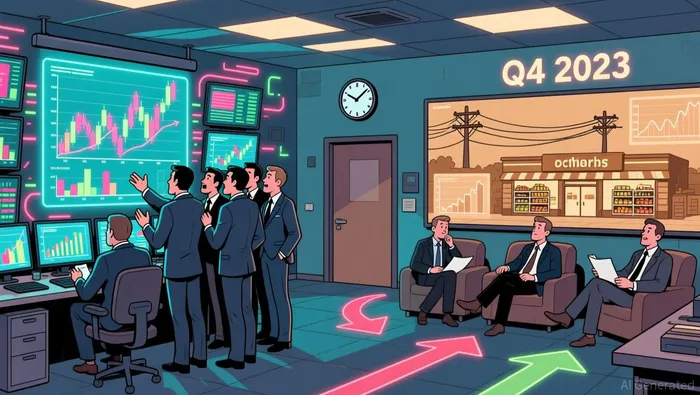
Investor sentiment mirrors this caution. The S&P 500's record highs in late 2025 were underpinned by a "bull market narrative," but this resilience masked a broader rotation into defensive assets according to market analysis. As wage growth stagnated-nonfarm payrolls rose by just 64,000 in November 2025-investors increasingly distanced themselves from cyclical bets according to Janus Henderson. The result: a market environment where defensive positioning in utilities and consumer staples has gained traction.
Defensive Sectors: Utilities and Consumer Staples
Utilities and consumer staples, long favored for their stable cash flows and low volatility, have emerged as key beneficiaries of labor market uncertainty. According to BlackRock's 2025 Fall Investment Directions, these sectors serve as "bond proxies" in a world where traditional diversification strategies are faltering according to BlackRock insights. For example, the Invesco QQQ Low Volatility ETF (QQLV) and the S&P 500 Dividend Aristocrats ETF (NOBL) have attracted inflows as investors seek income and stability according to Yahoo Finance.
Data from November 2025 underscores this shift. While the Consumer Staples sector was rated "Marketperform" by SchwabSCHW--, its ETFs-such as the Consumer Staples Select Sector SPDR ETF (XLP) and the iShares U.S. Consumer Staples ETF (IYK)-posted gains amid rising inflation concerns according to Yahoo Finance. Utilities, though downgraded to "Underperform" due to consumer stress and tariff impacts, maintained positive year-to-date inflows, reflecting their historical role as safe havens during volatility according to Schwab analysis.
The labor market's fragility further reinforces the case for defensive positioning. A 4.6% unemployment rate in November 2025, coupled with a 105,000 drop in October nonfarm payrolls, signals a cooling labor market according to Janus Henderson. In such an environment, sectors like utilities and consumer staples-whose demand is less sensitive to economic cycles-offer a buffer against downside risk. PwC's 2025 Global Workforce Hopes and Fears Survey notes that 54% of workers now use AI in their roles, but this technological shift has yet to disrupt the stability of defensive sectors according to PwC research.
Strategic Implications for Investors
For investors, the interplay between labor market fragility and sector rotation demands a nuanced approach. Schwab's December 2025 report recommends overweighting Communication Services and Health Care while underweighting Utilities and Consumer Discretionary according to Schwab analysis. However, this does not negate the defensive appeal of utilities and staples in a low-growth environment. BlackRock emphasizes that alternative assets and international equities should complement traditional defensive holdings to mitigate correlation risks according to BlackRock insights.
Moreover, the Federal Reserve's potential rate cuts-now priced at 80% for September 2026-add another layer of complexity according to Yahoo Finance. Defensive sectors, with their high dividend yields and stable earnings, are better positioned to weather rate-cut cycles than cyclical peers. As James Investment's December 2025 commentary notes, "defensive ETFs are gaining attention as investors hedge against a potential Fed pivot and prolonged labor market softness" according to James Investment.
Conclusion
The 2025 labor market's fragility-marked by record-low worker confidence in job mobility and a fragile "low-hire, low-fire" dynamic-has reshaped equity market dynamics. Cyclical sectors face headwinds as workers prioritize stability over exploration, while defensive positions in utilities and consumer staples gain traction. Investors must navigate this landscape by balancing sector rotation with a focus on resilience, leveraging ETF allocations and dividend-driven strategies to mitigate volatility. As the year closes, the message is clear: in an era of uncertainty, defensive positioning is not just prudent-it is essential.





Comentarios
Aún no hay comentarios