
Labor Market Crossroads: Why the Claims Split Signals a Fed Pause—and Investors Should Prepare
The U.S. labor market is sending mixed signals, and investors ignore the divide between falling initial jobless claims and rising continuing claims at their peril. While fewer workers are newly entering unemployment, those already out of work are struggling to re-enter the labor force—a divergence that could force the Federal Reserve to pause its rate-hiking campaign and unsettle equity markets. Let's unpack the data, its implications, and what to do next.
The Claims Contradiction
The latest data paints a bifurcated picture. For the week ending July 5, initial jobless claims fell to 227,000, marking a four-week decline and a 7-week low. This suggests employers are holding onto workers despite economic headwinds, particularly as companies navigate post-holiday adjustments and seasonal auto plant retooling. However, the 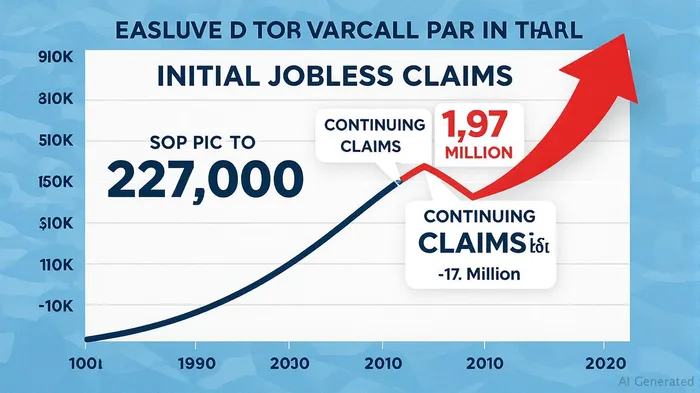 continuing claims skyrocketed to 1.97 million, the highest since late 2021. This reflects a labor market where layoffs are rare, but rehiring is sluggish—leaving millions in prolonged unemployment.
The visual starkly illustrates the gap: initial claims have trended lower since April, while continuing claims have climbed relentlessly. The disconnect points to a “jobless recovery” scenario, where the economy avoids mass layoffs but fails to create enough new opportunities to absorb the unemployed.
Why This Matters for the Fed
The Fed faces a quandary. Falling initial claims might suggest labor market resilience, justifying further rate hikes to combat inflation. But the surge in continuing claims hints at underlying weakness—long-term unemployment often correlates with reduced consumer spending and weaker GDP growth. If the Fed misreads this data, it risks over-tightening and triggering a recession or under-tightening and letting inflation spiral.
The data will likely push the Fed to adopt a “wait-and-see” stance. Chair Powell has already signaled a slower pace of hikes, and June's non-farm payrolls report—showing 147,000 jobs added, below the 200,000 threshold of recent years—supports caution. If continuing claims stay elevated, the Fed could pause entirely by year-end, as economists at JPMorganJPM-- now project.
Equity Markets: Bracing for Volatility
Investors should prepare for sector-specific turbulence. Consumer discretionary stocks (e.g., AmazonAMZN--, Walmart) are particularly vulnerable. If prolonged unemployment crimps spending, retailers and travel companies could face margin pressure. Meanwhile, rate-sensitive sectors like real estate and utilities—sensitive to Fed policy—will swing on every jobs report.
The historical data shows XLY underperformed XLU during tightening phases, a pattern that could repeat. Investors might consider hedging with defensive plays like healthcare (e.g., Johnson & Johnson) or dividend-heavy sectors.
Action Plan for Investors
1. Stay Defensive: Prioritize quality over yield. Utilities and healthcare offer stability amid uncertain macro conditions.
2. Short the Volatility: Use put options on consumer discretionary stocks or sector ETFs to hedge against a slowdown.
3. Monitor Payrolls: August's employment report will be critical. A miss below 100,000 jobs could force the Fed's hand to pause.
4. Avoid Overreacting to Noise: Seasonal factors (like auto retooling) distort weekly claims. Focus on the four-week moving average and continuing claims trends for clarity.
Final Take
The labor market's split signals a crossroads for the economy. While layoffs are contained, the inability to rehire suggests deeper structural issues—likely tied to automation, skill mismatches, and trade policy uncertainty. For investors, this is no time to gamble. Stay nimble, favor defensive assets, and let the Fed's next moves guide your portfolio. The labor market's “resilience” is fragile; don't bet against caution.







Comentarios
Aún no hay comentarios